Reply With Quote
People were employed by the govt.. it wouldn't be a real recovery because the war command economy wouldn't last,.. it was temporary. The question is whether FDR's programs worked. They didnt.

Were people employed? Was the economy recovering and getting out of the recession?
Obviously private investors are going to wait to see that the economy is back on it's feet before throwing dollars into it. Especially after getting burned in the 30's. That doesn't mean that the economy was not in a good shape by then.

People were employed by the govt.. it wouldn't be a real recovery because the war command economy wouldn't last,.. it was temporary. The question is whether FDR's programs worked. They didnt.
I meant to say keynesians.. and no it wasn't a strawman, they did predict a bust after ww2 because they thought that all those people coming back to america from fighting would not find jobs, and that the govt would have to continue to pump credit.
That was their actual prediction.
When this war comes to an end, more than one out of every two workers will depend directly or indirectly upon military orders. We shall have some 10 million service men to throw on the labor market. [DRH comment: he nailed that number.] We shall have to face a difficult reconversion period during which current goods cannot be produced and layoffs may be great. Nor will the technical necessity for reconversion necessarily generate much investment outlay in the critical period under discussion whatever its later potentialities. The final conclusion to be drawn from our experience at the end of the last war is inescapable--were the war to end suddenly within the next 6 months, were we again planning to wind up our war effort in the greatest haste, to demobilize our armed forces, to liquidate price controls, to shift from astronomical deficits to even the large deficits of the thirties--then there would be ushered in the greatest period of unemployment and industrial dislocation which any economy has ever faced.
El nono, even the keynesians knew that the command economy of WW2 wasn't a real recovery, and that it would have to be sustained because all those jobs wouldn't have govt spending to keep them afloat like during the war, and that millions of soldiers would flood the labor market.
Sorry guy, history is not on your side.
Of course it was temporary. That's exactly what Keynes preached: spending during recession, make up for the extra spending when the economy flourishes.
Obviously, Keynes critics love to gloss over the second part.
What they predicted is irrelevant. I asked you to please post a chart of unemployment vs spending in the era, so we could determine wether your claim that the economy recovered before or after shrinking spending...
You obviously rather deflect the conversation when addressing one of your own claims.
Because you say so? I asked you to back it up with real numbers, and you keep on pouring in excuses.
It would be more plausible if you were to tell me that the economy really recovered because of the influx of gold that allowed us to back up more money, and thus expand our monetary base. I personally think THAT is actually the main reason for the recovery, even more than the over the top spending. But cutting spending during a recession definitely doesn't enter into the realm of solutions.
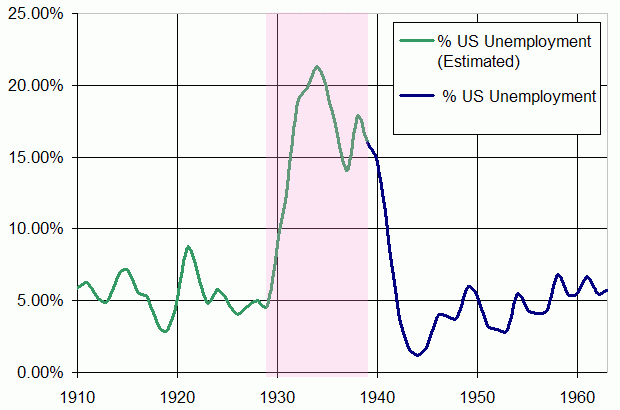
when total spending dropped, in theory the unemployment rate should have gone back to the upper teens like in the 30's but instead it remained healthy with less spending.
Infact.. unemployment went back to pre 1929 levels of unemployment with less govt spending.
Whose theory is that? Yours?
It obviously shouldn't had, because we were not in a recession like in the 30's.
And you can see in the graph that the recovery started in 1939, not 'after the war once we reduced spending'
It has nothing to do with the spending. It has to do with being in recession or not. It makes sense: Once the recession was over we went back to unemployment levels pre-recession, and we also reduced our spending to pre-recession amounts.
Over the top spending got the economy out of the recession and back on track. Who would have thought?
Actually, I'll make a correction: we didn't reduce our spending all the way down to pre-recession levels. And I think that was a mistake, and a failure to completely apply Keynes economics. Obviously, the fear was still recent of getting burned again, but with the economy flourishing, it was certainly doable.
Ultimately this is the biggest criticism you can make: Politicians never cared to actually cut back enough once the economy is on track. But that's really not Keynes fault, is it?
I seem to recall you were pretty gung ho on Obama during the election. Am I mistaken?
Suit yourself. If those are my choices I'm voting for the one with the best s.
Well, if the options on the table are Barry vs Palin, then I'll take Barry every time. That doesn't mean Barry is any better/different than your average DC politician. I also have to say it was incredibly funny to counter the unrealistic stuff posted by GOP residents at the time (remember the daily polls? or whottt and his gut feeling?)
Hey, I'm not going to judge anybody else's criteria for voting.
The choice was Barry vs McCain. Or Biden vs Palin if you want to compare apples to apples.
Well, McCain was going nowhere until Palin received the nomination. Too much Bush shadowing him.
Not that Barry is that much different. But I'm the kind of guy that like to see transition between the left and the right, as much as possible. Keeps things somewhat in the center, which I feel more comfortable at. That's why I want the GOP to win the Congress elections in November.

So your for obstructionism?
Was that question for me?
You're right, we were at that time in a temporary phase known as a command economy, but you are completely missing the point. The recovery was all in part because of GOVT demand and spending not because of real market demand between individuals , the producers were having their supplies being bought by the GOVT for war, after the War, the govt would cease to stop spending for the simple fact that there was no war.
PRIVATE INVESTMENTS shrank during that time, so in this case Keynesian theorist were afraid that we would go back to a bust. You are missing this key point, the economy recovery was only due to boost in GOVT demand, in 1939, buisinesses were being asked to fund the war on both fronts.
You can't say that if you're maintaining Keynesian theory, it has everything to do with spending. The key consumer of that command economy was the govt, not the consumer, once the govt contracts then you go back to pre ww2 recession.It has nothing to do with the spending. It has to do with being in recession or not. It makes sense: Once the recession was over we went back to unemployment levels pre-recession, and we also reduced our spending to pre-recession amounts.
Over the top economic spending did get us to recover because of the cir stance of war, but to have the economy recover, you had to remove the economic controls of the war and the depression like price controls. The actual removal of govt led to the expansion of the economy, the actual economy boom started in 1947.Over the top spending got the economy out of the recession and back on track. Who would have thought?
This is why the unemployment figures of 1940-45 are bad to use when talking about true economic recovery.
1. Private investments continued to contract and flounder during WW2
2. A huge vasts of Men were removed from the labor market to fight the war, that's why UNEMPLOYMENT WENT DOWN TO UNREAL LEVELS. LOL!!
3. The Majority of products that were being purchased during the command economy of ww2 were planes, ships, tanks, bullets, etc.. things that were to be destroyed. If you think a longterm economic model based on providing goods to be destroyed is sound, you're insane. You could not have an economic system based on these products to hold a stable and prosperous era, it's only momentary.
Concerning the 1939 recovery, that was due to es in commodities because Britian and Germany were fighting wars. It had nothing to do with economic policies of FDR.
Well you and I agree on something then. We are better off when power is split between the branches.
The point doesn't escape me at all. That's exactly what Keynes espoused, that by stimulating the economy FROM THE GOVERNMENT you would end the recession. It's obvious private investment wasn't interested in pumping money into the economy, otherwise you wouldn't have a recession in the first place.
Of course it shrank. Private investors got burned by the bank runs and were really wary of putting money into the system again. You had to give them either some serious guarantees or an investing opportunity too good to pass up.
By the end of the 30's, the government was actually paying bonuses for hiring people as part of the stimulus at the time. Coupled with the high demand created by the war, it finally convinced investors that they could make a lot of money both from the enterprise and the government. In other words, the stimulus when coupled with the high demand, created an environment that was too good to pass up for investors.
It was in response to your argument that the economy only recovered once we cut spending. It has nothing to do with spending at that point, because our economy was already in the upswing. Once you get to that point, cutting spending makes sense since the economy doesn't require any extraordinary stimulus at that point, and so you go back to the pre-recession economic state.
No, you do that once you already recovered and you're in the upswing, in order to stabilize the economy. There's simply no more need for an artificial stimulus at that point. Where there people wary that by withdrawing the stimulus too early we would fall back into recession? Sure. Heck, it actually happened to Japan in the 90's. But it's merely opinion. Reality dictates that the economic recovery started in '39 and improved during the war, where the spending ed to 120% of the GDP. It was an artificial measure that served to regain investment and get the economy back on track. Once it served it's purpose, it was done away with.
If anything, the war was the perfect excuse to shoot up the debt to unimaginable levels.
You don't understand what Keynes proposed to combat recession at all. He didn't propose a long term economic plan. He proposed a short, artificial stimuli to regain consumer and investor confidence in the system.
Recession is mostly a byproduct of losing trust in the system. People are wary to spend money, which makes investment dwindle, which makes the economy drag down even deeper and creates more lack of trust. Eventually you need to do something to regain that trust and go back to your normal economic life.
What were the american people doing with their money during the time you two are arguing about?
If that's all it took, why did the government need to go that deep into the red and hire so many people? Obviously, it took more than high demand to regain confidence from some businesses that were pretty angry after the second New Deal of 37-39...
The government began heavy military spending in 1940, and started drafting millions of young men that year;[21] by 1945, 17 million had entered service to their country. But that was not enough to absorb all the unemployed. During the war, the government subsidized wages through cost-plus contracts. Government contractors were paid in full for their costs, plus a certain percentage profit margin. That meant the more wages a person was paid the higher the company profits since the government would cover them plus a percentage.[22] Using these cost-plus contracts in 1941-1943, factories hired hundreds of thousands of unskilled workers and trained them, at government expense. The military's own training programs concentrated on teaching technical skills involving machinery, engines, electronics and radio, preparing soldiers and sailors for the post-war economy.[23]
There are currently 1 users browsing this thread. (0 members and 1 guests)
 Posting Permissions