


 Reply With Quote
It's more semi-controlled. The government controls access to credit, but not to profit, so much. There are powerful private concerns in China.

In china, everything is still controlled. The loser is the consumer and the peoper.lol

It's more semi-controlled. The government controls access to credit, but not to profit, so much. There are powerful private concerns in China.
Otherwise, their version of (state-steered) capitalism wouldn't work so well.
China's been on a tear since practically the 60's, but actually, way more dramatically after GHWB and Bill Clinton.
Last edited by Winehole23; 08-15-2010 at 03:44 AM.
GDP growth is hard to deny.
g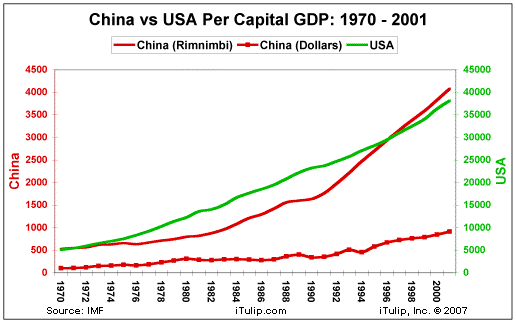

A monopoly implies a lack of compe ion. This is what's been escaping you in every single of your responses. We know for a fact that monopolies will go at any length to squash any raising compe ion, and if not for anti-compe ive regulation they will succeed 9 out of 10 times.
What the public demands is irrelevant when you only have one supplier.
Furthermore, under your model, whatever innovation the little guy comes up with can be automatically copied and produced by the bigger guy, because patent and copyright protection doesn't apply.
What is happening to cable companies? They have more compe ion today from phone companies, but they're hardly going broke.
It helps the consumer, price wise, short term. Once they corralled the market and drove compe ion bankrupt, they're free to do and charge whatever they want. That's how you capture markets without government intervention.
Except when it's done at the international level, and producers simply have no say. This happens more often than people think, see 'DRAM price fixing' or even more recently 'LCD price fixing'.
Sure it can. Madoff was eventually caught, did he not? By regulators none the less. And faces jail time for breaking a mul ude of regulations.
Does it matter? Again, what's preventing anybody from opening a bank and not backing up any of the deposits? I obviously don't need to inform the public either, since there's no regulation forcing me to do that. I can keep on siphoning money to the Cayman Islands until too many people want their money back, at which point I can simply declare bankruptcy and insolvency.
Heck, if Madoff got away with it for so long WITH regulators peeking at his numbers, image the fortune you can amass with nobody looking. Does it matter to Madoff what his reputation looks like after the fact?
Nobody claim that they don't change, but they do so within a framework that ensures compe ion. That's exactly WHY it changes. If that framework were not to exist, you would see more captive markets, less compe ion and less actual change.
They're growing faster than we are. And the loser is the US also, losing all manufacturing to them.
Strawman, A free market system can have objective law that prevents the use of force or fraud.
Please study more of these things.
When you have artificial wage increases, ofcourse you're going to gut all your manufacturing.
Chineese companies have to spend fuel to get their supplies here. American companies don't have to use the same shipping methods, we have an advantage. Where made that advantage useless is by forcing labor unions, and raising minimum wage, and inflating the money supply in order to combat the effects of those laws. We've also made it illegal to use vertical integration here in the states.
So don't blame free markets for this, blame interventionist moneterist and progressive thought for this.
You mean, regulations.
In a fiat economy you're not forced to back the money that comes in. That's how every bank, including the Fed, operates. There are regulations stating what minimum percentage they have to back up. Without those regulations, why would they back up any money at all?

Collusion... say, for instance, all the farmers that supply an area decide to jack up the prices of bread, egg, and various other staple items much higher than normal (20 bucks for a loaf of bread, 15 bucks for eggs, 20 for a gallon of OJ etc etc).

I have to cut in here.
What you forget is the same regulations that make it hard for small start-ups would be gone, making it easier for someone to start in a market dominated by a monopoly. When you eliminate the connection between the corporation, and the lawmakers, they can no longer get regulations that keep them the top dog.
This is the proper way to relax regulations. Not just any regulation, but those that interfere with the free market unnecessarily.
Lol.. that's called subsidies in these times.
What regulations are maintaining Microsoft's monopoly?
the consolidation of the health insurance industry into local monopolies?
what specific regulations do you want killed that are preventing entry of compe ors?
I don't necessarily disagree that sometimes regulations are too many, too broad and too overreaching. Even that some are specifically tailored to favor somebody and thus bad regulation. But the fantasy that companies are not greedy and that would not try to game the system is completely naive. A baseline of regulation is required to even the field.
Your scenario is also fairly silly. Plenty of top dogs cut deals under the table with say, suppliers, to kill the startup. If not for anti-compe ive regulation, the startup wouldn't last a year.
Reminds me of Intel having to pay up after they were cutting deals with PC suppliers not to ship AMD chips a few years ago. These are big companies willing to grease whatever wheel to get their way.
BTW, gTown... Now I know what you mean by 'what's happening to cable companies'...
ing Comcast died on me halfway through Sunday, and they won't send a tech until Tuesday afternoon.
I'm typing this on my iPhone
That doesn't really answer my question though.
There's no possibility of collusion in the free market cinderella. Everybody is a honest compe or, even in incredibly thin profit margin businesses.
I'm still waiting to hear what's the point of investing in innovation if everything is public domain after it's invented...
If companies want to get the highest value for their grain, rice, and such then there will be a threshold of up to how much they can make with out taking a loss. Collusion doesnt work in a free market, in your scenario supermarkets will boycott the suppliers who engage in sorts and will demand supplies from other regions. Walmart infact does this, if their suppliers can't lower their prices, they get other suppliers.
In a free market, it's the consumers who have the final say.
Patents..copyrights.. they give the investor time to milk the products rawness.
Those instruments provided by the government grant a de-facto temporary monopoly... isn't that what you call market distortion?
But oh, no, can't do anything about copyright! *gasp* Otherwise how would anyone ever produce anything?
The book, Against Intellectual Monopoly, available at http://levine.sscnet.ucla.edu/genera...al/against.htm pretty much blows that argument out of the water.
In short:
Brand recognition/good-will
Being first
Being better
As for investing in innovation, it would be cheaper because you could piggy-back off the work of others instead of re-inventing the wheel every time.
People always seek profits. That is why they will innovate. It is why they always have innovated.
no.
That's someone's intellectual right. Just like a book is someones intellectual right, art or song.
It is govts job to defend us from the stealing of our property in a free society.
There are currently 1 users browsing this thread. (0 members and 1 guests)
 Posting Permissions
