


 Reply With Quote
For one thing, if you're talking about a power grid, I can't imagine how much of a pain in the ass it would be to integrate thousands of different local power grids, with each organization probably having different rules, regs, ops etc etc.
a question like this is so multifaceted and complex that it's impossible to answer. the best answer is probably to just copy a wind power infrastructure that already exists and works well:
http://en.wikipedia.org/wiki/Wind_power_in_Denmark
they subsidize the out of it, but of course its not as cheap and cost-efficient as a massive coal or powerplant. the benefits of subsidizing this (OMFG SOCIALISMM) are 1. lack of pollution emission and 2. wind is an infinite and renewable resource.
Last edited by greyforest; 10-02-2010 at 10:50 PM.

For one thing, if you're talking about a power grid, I can't imagine how much of a pain in the ass it would be to integrate thousands of different local power grids, with each organization probably having different rules, regs, ops etc etc.

Bzzzz...
You obviously don't understand.
Well, you responded earlier as if a windmill stored power like a rotary UPS can. It doesn't. A rotary UPS can stay on line for several minutes at full power if the engine fails to start.
I know, and a windmill doesn't have a massive flywheel, hence.... zero storage capacity!
Flat out wrong. Torque has a very defined meaning. Power is a measurement of torque times time.
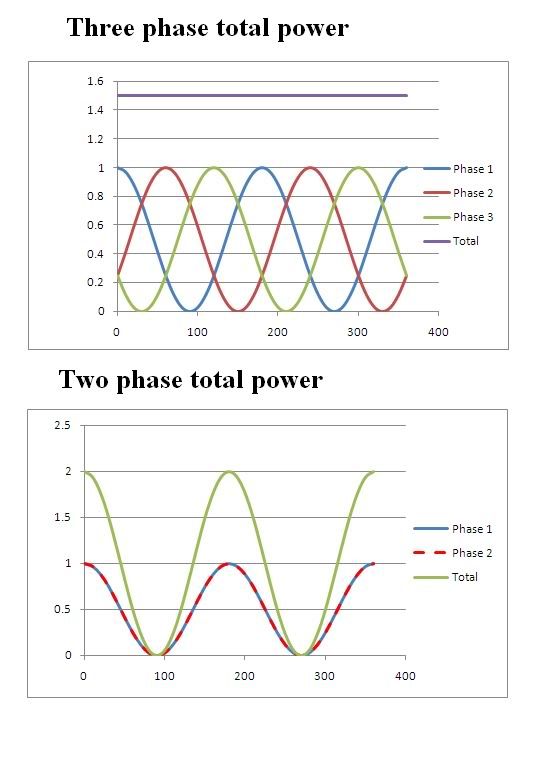
Here's the deal. Three phase power is used because you can rectify the three phases and add it together, and get a flat line with no ripple. All car alternators use three phase with full wave rectifiers to produce a smooth DC signal. It's the cost efficient way to transfer the full potential of the power. The two hot wires and neutral we see in our house wiring produces the 120 and 240 volts for normal outlets and appliances like our dryers, baseboard heaters, etc. The power lines this comes off of are all three phase with a single tap from one phase to a transformer to step the voltage down for residential usage. Where I work at, we have 480 volts three phase coming in to our facility. We have I think four huge transformers that reduce this to 208 volts three phase, which we send to our dozens of automation equipment, and can get 120 volts from a tap to neutral. We actually have some equipment that takes the 480 volt three phase to operate on, but most of it used the stepped down 208 three phase. We use so much power, even with the AC's running, it gets hot in the winter time, and our building is 350 x 550 ft!
Look at any power line. There are three wires. Each are one of the three phases, 120 degrees apart. If you understand trigonometry, you understand this significance, and don't need to understand AC power.
Oh...
The last rotary UPS I worked on used a 6 cylinder turbocharged diesel engine that sat idle with the glow plugs always hot. It had an electric clutch that the incoming power held disengaged. The next component was a massive flywheel. I don't know the weight, but by the size, I will guess it weighted about 17,000 pounds or so. My recollection of its size and material calculates to 17,675 lbs, but I could be wrong. After this, there was a 55 KW motor, driven from the incoming commercial AC. Then, the 45 KW alternator, supplying our communications equipment with power, at the Antenna Farm. When the power is lost, the flywheel engages, and the IC engine fires up right away. Seamless... No loss of site equipment power and no power es. Now the lights would go out, and the 150 KW generator would take a few seconds to engage.
Yes, I know. Why a 150 KW generator system...
We had huge air-conditioning to keep the equipment cool! We didn't need much for lights, etc, but the equipment would burn up otherwise.
Anyway, any flywheel that windmills may have is to keep sudden changes in speed from occurring. Not to store power.
Correct me if I'm wrong, but isn't the polar wind always blowing in their area? We have few places in the USA that the wind is always blowing.
Now I agree it is a clean form of energy. I never said otherwise. I am simply of the mindset it is cheaper to build with clean technology (low emission) natural gas and coal power plants. I honestly do thrust that when alternate forms of energy become cost effective, they will be used without needing subsidies.
What will happen in maybe 10 years when the subsidies run out? well the power companies abandon wind power as they need repairs because of cost to revenue ratios? Will the country side start being filled with windmills not doing anything?
Just a thought. Agree or disagree. I simply believe in the free market more than most.
Well, considering synchronization of AC is difficult over lengths, the only way to do such a thing would be to create a huge DC network. Everyone sends power via DC onto the network, and pulls it off as needed, using inverters to create the AC power for local transmission. Otherwise, trying to make grids work without cascading failures is next to impossible.
Expensive...
Check out this for reference:
wiki: Pacific DC Intertie

What are the emissions of power plants currently using "clean burning" technology?
Can you also guarantee that the mine trailings of the mines used to supply those plants are going to be "clean" too?

You're wrong. We have a ton of area with more than adequate wind resources.
http://www.windpoweringamerica.gov/wind_maps.asp
Denmark's winds aren't that great at all.
Those maps don't even account for offshore wind energy potential which is higher.
Wind energy can power much of East Coast,
The strong winds off the Atlantic Ocean could become a cost-effective way to power much of the East Coast -- especially North and South Carolina, Delaware, Massachusetts, New Jersey and Virginia, a new study released Tuesday says.
The report by the conservation advocacy group Oceana argues that offshore wind could generate 30 percent more electricity on the East Coast than could be generated by the region's untapped oil and gas. It predicts that wind from the ocean could be cost compe ive with nuclear power and natural gas to produce electricity.
http://www.physorg.com/print204904716.html
Denmark is a small, manageable country where the govt actually runs the country to the peoples' advantage, unlike the US where the corporations run the govt to the corporations' profits.
Denmark has this quaint, charming rule were lenders cannot just pocket their fees and the sell the loans into the financial netherworld, but must service the loans to term. No CDOs and MBSs there, no financial crisis.
An imperfect solution to an imperfect situation should never be considered as a part of a strategy for an overall upgrade?
No jackass the neutral wire happens to cancel out because of how phased sinusoids work. 2 just lines up the peaks and troughs if its symmetrical so they cancel out as well. That is just a caveat. The reason why its 3 is because you need three phases in order for an electric motor to create tourque. 2 or 1 will not and anything more is redundant. Using a residential supply you have to rephase for that very reason.
The only thing I said about windmills was that they are old ass technology that has no bearing on the current technology.
I want to repeat that I NEVER said anything about a rotary ups. EVER. Whats even sadder is that you mention a flywheel and then turn around and say it does not store energy in rotational motion.
Here from wikipedia:
How the do you think you accelerate something? Thats how you change speeds or prevent change as you like to look at it.A flywheel is a mechanical device with a significant moment of inertia used as a storage device for rotational energy.
I was not even talking about use of rotational storage in that context anyway but that is exactly what that flywheel does.
Power also has several different formulas that can be used to attain it. Thats the beauty of physics and SI, that they all use the same units and because they use the same derivations they come to the same value. James Clerk Maxwell was a badass.
In this case when creating power from AC the formula that you would use would be volts times amps which is how you determine electrical power. From there you can translate the power generation into torque and work backwards from there but that is hardly the only way of doing it and something you obviously have no concept of.
There are other ways as well. The expansion of gases, chemical energy etc all have power equations associated with them and the beauty of it is that power is always joules per second at the end.
This is all a red herring anyway because at the end of the day when you are dealing with whole power grids there is no giant flywheel. That was the whole point of this discussion.
Wind plants operate at similar efficiency as coal and natural gas boilers ie 95%. But hey youre a technician ie a parts changer.
Why do you bother? If you want 0% emissions, you will pay out the ass.
Here is a tidbit from the DOE. It's not the current clean burning technology, but what is currently being worked on:
Gasification Technology R&D
one paragraph of the article:
I have been exposed to the numbers before, but haven't found them yet.The environmental benefits of gasification stem from the capability to achieve extremely low SOx, NOx and particulate emissions from burning coal-derived gases. Sulfur in coal, for example, is converted to hydrogen sulfide and can be captured by processes presently used in the chemical industry. In some methods, the sulfur can be extracted in either a liquid or solid form that can be sold commercially. In an Integrated Gasification Combined-Cycle (IGCC) plant, the syngas produced is virtually free of fuel-bound nitrogen. NOx from the gas turbine is limited to thermal NOx. Diluting the syngas allows for NOx emissions as low as 15 parts per million. Selective Catalytic Reduction (SCR) can be used to reach levels comparable to firing with natural gas if required to meet more stringent emission levels. Other advanced emission control processes are being developed that could reduce NOx from hydrogen fired turbines to as low as 2 parts per million.

Why do you bother?
That wasn't what was asked for.
So in other words there is not a production model for this tech much less any actually out in the field working using this? Those are all projections.
, that was a blast.
This is why I get frustrated with this asshole. He's littered this thread with bull from the get go and has been knocked down time and time again. He's so full of its amazing but he mixes in a bit of jargon or graphics with his posts and the average reader actually thinks that WC knows what he's talking about.
Fuzzy made a blatantly obvious point that it doesn't matter that the wind doesn't run all the time because you can store the energy in any number of ways and use it when its actually needed. Then WC goes on a bull rant about phases and UPS systems. Its ing ridiculous.
So sick of this guy.
I didn't ask for the cost to get to 0% emissions, although that would be nice as a base line for comparison.
Coal gassification still does not address the costs of mining and the depletion factors that will drive the price per joule up in the coming decades.
I don't expect any energy source to be completely pollution free. That is both unreasonable and expensive.
But I do like data that is comprehensive, and looks at the system in a comprehensive manner.
I am willing to accept the fact that coal is an important energy source. I am willing to accept that it is readily available, and part of our energy supply.
I am not willing to accept it as a long term solution, simply because it isn't.
I know. I think it would be really cool to have one though.
At the risk of mentioning an interesting technology too much:
Concentrating thermal solar stores energy in the form of molten salts. No phase change losses, and the abililty to smooth out energy production to a 24 hour cycle.
Just to be clear, yet again:
I do not expect coal to get to 0% emissions.
I am fine with coal putting out some pollution, although I am beginning to think that any heavy metal emissions at all is probably not a good idea.
I just want to be honest about what it DOES put out though. If coal supporters were honest about both the mining and the burning of the thing, that would be one thing, but the fact that they gloss over some pretty nasty in making their case does not lead me to find them credible when it comes to long-term viability arguments.
In the end Solar will win out over everything else. We're not there yet, but we will be.
Wow... you are an idiot. Most motors are not synchronous and do not rely on phasing. However most motors I work with in automation are either brushless DC motors, or synchronous motors powered through a VFD.
Yes, three phase allows for rotational motor control, but that's not why three phase is used. I see what I said went strait over your head. One reason is that a neutral isn't needed, and power is shared between all conductors. It's more efficient to use three conductors power-wise than two. Here's an article explaining the vector math somewhat:
Three-phase power systems
Smooth power is what mean. The below graph is taken by adding the power of each phase together. In the case of three phase, three signals 120 degrees apart are squared to convert relative voltage to relative power. The three are then added together give a strait line. For single phase, two hots, referring to a house 240 volt, they are 180 degrees apart. Same thing, squared, then added together. Not smooth at all.

Maybe. And every solar panel will come from China,.
Probably.
India or Africa would be more probable.
For all the hoopla about Chinese manufacturing and economic growth, they are going to run into some really nasty demographic bumps in about 10-15 years.
There is some fair lines of reasoning that put India on track to have a much more sustained period of economic growth.
Yo, flywheel, you realize that the term 'smooth' comes from the symmetry from three phase as it powers a motor? Like I said before, a symmetrical two phase AC rotor will line up the peaks and troughs.
You're a ing parts changer. You work on flywheels and you do not even know what they do much less how they do it.
Do you know what they mean when they say it s a brushless motor? That should be good for a laugh.
And again this is a ing red herring. IT has absolutely no bearing on the discussion of power storage. But by all means keep going.
There are currently 1 users browsing this thread. (0 members and 1 guests)
 Posting Permissions