Reply With Quote
I thought the GOP congress was going to stop this?


Feds just announced another 600 billion of "quan ative easing" also known as "printing money".

I thought the GOP congress was going to stop this?
Even if they wanted to they don't get seated for months yet...
CC you had to know I was joking.
I'm not too mad - at this rate I can stash away a few Euros and then pay off my student loans pretty easily when the dollar is worth less than the Peso. it!
Yeah, I did. And yeah, thats why I'm gonna refinance my house for 30 years fixed.

Partisan Hack!
I still don't understand why they don't cut each taxpayer a check and let them put it to work in the economy. Beats giving it to banks at zero percent so they can go purchase investment instruments.

It will probably never be printed. It will probably just be "digitized" and deposited with the same banks that are responsible for this mess to begin with. Then they will loan it and collect interest on loans, and make record profits again. So another victory for the corrupt Fed system, Im sure.
Because the Fed is run by bankers, sir. Not the people.

You really don't understand why?
He should now.
And by understand, I'm talking about the mechanics and theory, not necessarily the prevailing conventional wisdom.
I am, on occasion, given to bouts of unrealistic optimism. Must be time for a Buttface Ale.
But why be optimistic? As I said before, the fed is run by bankers.

We are all debtors, you me, the federal government, state governments, municipalities, corp, etc.Originally Posted by TeyshaBlue
And by understand, I'm talking about the mechanics and theory, not necessarily the prevailing conventional wisdom.
I am, on occasion, given to bouts of unrealistic optimism. Must be time for a Buttface Ale.
By giving the money to banks, we still have to borrow the money that we need...this includes the government. When Joe Schmuck Congressman wants to enact a new program, Congress borrows the money to do that. . If the government just passed out the dough, the bankers wouldn't make any money.
And bankers are in charge of the currency. So they ensure that business remains profitable.
The crazy part? The federal gov issues bonds, very much like promissory notes, which are held by banks as an IOU on the debt, and those bonds are backed by the full faith and credit of the United States.
Yet, that same FF&C is not sufficient to back currency. Or is it? Is it more efficient just to have Congress issue currency through treasury? Or to have it issued through private banking interests, so they can keep us all in debt till the end of time (including the gov)?
Time for that Ale.
Am I lyin' Cosmic Cowboy?
That explains why even in the worst of times...
http://www.huffingtonpost.com/2010/0..._n_700574.htmlBank Profits Soar, Lending Falls As Banks Pay Next To Nothing For Funds
Bank profits jumped 21 percent last quarter to nearly $22 billion, the highest level in three years, as banks put away less money to cover future losses, fewer borrowers fell behind on payments and lenders paid the least for their funds in perhaps 50 years, a government report released Tuesday shows.
Lending also dropped by about $96 billion, or 1.3 percent, as borrowers continue to remain skittish about the "slow recovery," Federal Deposit Insurance Corporation Chairman Sheila Bair told reporters Tuesday in Washington. "Consumers and businesses need to have confidence in the recovery before they will start making decisions on credit," Bair said, according to a transcript of her remarks.
Meanwhile, despite the sector's high profits, challenges remain: home prices are forecast to decline into next year while lenders continue to repossess homes at record rates; the commercial real estate market has yet to hit its nadir; community banks continue to fail; and the number of lenders on the FDIC's confidential "Problem List" continues to grow. Nearly 830 banks are on the list, up from 775 at the end of March, the FDIC's quarterly report shows.
"Without question, the industry still faces challenges," Bair said in a statement. "Earnings remain low by historical standards, and the numbers of unprofitable ins utions, problem banks and failures remain high. But the banking sector is gaining strength... most asset quality indicators are moving in the right direction."
It also helps that banks' cost of funds -- the money they pay to garner deposits and other funds that are then used to lend, invest or trade -- dropped to the lowest rate in 26 years of FDIC quarterly records. Banks paid 0.97 percent in interest for their funds, the first time they've paid less than one percent during a quarter since at least 1984, FDIC do ents show.
Historical records on commercial banks' cost of funds going back to the inception of the agency in 1934 show that the last time banks paid less than one percent for the year was 1960.
With the main interest rate effectively at 0.19 percent, savers suffer in a low interest-rate environment as banks pay less to attract deposits. The Federal Reserve's policy-making body, the Federal Open Market Committee, has kept the rate at which banks lend to each other for overnight funds between 0 and 0.25 percent since December 2008.
Elsewhere in the FDIC report, the agency noted that two of every three banks reported higher profits compared to last year as firms put away the least amount of money to cover losses since the January-March period of 2008. Money socked away for a rainy day would otherwise be recorded as profit.
Though nearly two of every three banks increased their reserves for potential future losses, large banks cut theirs. Banks put away $40 billion, 40 percent less than during the same period last year, to cover future losses. Those with more than $10 billion in assets recorded $19.9 billion of the industry's $21.6 billion of profit, or more than 92 percent.
Also, lenders wrote off $49 billion in uncollectible loans, a small decline from a year earlier and the first year-over-year decline since 2006. Loan losses are stabilizing, the agency said. Commercial real estate loan charge-offs, though, saw an increase.
Loans delinquent for at least 90 days but not yet written off also declined for the first time in four years, though they increased for banks with less than $1 billion in assets, the agency said.
Loan balances continued their decline, led by real estate construction and development lending which dropped more than eight percent from last quarter, according to the FDIC. Loans to small businesses and farms dropped almost two percent, or more than $13 billion. Loans to large businesses, meanwhile, dropped just 0.4 percent.
Bair noted that community banks "slightly" increased their lending -- "to their credit," she added.
But keep in mind that big banks fare much better in this scheme than smaller local banks. Its the big guys wiping out the little guys, just like in every other industry. Especially the ones with their straw in the main artery...that is, those banks who actually loan to the fed gov.

They aren't in power yet, and you know it. Stupid point to stir the pot with.

Jesus ing Christ.
Result: bankers own you, your kids, your grandkids, your great grandkids...
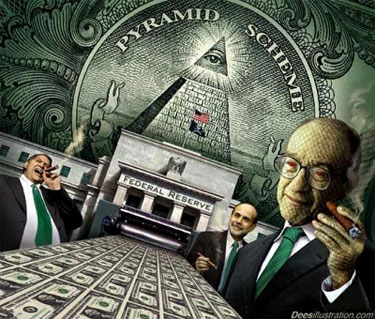
The Fed No Longer Cares About Hiding The Fact It Is Killing The Dollar
A number of prominent figures within the financial world are warning that a second round of quan ative easing, expected to be announced today by the Federal Reserve, will have disastrous consequences for the US dollar and the global economy.
The Fed will release a statement this afternoon, most likely confirming that it is to buy at least $500 billion of long-term securities, in the form of printing money out of thin air.
The justification is to offset deflationary fears and stimulate spending, however, critics have refuted this outlook.
Peter Schiff, CEO of Euro Pacific Capital notes:
“At the end of the day, all this deflation talk is a red herring. The true purpose of QE 2 is to disguise the decreasing ability of the Treasury to finance its debts. As global demand for dollar-denominated debt falls, the Fed is looking for an excuse to pick up the slack. By announcing QE 2, it can monetize government debt without the markets perceiving a funding problem.”“I think that this will quite possibly be the worst mistake by the Fed in a generation,” adds Stephen Stanley of Pierpont Securities.
Bill Gross, the manager of the world’s largest mutual fund, told Reuters on Monday that he fears that the measures will result in a catastrophic decline in the value of the dollar:
“I think a 20 percent decline in the dollar is possible,” Gross said.
“When a central bank prints trillions of dollars of checks, which is not necessarily what (a second round of quan ative easing) will do in terms of the amount, but if it gets into that territory—that is a debasement of the dollar in terms of the supply of dollars on a global basis,” Gross told Reuters in an interview at his PIMCO headquarters.
“QEII not only produces more dollars but it also lowers the yield that investors earn on them and makes foreigners, which is the key link to the currencies, it makes foreigners less willing to hold dollars in current form or at current prices,” Gross added.
The Fed seems unconcerned that the public impression it is creating is that it is clearly acting to debase the US dollar.
“It’s a desperate act,” says Jeremy Grantham, co-founder of the investment firm GMO. Grantham says it’s a clear message from the Fed to the rest of the world: “The U.S. doesn’t care if the dollar weakens.”
James D. Hamilton, a University of California, San Diego economist notes that Bernanke may risk increasing expectations for higher inflation by too much, causing a shake- up in currency and bond markets.
“That perception alone would bring about a series of immediate challenges, such as a rapid flight from the dollar, commodity speculation and possible under-subscription to Treasury auctions,” said Hamilton, a former visiting scholar at the Fed board and the New York and Atlanta district banks.
“The real ugly question is, will this ultimately end up being inflationary?” said Scott Minerd, the Santa Monica, California-based chief investment officer at Guggenheim Partners LLC, who helps oversee $76 billion. “In the long run, five to 10 years from now or in the next decade, this is going to be a massive problem.”
The London Telegraph’s International Business Editor, Ambrose Evans-Pritchard, agrees with this outlook, noting that QE2 risks currency wars and the end of dollar hegemony:
“The Fed’s “QE2″ risks accelerating the demise of the dollar-based currency system, perhaps leading to an unstable tripod with the euro and yuan, or a hybrid gold standard, or a multi-metal “bancor” along lines proposed by John Maynard Keynes in the 1940s.” Evans-Pritchard writes, referring to the stated intention to ins ute a new global currency out of the ashes of the crippled world economy.
The most noted critics of the plan, however, have been Fed members themselves who fear the plan is dangerous, unnecessary “bargain with the devil” that will fuel long-term inflation.
As reported by Bloomberg:
Kansas City’s Thomas Hoenig, who has already dissented six straight times, said Oct. 25 that he opposes more easing and because it’s “a very dangerous gamble” that may accelerate inflation and create asset price bubbles. Dallas Fed President Richard Fisher and the Philadelphia Fed’s Charles Plosser have also spoken out since the FOMC’s last meeting against more action by the central bank.In addition, Minneapolis Fed President Narayana Kocherlakota has questioned whether QE2 will work. Richmond Fed President Jeffrey Lacker has also seemed to doubt whether it is necessary.
Instead they say that the markets should be allowed to correct themselves.
There are currently 1 users browsing this thread. (0 members and 1 guests)
 Posting Permissions