Just let me remind you that the sun is the source of nearly all our heat. When it took a slow average increase in output from about 1700 to 1950, that not all effects are instantaneous. We can still see latent heat from that collected in the oceans for hundreds of years. The cooling scare in the 70's could easily be the cause of aerosols in the air. Once we cleaned them out of the skies, we now see heat from the past solar warming. Over the long term, this applies if we assume the 0.18% increase in solar output during the time the AR4 covers:
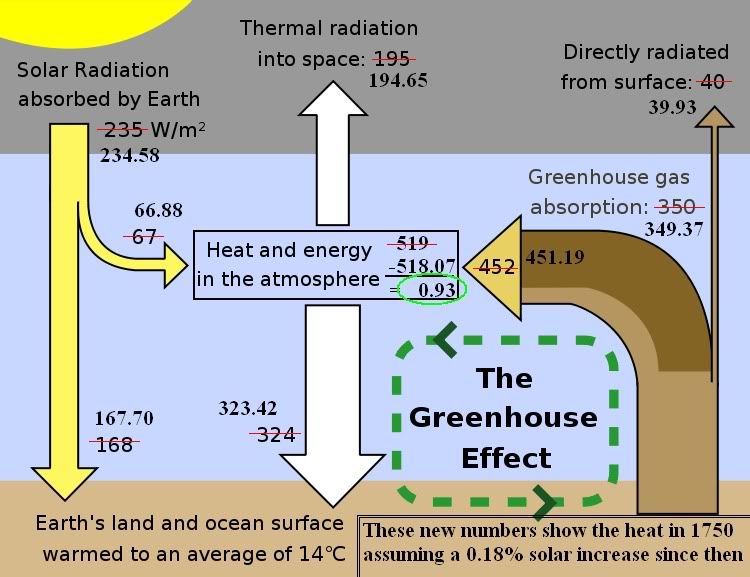
The IPCC AR4 has a net radiative forcing of 1.6 watts. This edited diagram shows an increase of 0.93 watts by direct and indirect solar changes. The IPCC is sneaky by saying the sun has increased the "direct" radiative forcing by 0.12 watts, leaving out the extra energy amplified by the indirect radiation in the greenhouse effect. This added 0.81 watts is because of the sun. Not extra greenhouse gasses, yet the IPCC assigns this value withing the greenhouse gas forcing numbers.
Black carbon is the largest contributor to anthropogenic warming. It speeds the melting of snow and ice, and traps energy from the sun that would otherwise be reflected. I can confidently say that the retreat of the ice shelves is not from increased air warming, but from increased solar collection.
More on the 0.12 watts the IPCC limits solar forcing to. Look at the left side of the graphic. The delta is the 0.12 watts generated by the 0.18% change in solar output, that directly goes into the atmosphere. There is another difference of 0.3 watts that heats the earth, generating more IR into the greenhouse effect, which gets amplified by the greenhouse gasses to that 0.81 watts extra.
Is that enough for now?



 Reply With Quote