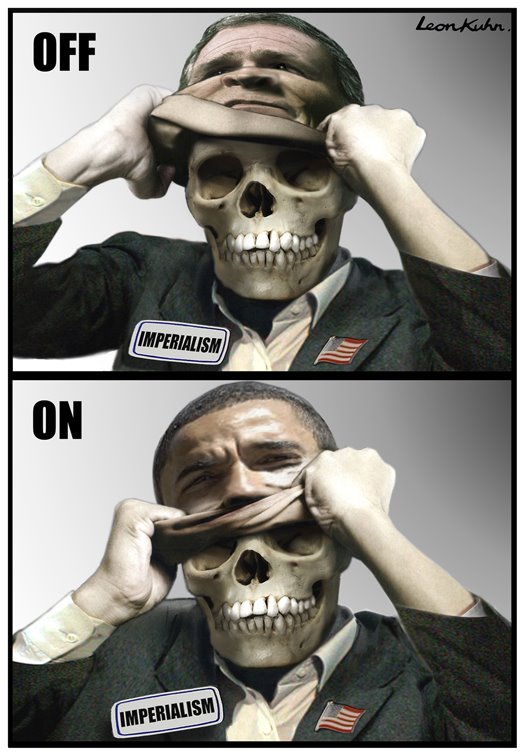
Obama's new view of his own war powers
By
Glenn Greenwald
Back in January, 2006, the Bush Justice Department released a
42-page memo arguing that the President had the power to ignore Congressional restrictions on domestic eavesdropping, such as those imposed by FISA (the 30-year-old law that made it a felony to do exactly what Bush got caught doing: eavesdropping on the communications of Americans without warrants). That occurred roughly 3 months after I began blogging, and -- to my embarrassment now -- I was actually
shocked by the brazen radicalism and extremism expressed in that Memo. It literally argued that Congress had no power to constrain the President in any way when it came to national security matters and protecting the nation.
To advance this defense, Bush lawyers hailed what they called "the
President's role as sole organ for the Nation in foreign affairs"; said the President’s war power inherently as "Commander-in-Chief" under Article II "includes
all that is necessary and proper for carrying these powers into execution"; favorably cited an argument made by Attorney General Black during the Civil War that statutes restricting the President's actions relating to war "could probably be
read as simply providing 'a recommendation' that the President could decline to follow at his discretion"; and, as a result of all that, Congress "was pressing or even exceeding cons utional limits" when it attempted to regulate how the President could eavesdrop on Americans. As a result, the Bush memo argued, the President had the power to ignore the law because FISA, to the extent it purported to restrict the President's war powers, "would be uncons utional as applied in the context of this Congressionally authorized armed conflict."
That claim -- that the President and he alone possesses all powers relating to war under the "Commander-in-Chief" clause of Article II -- became the cornerstone of Bush's "ideology of lawlessness." In a
post that same month defining that ideology, I argued that this lawlessness was grounded in the
September 25, 2001, War Powers memo by John Yoo, which infamously concluded as follows:
In both the War Powers Resolution and the Joint Resolution, Congress has recognized the President's authority to use force in cir stances such as those created by the September 11 incidents. Neither statute, however, can place any limits on the President's determinations as to any terrorist threat, the amount of military force to be used in response, or the method, timing, and nature of the response. These decisions, under our Cons ution, are for the President alone to make.
That was the heart and soul of Bush lawlessness: no "statute can place any limits on the President's determinations" as "these decisions, under our Cons ution, are for the President alone to make."
Yesterday, Hillary Clinton told the House of Representatives that "the White House would forge ahead with military action in Libya
even if Congress passed a resolution constraining the mission." As
TPM put it: "the administration would ignore any and all attempts by Congress to shackle President Obama's power as commander in chief to make military and wartime decisions," as such attempts would cons ute "an uncons utional encroachment on executive power." As Democratic Rep. Brad Sherman noted, Clinton was not relying on the War Powers Resolution of 1973 (WPR); to the contrary, her position is that the Obama administration has the power to wage war in violation even of the permissive dictates of that Resolution. And, of course, the Obama administration has indeed involved the U.S. in a major, risky war, in a country that has neither attacked us nor threatened to, without even a pretense of Congressional approval or any form of democratic consent. Whether the U.S. should go to war is a decision, they obviously believe, "for the President alone to make."
Initially, I defy anyone to identify any differences between the administration's view of its own authority -- that it has the right to ignore Congressional restrictions on its war powers -- and the crux of Bush radicalism as expressed in the once-controversial memos by John Yoo and the Bush DOJ. There is none. That's why Yoo
went to The Wall Street Journal to lavish praise on Obama's new war power theory: because it's Yoo's theory (as I was finishing this post, I saw that
Adam Serwer makes a similar point today). If anything, one could argue that Yoo's theory of unilateral war-making was more reasonable, as it was at least tied to an actual attack on the U.S.: the 9/11 attacks. Here, the Obama administration is arrogating unto the President the unilateral, unrestrained right to start wars in all cir stances, whether or not the U.S. is attacked.
But what Clinton's stated view really harkens back to is the Iran-contra scandal, when the Reagan administration funded the Nicaraguan contras despite an express Congressional prohibition on doing so, and then took the position -- when exposed -- that Congress has no power to restrict its national security decisions. That position was pioneered in 1987 by then GOP Rep. Cheney and his longtime aide David Addington, who wrote a dissenting report to the finding of the Iran-contra committee that the administration's funding of the contras violated the law.
As Charlie Savage detailed in his book, Takeover, Cheney insisted that Congress lacked the power to restrict the President's national security power in any way --
i.e., that the prohibition on funding the contras was cons utionally null and void -- and it was this theory of Presidential Omnipotence which laid the groundwork for Bush 43's imperial presidency:
Cheney has been on a thirty-year quest to implement his views of unfettered executive power For example, when it was revealed in 2005 that the Bush administration had been illegally spying on Americans, Cheney responded: "If you want to understand why this program is legal…go back and read my Iran-Contra report." In that report -- authored in 1987 -- Cheney and aide David Addington defended President Reagan by claiming it was "uncons utional for Congress to pass laws intruding" on the "commander in chief."
Isn't that bolded part -- the self-proclaimed crux of Cheneyite executive power radicalism -- exactly what Hillary Clinton asserted yesterday on behalf of the Obama administration to justify the unauthorized war in Libya? Yes, it is.
The arguments raised to justify the Obama view of his own powers are every bit as frivolous as they were during the Bush years. Many claim that the
War Powers Resolution of 1973 allows a President to fight wars for 60 days without Congressional approval, but (a) the Obama administration is taking the position that not even the WPR can constrain the President, and (b)
1541(c) of that Resolution explicitly states that the war-making rights conferred by the statute apply
onlyto a declaration of war, specific statutory authority, or "
a national emergency created by attack upon the United States, its territories or possessions, or its armed forces." Plainly, none of those cir stances prevail here. That's why the Obama administration has to argue that it is empowered to ignore the WPR: because nothing in it permits the commencement of a war without Congressional approval in these cir stances; to the contrary, it makes clear that he has no such authority in this case (just
read 1541(c) if you have any doubts about that).
Then there's the notion that Presidents in the past have started similar wars without Congressional approval. That's certainly true, but so what? The fact that an act is commonplace isn't a defense or justification. That "defense" was also a common refrain of Bush followers to justify their leader's chronic uncons utional acts and other forms of law-breaking:
Lincoln suspended habeas corpus and FDR interned Japanese-Americans, so why are you upset that Bush is acting outside the law? The pervasiveness of this form of thought underscores the dangers of
learned acquiescence: once a government engages long enough or pervasively enough in a certain form of criminality or corruption, the citizenry is trained to accept it and collectively ceases to resist it, even learns to embrace it. What Obama is doing in Libya is either lawful or it isn't on its own terms; whether other Presidents in the past have acted similarly (and they have) is irrelevant.
Then there's the claim that the President, as "Commander-in-Chief" under Article II, is vested by the Cons ution with the unilateral power to make decisions about America's national security. Leave aside the fact that this premise was the crux of the Bush/Cheney worldview, one which every Good Democrat and Liberal vehemently condemned until recently. Further leave aside the fact that both
Obama and Clinton as Senators and presidential candidates insisted exactly the opposite when they specifically argued that Congress could legally require Bush to obtain Congressional approval before bombing Iran and generally that Presidents have no power to start wars without a vote from Congress. It was true during the Bush years and it is true now that this is an absolute distortion of the "Commander-in-Chief" power of Article II.
To say that the President is "Commander-in-Chief" is not to say that he has the power to start wars. That power is expressly assigned to Congress under Article I, Section 8. The "Commander-in-Chief" power means nothing more than,
once a war starts, the President is the top General with the power to decide how it is tactically prosecuted. I made this argument over and over during the Bush years because this warped Article II view was the principal Bush/Cheney argument for justifying almost everything they did, and to rebut it, I invariably cited the
dissent written by Antonin Scalia -- and joined by John Paul Stevens -- in Hamdi v. Rumsfeld, in which the Surpeme Court ruled that the President, as "Commander-in-Chief," has the power to detain even American citizens as "enemy combatants."
Both Scalia and Stevens insisted that any such attempt was plainly uncons utional, and emphatically rejected the Bush/Cheney (now-Obama/Clinton) view that Presidents have unconstrained national security power under Article II. They explained just how limited of a power the "Commander-in-Chief" clause vests, and that the expansive Bush/Cheney view would replicate the worst excesses of the British King:
The proposition that the Executive lacks indefinite wartime detention authority over citizens is consistent with the Founders' general mistrust of military power permanently at the Executive’s disposal. . . . No fewer than 10 issues of the Federalist were devoted in whole or part to allaying fears of oppression from the proposed Cons ution’s authorization of standing armies in peacetime. Many safeguards in the Cons ution reflect these concerns. Congress's authority "[t]o raise and support Armies" was hedged with the proviso that "no Appropriation of Money to that Use shall be for a longer Term than two Years." U.S. Const., Art. 1, §8, cl. 12. Except for the actual command of military forces, all authorization for their maintenance and all explicit authorization for their use is placed in the control of Congress under Article I, rather than the President under Article II. As Hamilton explained, the President's military authority would be "much inferior" to that of the British King:
"[The Commander-in-Chief power] would amount to nothing more than the supreme command and direction of the military and naval forces, as first general and admiral of the confederacy: while that of the British king extends to the declaring of war, and to the raising and regulating of fleets and armies; all which, by the cons ution under consideration, would appertain to the legislature." The Federalist No. 69, p. 357.
A view of the Cons ution that gives the Executive authority to use military force rather than the force of law against citizens on American soil flies in the face of the mistrust that engendered these provisions.
That bolded section -- quoting Alexander Hamilton, the founder most enthusiastic of executive power -- is dispositive. The British King could start wars on his own; the American President cannot, as that power is reserved exclusively for Congress. The Bush/Cheney "Commander-in-Chief" view suffered a death blow two years later, in 2006, when the Supreme Court,
in Hamdan v. Rumsfeld, rejected the claim that the Commander-in-Chief has the unconstrained power to decide how prisoners will be detained during wartime. The Court emphasized "
the powers granted jointly to the President and Congress in time of war," and -- citing
Youngstown, which rejected Harry Truman's efforts to seize steel mills to support the Koren War in the absence of Congressional authorization -- explicitly held that the President "
may not disregard limitations that Congress has, in proper exercise of its own war powers, placed on his powers." The notion that Presidents have unconstrained war powers is an obsolete, discredited relic of the Bush years, no matter how much Barack Obama and Hillary Clinton attempt to revitalize it in pursuit of their own Freedom-Spreading War.
One's views on the desirability of the Libya war have absolutely nothing to do with whether Obama has acted legally and/or whether his theories of presidential power are valid. This, too, should have been decisively settled during the Bush years, when
Bush followers invariably argued that Bush was justified in eavesdropping without warrants or torturing because of the good outcomes it produced (Keeping Us Safe) -- as though Presidents have the power to violate laws or transgress Cons utional limits provided they can prove that doing so produces good results. The one and only safeguard against tyranny is that political leaders are subjected to the constraints of the Cons ution and law (we're a nation of laws or a nation of men, said Adams: you must choose). To argue that you're supportive of or indifferent to lawless acts because of the good results they produce is simply another way of yearning for a benevolent tyrant (and is another way of replicating the mindset of the Bush follower).
Matt Yglesias is absolutely right when
he points out that, in reality, Congress is happy to have the President usurp its powers in these cases because it alleviates them of responsibility to act. But the same was true of the Democratic Congress under Bush, and that didn't justify anything Bush did; it just meant that Congress shared the blame for acquiescing to it. It may be common, and it may produce good outcomes, and it may be a longstanding problem, but there's no question that Obama's commencement of this war without Congressional approval, and especially Hillary Clinton's announcement that Congress has no power to restrict the President in any way, are acts of pure imperial lawlessness.
Daniel Larison put it best:
This is an outrageous statement, but it’s entirely consistent with what the administration has been illegally doing for the last 12 days. They seem to believe quite seriously that, as long as they don’t call it a war, it doesn’t fall under any laws regulating war powers or the Cons ution. The sliver of good news in all of this is that Obama and his officials are showing such contempt for American law and ins utions that they are exposing themselves to a serious political backlash. War supporters won’t be able to hide behind the conceit that the war is legal. As far as U.S. law is concerned, it has never been legal, and only people making the most maximalist claims of inherent executive power can believe otherwise. Anyone who continues to support the war from this point on will be revealed as being either a blind Obama loyalist, an ideological liberal interventionist, or a devotee of the cult of the Presidency.
Most Democrats, liberals, and even traditional conservatives and libertarians purported to find such lawlessness outrageous and dangerous during the Bush years. It isn't any less so now.



 Reply With Quote