

 Reply With Quote
Klassic Kool
Nothin' better than when Kool flattens out like this. It's like money from home.


Has someone ever made you so sick at the site of them...I usually don't lose my Kool like this...but I must speak up this one time....Tyson Chandler ( not the Tyson on this board) but the basketball player literally makes me sick when I see his punk ass face...I mean it's dam near sickening...his face reminds me of BR's personality...completely disgusting...I dam near hate the dude...makes me want to puke...and what makes it worse is that Pau makes this got look all world...
I don't know if I can even watch this series knowing I'll see his face. He's just a punk ass...faking like he needed to be stretched...that scrub should be ushering at walmart not playing in the association....
Nothin' better than when Kool flattens out like this. It's like money from home.


Beet
From Wikipedia, the free encyclopedia
Jump to: navigation, search
This article is about the vegetable. For the village in North Holland, see Beets, Netherlands. For the manga and anime character, see Beet the Vandel Buster.
BeetrootBeta vulgaris subsp. vulgaris Scientific classification Kingdom: Plantae (unranked): Angiosperms (unranked): Eudicots (unranked): Core eudicots Order: Caryophyllales Family: Chenopodiaceae Genus: Beta Species: B. vulgaris Binomial name Beta vulgaris
L.
The beet (Beta vulgaris) is a plant in the Chenopodiaceae family.[1][2][3][4][5] It is best known in its numerous cultivated varieties, the most well known of which is the purple root vegetable known as the beetroot or garden beet. However, other cultivated varieties include the leaf vegetables chard and spinach beet, as well as the root vegetables sugar beet, which is important in the production of table sugar, and mangelwurzel, which is a fodder crop. Three subspecies are typically recognised. All cultivated varieties fall into the subspecies Beta vulgaris subsp. vulgaris, while Beta vulgaris subsp. maritima, commonly known as the sea beet, is the wild ancestor of these, and is found throughout the Mediterranean, the Atlantic coast of Europe, the Near East, and India. A second wild subspecies, Beta vulgaris subsp. adanensis, occurs from Greece to Syria.
The beet has a long history of cultivation stretching back to the second millennium BC. The plant was probably domesticated somewhere along the Mediterranean, whence it was later spread to Babylonia by the 8th century BC and as far east as China by 850 AD. Available evidence, such as that provided by Aristotle and Theophrastus, suggests the leafy varieties of the beet were grown primarily for most of its history, though these lost much of their popularity much later following the introduction of spinach. The beet became highly commercially important in 19th century Europe following the development of the sugar beet in Germany and the discovery that sucrose could be extracted from them, providing an alternative to tropical sugar cane. It remains a widely cultivated commercial crop for producing table sugar.
Beta vulgaris is a herbaceous biennial or, rarely, perennial plant with leafy stems growing to 1–2 m tall. The leaves are heart-shaped, 5–20 cm long on wild plants (often much larger in cultivated plants). The flowers are produced in dense es; each flower is very small, 3–5 mm diameter, green or tinged reddish, with five petals; they are wind pollinated. The fruit is a cluster of hard nutlets.
Contents
[hide]
[edit] Taxonomy
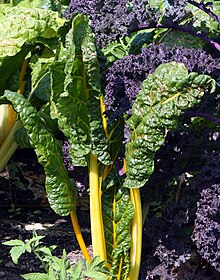
Yellow-stemmed chard (with purple-leaved kale.
The taxonomy of the various wild and cultivated races of beets has a long and complicated history. Mansfeld's Encyclopedia of Agricultural and Horticultural Crops following Letschert's 1993 treatment of Beta, section Beta recognizes the following taxa:[6]
- Beta all cultivated varieties of the beet, which are grown for their taproots, leaves, or swollen midribs.
- B. v. ssp. vulgaris convar. cicla (leaf beets) - The leaf beet group has a long history dating to the second millennium BC. The first cultivated forms were believed to have been domesticated in the Mediterranean, but were introduced to the Middle East, India, and finally China by 850 AD. These were used as medicinal plants in Ancient Greece and Medieval Europe. Their popularity declined in Europe following the introduction of spinach.
- B. v. ssp. v. convar. cicla. var. cicla (spinach beet) - This variety is widely cultivated for its leaves, which are usually cooked like spinach. It can be found in many grocery stores around the world.
- B. v. ssp. v. convar. cicla. var. flaviscens (chard) - Chard is grown for its leaves, which have thick and fleshy midribs that are used as a vegetable. Some cultivars are also grown ornamentally for their coloured midribs. The thickened midribs are thought to have arisen from the spinach beet by mutation.
- B. v. ssp. vulgaris convar. vulgaris (tuberous beets) - This grouping contains all beets grown for their thickened tubers rather than their leaves.
- B. v. ssp. v. convar. vulgaris var. crassa (mangelwurzel) - This variety was developed in the 18th century for its tubers for use as a fodder crop.
- B. v. ssp. v. convar. vulgaris var. altissima (sugar beet) - The sugar beet is a major commercial crop due to its high concentrations of sucrose, which is extracted to produce table sugar. It was developed in Germany in the late 18th century after the roots of beets were found to contain sugar in 1747.
- B. v. ssp. v. convar. vulgaris var. vulgaris (garden beet) - This is the red root vegetable that is most typically associated with the word 'beet'. It is especially popular in Eastern Europe where it is the main ingredient of borscht.
[edit] Uses
[edit] Food
Beets, raw, 100g Nutritional value per 100 g (3.5 oz) Energy 180 kJ (43 kcal) Carbohydrates 9.56 g - Sugars 6.76 g - Dietary fiber 2.8 g Fat 0.17 g Protein 1.61 g Water 87.58g Vitamin A equiv. 2 μg (0%) - beta-carotene 20 μg (0%) - lutein and zeaxanthin 0 μg Thiamine (Vit. B1) 0.031 mg (2%) Riboflavin (Vit. B2) 0.040 mg (3%) Niacin (Vit. B3) 0.334 mg (2%) Pantothenic acid (B5) 0.155 mg (3%) Vitamin B6 0.067 mg (5%) Folate (Vit. B9) 109 μg (27%) Vitamin C 4.9 mg (8%) Calcium 16 mg (2%) Iron 0.80 mg (6%) Magnesium 23 mg (6%) Phosphorus 40 mg (6%) Potassium 325 mg (7%) Zinc 0.35 mg (3%) Percentages are relative to US recommendations for adults.
Source: USDA Nutrient database Spinach beet leaves are eaten as a pot herb. Young leaves of the garden beet are sometimes used similarly. The midribs of Swiss chard are eaten boiled while the whole leaf blades are eaten as spinach beet.
In some parts of Africa, the whole leaf blades are usually prepared with the midribs as one dish.[7]
The leaves and stems of young plants are steamed briefly and eaten as a vegetable; older leaves and stems are stir-fried and have a flavour resembling taro leaves.
The usually deep-red roots of garden beet are eaten boiled either as a cooked vegetable, or cold as a salad after cooking and adding oil and vinegar. A large proportion of the commercial production is processed into boiled and sterilised beets or into pickles. In Eastern Europe beet soup, such as cold borsch, is a popular dish. Yellow-coloured garden beets are grown on a very small scale for home consumption.[7]
Beetroot can be peeled, steamed, and then eaten warm with butter as a delicacy; cooked, pickled, and then eaten cold as a condiment; or peeled, shredded raw, and then eaten as a salad. Pickled beets are a traditional food of the American South. It is also common in Australia and New Zealand for pickled beetroot to be served on a hamburger.[8]
A traditional Pennsylvania Dutch dish is Red Beet Eggs. Hard-boiled eggs are refrigerated in the liquid left over from pickling beets and allowed to marinate until the eggs turn a deep pink-red color.
When beet juice is used, it is most stable in foods with a low water activity, such as frozen novelties and fruit fillings.[9] Betanins, obtained from the roots, are used industrially as red food colourants, e.g. to intensify the colour of tomato paste, sauces, desserts, jams and jellies, ice cream, sweets and breakfast cereals.[7]
Beet pulp is fed to horses that are in vigorous training or conditioning and to those that may be allergic to dust from hay.[citation needed]
Beetroot can also be used to make wine.[10]
The consumption of beets causes pink urine in some people.
Jews traditionally eat beet on Rosh Hashana (New Year). Its Aramaic name סלקא sounds like the word for "remove" or "depart"; it is eaten with a prayer "that our enemies be removed".[11]
[edit] Medicine
The roots and leaves of the beet have been used in folk medicine to treat a wide variety of ailments.[7] Ancient Romans used beetroot as a treatment for fevers and constipation, amongst other ailments. Apicius in De re coquinaria gives five recipes for soups to be given as a laxative, three of which feature the root of beet.[12] Hippocrates advocated the use of beet leaves as binding for wounds. Since Roman times, beetroot juice has been considered an aphrodisiac. From the Middle Ages, beetroot was used as a treatment for a variety of conditions, especially illnesses relating to digestion and the blood. Platina recommended taking beetroot with garlic to nullify the effects of 'garlic-breath'.[13][clarification needed]
It has been suggested the pigment molecule betanin in the root of red beets may protect against oxidative stress and has been used for this purpose in Europe for centuries.[14]
All parts of the beet plant contain oxalic acid. Beet greens and Swiss Chard are both considered high Oxalate foods which have been implicated on the formation of kidney stones.
[edit] Other uses
Cultivars with large, brightly coloured leaves are grown for decorative purposes.[7]
Beets are used as a food plant by the larvae of a number of Lepidoptera species.
[edit] Cultivation
See also: List of beet diseases

A selection of Beta vulgaris, known as beet root, at a grocery store.
Beets are cultivated for fodder (e.g. mangelwurzel), for sugar (the sugar beet), as a leaf vegetable (chard or "Bull's Blood"), or as a root vegetable ("beetroot", "table beet", or "garden beet"). Major root vegetable cultivars include:
- "Albina Vereduna", a white variety
- "Burpee's Golden", a beet with orange-red skin and yellow flesh.
- "Chioggia", an open-pollinated variety originally grown in Italy. The concentric rings of its red and white roots are visually striking when sliced. As a heritage variety, Chioggia is largely unimproved and has relatively high concentrations of geosmin.
- "Detroit Dark Red", with relatively low concentrations of geosmin, and is therefore a popular commercial cultivar in the United States.
- "India Beet" is not as sweet as Western beet. However India beet is more nutritious than Western beet.[citation needed]
- "Lutz Greenleaf", a variety with a red root and green leaves, and a reputation for maintaining its quality well in storage.
- "Red Ace", the principal variety of beet found in the United States[citation needed], typical for its bright red root and red-veined green foliage.
"Blood Turnip" was once a common name for beet root cultivars for the garden. Examples include: Bastian's Blood Turnip, Dewing's Early Blood Turnip, Edmand Blood Turnip, and Will's Improved Blood Turnip.[15]
The "earthy" taste of some beetroot cultivars comes from the presence of geosmin. Researchers have not yet answered whether beets produce geosmin themselves, or whether it is produced by symbiotic soil microbes living in the plant.[16] Nevertheless, breeding programs can produce cultivars with low geosmin levels yielding flavours more acceptable to consumers.[17]
Beets are one of the most boron-intensive of modern crops, a dependency possibly introduced as an evolutionary response its pre-industrial ancestor's constant exposure to sea spray; on commercial farms, a 60 tonne per hectare (26.8 ton/acre) harvest requires 600 grams of elemental boron per hectare (8.6 ounces/acre) for growth.[18] A lack of boron causes the meristem and the shoot to languish, eventually leading to heart rot.[18]
[edit] Red/Purple coloring

A selection of different colored beetroots.
The color of red/purple beetroot is due to a variety of betalain pigments, unlike most other red plants, such as red cabbage, which contain anthocyanin pigments. The composition of different betalain pigments can vary, giving breeds of beetroot which are yellow or other colors in addition to the familiar deep red.[19] Some of the betalains in beets are betanin, isobetanin, probetanin, and neobetanin (the red to violet ones are known collectively as betacyanin). Other pigments contained in beet are indicaxanthin and vulgaxanthins (yellow to orange pigments known as betaxanthins). Indicaxanthin has been shown as a powerful protective antioxidant for thalassemia, as well as prevents the breakdown of alpha-tocopherol (Vitamin E).
Betacyanin in beetroot may cause red urine in some people who are unable to break it down. This is called beeturia.[20]
The pigments are contained in cell vacuoles. Beetroot cells are quite unstable and will 'leak' when cut, heated, or when in contact with air or sunlight. This is why red beetroots leave a purple stain. Leaving the skin on when cooking, however, will maintain the integrity of the cells and therefore minimize leakage.
[edit] History

Sea beet (Beta vulgaris subsp. maritima), the wild ancestor of the cultivated forms.
The sea beet, the ancestor of modern cultivated beets, prospered along the coast of the Mediterranean Sea. Beetroot remains have been excavated in the Third dynasty Saqqara pyramid at Thebes, Egypt, and four charred beetroots were found in the Neolithic site of Aartswoud in the Netherlands though it is difficult to determine whether these are domesticated or wild forms of B. vulgaris. Zohary and Hopf note that beetroot is "linguistically well identified." They state the earliest written mention of the beet comes from 8th century BC Mesopotamia.[21] The Greek Peripatetic Theophrastus later describes the beet as similar to the radish, while Aristotle also mentions the plant.[21][22] Roman and Jewish literary sources suggest that by the 1st century BC the domestic beet was represented in the Mediterranean basin primarily by leafy forms like chard and spinach beet.[21] Zohary and Hopf also argue that it is very probable that beetroot cultivars were also grown at the time, and some Roman recipes support this.[21][22] Later English and German sources show that beetroots were commonly cultivated in Medieval Europe.[22]
[edit] The rise of the sugar beet
Modern sugar beets date back to mid-18th century Silesia where the king of Prussia subsidised experiments aimed at processes for sugar extraction.[22][23] In 1747 Andreas Marggraf isolated sugar from beetroots and found them at concentrations of 1.3-1.6%.[6] He also demonstrated that sugar could be extracted from beets that was the same as that produced from sugarcane.[23] His student, Achard, evaluated 23 varieties of mangelwurzel for sugar content and selected a local race from Halberstadt in modern-day Saxony-Anhalt, Germany. A man named Koppy and his son further selected from this race for white, conical tubers.[6] The selection was named 'Weiße Schlesische Zuckerrübe', meaning white Silesian sugar beet, and boasted about a 6% sugar content.[6][22] This selection is the progenitor of all modern sugar beets.[6]
A royal decree led to the first factory devoted to sugar extraction from beetroots being opened in Kunern, Silesia (now Konary, Poland) in 1801. The Silesian sugar beet was soon introduced to France where Napoleon opened schools specifically for studying the plant. He also ordered that 28,000 hectares (69,200 acres) be devoted to growing the new sugar beet.[22] This was in response to British blockades of cane sugar during the Napoleonic Wars, which ultimately stimulated the rapid growth of a European sugarbeet industry.[22][23] By 1840 about 5% of the world's sugar was derived from sugar beets, and by 1880 this number had risen more than tenfold to over 50%.[22] The sugar beet was introduced to North America after 1830 with the first commercial production starting in 1879 at a farm in Alvarado, California.[6][23] The sugar beet was also introduced to Chile via German settlers around 1850.[6]
[edit] See also
[edit] References
- ^ "PLANTS Profile for Beta vulgaris (common beet) | USDA PLANTS". Plants.usda.gov. http://plants.usda.gov/java/profile?symbol=BEVU2. Retrieved 2010-09-12.
- ^ "Spinach, Beet and Swiss Chard - Notes - HORT410 - Vegetable Crops - Department of Horticulture and Landscape Architecture - Purdue University". Hort.purdue.edu. http://www.hort.purdue.edu/rhodcv/ho...na/sp00001.htm. Retrieved 2010-09-12.
- ^ http://www.avrdc.org/pdf/seeds/beet.pdf
- ^ "Sugar beet". Agronomy.unl.edu. http://agronomy.unl.edu/ffa/SugarBeet.htm. Retrieved 2010-09-12. [dead link]
- ^ "Integrative Biology 335: Systematics of Plants". Life.illinois.edu. http://www.life.illinois.edu/ib/335/...phyllidae.html. Retrieved 2010-09-12.
- ^ a b c d e f g Hanelt, Peter; Büttner, R.; Mansfeld, Rudolf; Kilian, Ruth (2001). Mansfeld's Encyclopedia of Agricultural and Horticultural Crops. Springer. pp. 235–241. ISBN 3540410171
- ^ a b c d e Grubben, G.J.H. & Denton, O.A. (2004) Plant Resources of Tropical Africa 2. Vegetables. PROTA Foundation, Wageningen; Backhuys, Leiden; CTA, Wageningen.
- ^ Weird Foods from around the World
- ^ Francis, F.J. (1999). Colorants. Egan Press. ISBN 1-891127-00-4.
- ^ Making Wild Wines & Meads; Pattie Vargas & Rich Gulling; page 73
- ^ Keritot 6a; Horiyot 12a; Rabbenu Nissim at the end of Rosh Hashana, citing the custom of Rav Hai Gaon; Abudraham; Shulchan Aruch OC 583:1
- ^ Apicius De Re Coquinaria 3.2.1, 3, 4
- ^ Platina De Honesta Voluptate et Valetudine, 3.14
- ^ Carmen Socaciu (2008). Food colorants: chemical and functional properties. Washington, DC: Taylor & Francis. pp. 169. ISBN 0-8493-9357-4.
- ^ Beets Varieties, from Heirloom Seedsmen, a website of the Baker Creek Heirloom Seed Company
- ^ Lu, G.; Lu G, Edwards CG, Fellman JK, Mattinson DS, Navazio J. (February 2003). "Biosynthetic origin of geosmin in red beets (Beta vulgaris L.).". Journal of Agricultural and Food Chemistry (abstract) (American Chemical Society) 12 (51(4)): 1026–9. doi:10.1021/jf020905r. PMID 12568567.
- ^ Stephen Nottingham (2004) (E-book). Beetroot. http://ourworld.compuserve.com/homep...m/beetroot.htm.
- ^ a b "Can’t beet this" (PDF). Rio Tinto Minerals. http://www.borax.com/agriculture/fil...ts.pioneer.pdf.
- ^ Hamilton, Dave (2005). "Beetroot Beta vulgaris". http://www.selfsufficientish.com/beetroot.htm.
- ^ M.A. Eastwood; H. Nyhlin (1995). "Beeturia and colonic oxalic acid". QJM: an International Journal of Medicine 88 (10): 711. PMID 7493168. http://qjmed.oxfordjournals.org/cgi/...ract/88/10/711.
- ^ a b c d Hopf, Maria; Zohary, Daniel (2000). Domestication of plants in the old world: the origin and spread of cultivated plants in West Asia, Europe, and the Nile Valley. Oxford [Oxfordshire]: Oxford University Press. pp. 200. ISBN 0-19-850356-3.
- ^ a b c d e f g h Hill, G.; Langer, R. H. M. (1991). Agricultural plants. Cambridge, UK: Cambridge University Press. pp. 197–199. ISBN 0-521-40563-7.
- ^ a b c d Sugarbeet from a University of California, Davis website
[edit] External links
Wikimedia Commons has media related to: Beet
Wikisource has the text of the 1911 Encyclopædia Britannica article Beet.
- Cultural Information on Beets for the Home Garden
- PROTAbase on Beta vulgaris
- Beta vulgaris craca - Plants For a Future Database entry
- Stephen Nottingham (2004) (e-book). Beetroot. http://www.stephennottingham.co.uk/beetroot.htm.
- Sorting Beta names - multilingual listing of the Beta species
Retrieved from "http://en.wikipedia.org/wiki/Beet"
Categories: Leaf vegetables | Medicinal plants | Root vegetables | Biologically based ther

not sure which is the worst post in this thread so far..
post #1, the fudge licking in post #2 or the beets in post #3 and #4.
it's May 3rd 6:53p and the nba forum still sucks.
DMC don't around and get yourself banned...remember I do have Kori's ear...so don't with me...you better ask Red Zero bout that thread bombing ...and the price you'll pay...tbh
got, if you can get someone banned, there's no reason to be here.
You start a new thread every 15 minutes. I think there's a rule against starting a new thread about everything in your feeble brain.

Lil just trying to get recognized Too Kool.
who s with you becomes famous....but for all the wrong reasonsKeep the pimp hand strong playa
You done mourning?
Says the guy posting from a second account because the first was banned.

Something is happening here that ain't happened in years.
Keep talking, Ty, go slow and make it last.
boiled down::
Mavs 1
Lakers 0
Not now, Ty is talking naughty/Herself style.
if you don't get banned you most likely will get spanked...I'm not kidding you better watch yourself or I'm gonna holla at my fair lady...
and as for my posts...that's what the board is for....ingenuity and creativity something you could never do...I bet in your miserable life you've never thought of or initiated anything significant...we both know it....something in your life is seriously ed up and you're mad and angry so acting a gotdam fool on ST is your outlet....I get it dude...you're a loser...
I am too old to give a about that. I tried and couldn't. It's not my fault.
Someone here starts a new thread with every passing though and uses third person when referring to itself.
Hint: It's not me.
Actually that's not what I was told. I just keep it out of the upstairs forum. With what you gots do down here there's no way I could be worse.
Don't you have a cave that you should be scoping out for your new pad....
Just as I figured...you're an unsuccessful ....mad because you failed at accomplishing ....I bet you're as ugly as your personality...no pussy getting old er you....
Go jerk yourself into oblivion...
You mad...
Kori doesn't need to ban me. She only has to tell me to stop posting and that's that. I don't make troll accounts.
some people wake up in the morning...look in the mirror and stay mad at the world...Kool is not one of those people...
That's because only people who work actually get up in the morning.
Real women don't look for cute guys. If you think you're cute, you're obviously playing for the wrong team. That should be your admission thread.
It's not in me to do it. I wouldn't get anything out of it.
I'm handsome and debonair...stop hating you quasi modo looking muthafcker....
There are currently 1 users browsing this thread. (0 members and 1 guests)
 Posting Permissions


