

 Reply With Quote
Stupid song about lazy black guy

I just wanna lay in my bed
Don't feel like picking up my Phone so leave a message after da tone because today I don't feel like doin anything. Nothin at all.


Stupid song about lazy black guy


can't get a lady on your own merits?...don't worry hookers can be found discreetly online...


such a stupid ing song with an even dumber music video
Marsupial
From Wikipedia, the free encyclopedia
Jump to: navigation, search
This article is about mammals. For frogs, see Marsupial frog.
Marsupials[1][2]
Temporal range: Early Cretaceous–Recent
Female Eastern Grey Kangaroo with a joey in her pouchScientific classificationKingdom:AnimaliaPhylum:ChordataClass:MammaliaSubclass:TheriaInfraclass:Marsupialia
Illiger, 1811Orders
- Didelphimorphia
- Paucituberculata
- Microbiotheria
- Dasyuromorphia
- Peramelemorphia
- Notoryctemorphia
- Diprotodontia
- †Sparassodonta
- †Yalkaparidontia
Present day distribution of marsupials.
Marsupials are an infraclass of mammals, characterized by giving birth to relatively undeveloped young. Close to 70% of the 334 extant species occur in Australia, New Guinea, and nearby islands, with the remaining 100 found in the Americas, primarily in South America, but with thirteen in Central America, and one in North America north of Mexico.
Contents
[hide]
[edit] History
See also: Evolution of mammals
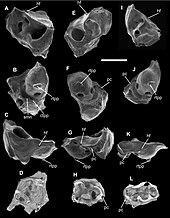
Isolated petrosals of Djarthia murgonensis, Australia's oldest marsupial fossils[3]

Den ion of an Eastern grey kangaroo, as illustrated in Knight's Sketches in Natural History
The relationships between the three extant divisions of mammals (monotremes, marsupials, and placental mammals) was long a matter of debate among taxonomists.[4] Most morphological evidence comparing traits such as number and arrangement of teeth and structure of the reproductive and waste elimination systems favors a closer evolutionary relationship between marsupials and placental mammals than either with the monotremes. Most genetic and molecular evidence also supports grouping marsupials and placental mammals as a single clade, subclass Theria.[5]
Marsupials and placental mammals split from the monotremes during the Cretaceous Period.[6] In the absence of soft tissues, such as the pouch and reproductive system, fossil marsupials can be distinguished from placentals by the form of their teeth; primitive marsupials possess four pairs of molar teeth in each jaw, whereas placental mammals never have more than three pairs.[7] Using this criterion, the earliest known marsupial is Sinodelphys szalayi, which lived in China around 125 million years ago (mya).[8][9][10] This makes it almost contemporary to the earliest eutherian fossils, which have been found in the same area.[10][11]
The oldest metatherian fossils (Metatheria being a larger clade that groups marsupials with some of their extinct relatives) are found in present-day China,[12] and there are a few species of marsupials presently living in Indonesia as far west as Sulawesi, which is sometimes considered to be in an Asian ecozone.[13] However, these modern marsupials appear to be have reached the islands relatively recently via Australia. About 100 mya, the supercontinent Pangaea was in the process of splitting into the northern continent Laurasia and the southern continent Gondwana, with what would become China and Australia already separated by the Tethys Ocean. Marsupials spread westward into modern North America (still attached to Eurasia) and then to South America, which was connected to North America until around 65 mya. Laurasian marsupials eventually died off, possibly due to compe ion from placental mammals for their ecological niches.
In South America, the opossums retained a strong presence, and the Tertiary saw the evolution of shrew opossums (Paucituberculata) and metatherian predators such as the borhyaenids and the saber-toothed Thylacosmilus. South American niches for mammalian carnivores were dominated by these marsupial and sparassodont metatherians. While placental predators were absent, the metatherians did have to contend with avian (terror bird) and terrestrial crocodilian compe ion. South America and Antarctica remained connected until 35 mya, as shown by the unique fossils found there. North and South America remained disjointed until about three million years ago, when the Isthmus of Panama formed. This led to the Great American Interchange. Compe ion from placental mammals from the north drove sparassodonts to extinction, while didelphimorphs (opossums) invaded Central America, with the Virginia opossum reaching as far north as Canada.
Marsupials reached Australia via Antarctica about 50 mya, shortly after Australia had split off. This suggests a single dispersion event of just one species, most likely a relative to South America's monito del monte (a microbiothere, the only New World australidelphian). This progenitor may have rafted across the widening, but still narrow, gap between Australia and Antarctica. In Australia, they radiated into the wide variety we see today, island hopping some way through the Indonesian archipelago.[14][15][16] A 2010 analysis of retrotransposon insertion sites in the nuclear DNA of a variety of marsupials has confirmed all living marsupials have South American ancestors. The branching sequence of marsupial orders indicated by the study puts Didelphimorphia in the most basal position, followed by Paucituberculata, then Microbiotheria, and ending with the radiation of Australian marsupials. This indicates that Australidelphia arose in South America, and reached Australia after Microbiotheria split off.[17][18]
In Australia, terrestrial placental mammals disappeared early in the Cenozoic (their most recent known fossils being 55 million year old teeth resembling those of condylarths) for reasons that are not clear, allowing marsupials to dominate the Australian ecosystem.[14] Extant native Australian terrestrial placental mammals (such as hopping mice) are relatively recent immigrants, arriving via island hopping from southeast Asia.[15]
[edit] Description
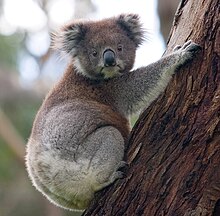
Koala
(Phascolarctos cinereus)
[edit] Early development
An infant marsupial is known as a joey. Marsupials have an extremely short gestation period (about 4–5 weeks), and the joey is 'born' essentially in a fetal state. The blind, furless, miniature newborn, the size of a jelly bean, crawls across its mother's fur to make its way into the pouch, where it latches onto a teat for food. It will not re-emerge for several months, during which time it develops fully. After this period, the joey begins to spend increasing lengths of time out of the pouch, feeding and learning survival skills. However, it returns to the pouch to sleep, and if danger threatens it will seek refuge in its mother's pouch for safety.
Joeys stay in the pouch for up to a year in some species, or until the next joey is born. A marsupial joey is unable to regulate its own body temperature, and thus relies upon an external heat source. Until the joey is well-furred and old enough to leave the pouch, a pouch temperature between 30-32° Celsius must be constantly maintained.
An early birth removes a developing marsupial from its parent's body much sooner than in placental mammals, and thus marsupials have not developed a complex placenta to protect the embryo from its mother's immune system. Though early birth places the tiny newborn marsupial at a greater environmental risk, it significantly reduces the dangers associated with long pregnancies, as there is no need to carry a large fetus to full-term in bad seasons.
Because newborn marsupials must climb up to their mother's nipples, their front limbs are much more developed than the rest of the body at the time of birth. It is possible that this requirement has resulted in the limited range of locomotor adaptations in marsupials compared to placentals. Marsupials must develop a grasping forepaw during their early youth, making the transition from this limb into a hoof, wing, or flipper, as some groups of placental mammals have done, far more difficult.
Some common structural features can be found among marsupials. Ossified patellae are absent. Marsupials (and also monotremes) also lack a gross communication (corpus callosum) between the right and left brain hemisphere.[19]
[edit] Reproductive system
Marsupials' reproductive systems differ markedly from those of placental mammals (Placentalia). Females have two lateral vaginas, which lead to separate uteri but both open externally through the same orifice. A third canal, the median vagina, is used for birth. This canal can be transitory or permanent.[19] The males generally have a two-pronged penis, which corresponds to the females' two vaginas.[20] The penis is used only for discharging semen into females, and there is instead a urogenital sac used to store waste before expulsion.
Pregnant females develop a kind of yolk sac in their wombs, which delivers nutrients to the embryo. Marsupials give birth at a very early stage of development (about 4–5 weeks); after birth, newborn marsupials crawl up the bodies of their mothers and attach themselves to a nipple, which is located on the underside of the mother either inside a pouch called the marsupium or open to the environment. To crawl to the nipple and attach to it, the marsupial must have well developed forelimbs and facial structures.[21][22] This is accomplished by accelerating forelimb and facial development in marsupials compared to placental mammals. As a result, there is decelerated development of such structures as the hindlimb and brain. There they remain for a number of weeks, attached to the nipple. The offspring are eventually able to leave the marsupium for short periods, returning to it for warmth, protection and nourishment.
[edit] Taxonomy

Sugar Glider (Petaurus breviceps)

Common Brushtail Possum (Trichosurus vulpecula)

Squirrel Glider
(Petaurus norfolcensis)

Virginia Opossum (Didelphis virginiana), the only North American marsupial north of Mexico.
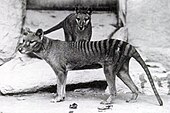
Thylacine (Thylacinus cynocephalus), an extinct carnivorous marsupial found in Tasmania until the 1930s
Taxonomically, there are two primary divisions of Marsupialia: American marsupials and the Australian marsupials.[1][2] The Order Microbiotheria (which has only one species, the monito del monte) is found in South America, but is believed to be more closely related to the Australian marsupials. There are many small arboreal species in each group. The term opossums is properly used to refer to the American species (though possum is a common diminutive), while similar Australian species are properly called possums.
† indicates extinction
- Order †Sparassodonta (formerly viewed as marsupials, now as a sister group of metatherians)
- Superorder Ameridelphia
- Order Didelphimorphia (93 species)
- Family Didelphidae: opossums
- Order Paucituberculata (6 species)
- Family Caenolestidae: shrew opossums
- Superorder Australidelphia
- Order Microbiotheria (1 species)
- Family Microbiotheriidae: monito del monte
- Order †Yalkaparidontia
- Order Dasyuromorphia (71 species)
- Family †Thylacinidae: thylacine
- Family Dasyuridae: antechinuses, quolls, dunnarts, Tasmanian devil, and relatives
- Family Myrmecobiidae: numbat
- Order Peramelemorphia (24 species)
- Family Thylacomyidae: bilbies
- Family †Chaeropodidae: pig-footed bandicoot
- Family Peramelidae: bandicoots and allies
- Order Notoryctemorphia (2 species)
- Family Notoryctidae: marsupial moles
- Order Diprotodontia (137 species)
- Family Phascolarctidae: koala
- Family Vombatidae: wombats
- Family †Diprotodontidae: diprotodon
- Family Phalangeridae: brushtail possums and cuscuses
- Family Burramyidae: pygmy possums
- Family Tarsipedidae: honey possum
- Family Petauridae: striped possum, Leadbeater's possum, yellow-bellied glider, sugar glider, mahogany glider, squirrel glider
- Family Pseudocheiridae: ringtailed possums and relatives
- Family Potoridae: potoroos, rat kangaroos, bettongs
- Family Acrobatidae: feathertail glider and feather-tailed possum
- Family Hypsiprymnodontidae: musky rat-kangaroo
- Family Macropodidae: kangaroos, wallabies, and relatives
- Family †Thylacoleonidae: marsupial lions
[edit] See also
[edit] References
- ^ a b Gardner, Alfred (16 November 2005). Wilson, Don E., and Reeder, DeeAnn M., eds. ed. Mammal Species of the World (3rd ed.). Baltimore: Johns Hopkins University Press, 2 vols. (2142 pp.). pp. 3–21. ISBN 978-0-8018-8221-0. OCLC 62265494. http://www.bucknell.edu/msw3.
- ^ a b Groves, C. (2005). Wilson, D. E., & Reeder, D. M, eds. ed. Mammal Species of the World (3rd ed.). Baltimore: Johns Hopkins University Press. pp. 22–70. OCLC 62265494. ISBN 0-801-88221-4. http://www.bucknell.edu/msw3.
- ^ "Australia's Oldest Marsupial Fossils and their Biogeographical Implications". Plos One. http://www.plosone.org/article/info%3Adoi%2F10.1371%2Fjournal.pone.0001858;jsessi onid=A57F0FDB595AC49992E2B5A390FA104C. Retrieved 2010-03-16.
- ^ Moyal, Ann Mozley (2004). Platypus: The Extraordinary Story of How a Curious Creature Baffled the World. Baltimore: The Johns Hopkins University Press. ISBN 0-8018-8052-1. http://books.google.com?id=5DkezNMhSTYC&printsec=frontcov er.
- ^ Van Rheede, T.; Bastiaans, T.; Boone, D.; Hedges, S.; De Jong, W.; Madsen, O. (2006). "The platypus is in its place: nuclear genes and indels confirm the sister group relation of monotremes and Therians". Molecular biology and evolution 23 (3): 587–597. doi:10.1093/molbev/msj064. PMID 16291999. edit
- ^ Tyndale-Biscoe, C. H. (2005). Life of marsupials. Collingwood, Vic: CSIRO. ISBN 0-643-09199-8. http://google.com/books?id=KqtlPZJ9y8EC&printsec=frontcover.
- ^ Benton, Michael J. (1997). Vertebrate Palaeontology. London: Chapman & Hall. p. 306. ISBN 0-412-73810-4.
- ^ Rincon, Paul (2003-12-12). "Rincon, P., Oldest Marsupial Ancestor Found, BBC, Dec 2003". BBC News. http://news.bbc.co.uk/2/hi/science/nature/3311911.stm. Retrieved 2010-03-16.
- ^ "Pickrell, J., Oldest Marsupial Fossil Found in China, National Geographic, December 2003". News.nationalgeographic.com. http://news.nationalgeographic.com/news/2003/12/1215_031215_oldestmarsupial.html. Retrieved 2010-03-16.
- ^ a b "Vertebrate Paleontology: Sinodelphys szalayi". Carnegie Museum of Natural History. http://www.carnegiemnh.org/vp/sinodelphys.html. Retrieved 2010-10-21.
- ^ Nature. "Ji, Q., et al., The Earliest Known Eutherian Mammal, Nature, 416, Pages 816-822, Apr 2002". Nature.com. http://www.nature.com/nature/journal/v416/n6883/full/416816a.html. Retrieved 2010-03-16.
- ^ Luo, Zhe-Xi; Ji, Qiang; Wible, John R.; Yuan, Chong-Xi (2003-12-12). "An early Cretaceous tribosphenic mammal and metatherian evolution". Science 302 (5652): 1934–1940. doi:10.1126/science.1090718. PMID 14671295. http://www.sciencemag.org/content/302/5652/1934.abstract. Retrieved 2010-12-27.
- ^ "Harrison, L., The Migration Route of the Australian Marsupial Fauna, Australian Zoologist, Volume 3, Pages 247-263, 1924". Wku.edu. 1914-09-12. http://www.wku.edu/~smithch/biogeog/HARR1924.htm. Retrieved 2010-03-16.
- ^ a b Dawkins, Richard (2005). The Ancestor's Tale : A Pilgrimage to the Dawn of Evolution. Boston: Mariner Books. ISBN 0-618-61916-X. http://books.google.com/?id=rR9XPnaqvCMC&pg=PA223.
- ^ a b Hand, Suzanne J.; Long, John; Archer, Michael; Flannery, Timothy Fridtjof (2002). Prehistoric mammals of Australia and New Guinea: one hundred million years of evolution. Baltimore: Johns Hopkins University Press. ISBN 0-8018-7223-5. http://books.google.com/?id=92yhnRHdxSoC&printsec=frontcover.
- ^ Kemp, T.S. (2005). The origin and evolution of mammals. Oxford [Oxfordshire]: Oxford University Press. ISBN 0-19-850761-5.
- ^ Schiewe, Jessie (2010-07-28). "Australia's marsupials originated in what is now South America, study says". LATimes.Com. Los Angeles Times. http://www.latimes.com/news/science/la-sci-marsupial-20100728,0,5549873.story. Retrieved 2010-08-01.
- ^ Nilsson, M. A.; Churakov, G.;, Sommer, M.; Van Tran, N.; Zemann, A.; Brosius, J.; Schmitz, J. (2010-07-27). "Tracking Marsupial Evolution Using Archaic Genomic Retroposon Insertions". PLoS Biology (Public Library of Science) 8 (7): e1000436. doi:10.1371/journal.pbio.1000436. PMC 2910653. PMID 20668664.
- ^ a b Nowak, Ronald M. (1999). Walker's Book Of Mammals, Sixth Edition. Baltimore and London: Johns Hopkins University Press. p. 5. ISBN 0-8018-5789-9.
- ^ [1] Iowa State University Biology Dept. Discoveries about Marsupial Reproduction Anna King 2001. webpage] (note shows code, html extension omitted)
- ^ Sears, K. E. (2009). "Differences in the Timing of Prechondrogenic Limb Development in Mammals: The Marsupial-Placental Dichotomy Resolved". Evolution 63 (8): 2193–2200. doi:10.1111/j.1558-5646.2009.00690.x. PMID 19453378.
- ^ Smith, K. K. (2001). "Early development of the neural plate, neural crest and facial region of marsupials". Journal of Anatomy 199 (Pt 1-2): 121–131. doi:10.1046/j.1469-7580.2001.19910121.x. PMC 1594995. PMID 11523813.
[edit] External links
- Tim Flannery (1994), The Future Eaters: An Ecological History of the Australasian Lands and People, pages 67–75. ISBN 0-8021-3943-4 ISBN 0-7301-0422-2
- Tim Flannery, Country: a continent, a scientist & a kangaroo, pages 196–200. ISBN 1-920885-76-5
- Austin, C.R. ed. Reproduction in Mammals. Melbourne: Cambridge University Press,1982.
- Bronson, F. H. Mammalian Reproductive Biology. Chicago: University of Chicago Press, 1989.
- Dawson, Terrence J. Kangaroos: Biology of Largest Marsupials. New York: Cornell University Press, 1995.
- Frith, H. J. and J. H. Calaby. Kangaroos. New York: Humanities Press, 1969.
- Gould, Edwin and George McKay. Encyclopedia of Mammals. San Diego: Academic Press, 1998.
- Hunsaker, Don. The Biology of Marsupials. New York: Academic Press, 1977.
- Johnson, Martin H. and Barry J. Everitt. Essential Reproduction. Boston: Blackwell Scientific Publications, 1984.
- Knobill, Ernst and Jimmy D. Neill ed. Encyclopedia of Reproduction. V. 3 New York: Academic Press, 1998
- McCullough, Dale R. and Yvette McCullough. Kangaroos in Outback Australia: Comparative Ecology and Behavior of Three Coexisting Species. New York: Columbia University Press, 2000.
- Taylor Andrea C., Sunnucks Paul (1997). "Sex of Pouch Young Related to Maternal Weight in Macropus eugeni and M. parma". Australian Journal of Zoology 45: 573–578. doi:10.1071/ZO97038.
Find more about Marsupial on Wikipedia's sister projects:Definitions from Wiktionary
Images and media from Commons
Learning resources from Wikiversity
News stories from Wikinews
Quotations from Wikiquote
Source texts from Wikisource
Textbooks from Wikibooks
Data related to Marsupialia at Wikispecies
[hide]Extant mammal orders by infraclassKingdom Animalia · Phylum Chordata · Subphylum Vertebrata · (unranked) AmniotaAustralosphenidaMonotremata (Platypus and echidnas)
Marsupialia at Wikibooks.
- The Marsupial Ring
- Western Australian Mammal Species
- Researchers Publish First Marsupial Genome Sequence The National Ins utes of Health May 2007
- First marsupial genome released. Most differences between the opossom and placental mammals stem from non-coding DNA
Metatheria
(Marsupial inclusive)
Ameridelphia
Paucituberculata (Shrew opossums) · Didelphimorphia (Opossums)
Australidelphia
Microbiotheria (Monito del Monte) · Notoryctemorphia (Marsupial moles) · Dasyuromorphia (Quolls and dunnarts) · Peramelemorphia (Bilbies and bandicoots) · Diprotodontia (Kangaroos and relatives)
Eutheria
(Placental inclusive)
Xenarthra
Cingulata (Armadillos) · Pilosa (Anteaters and sloths)
Afrotheria
Afrosoricida (Tenrecs and golden moles) · Macroscelidea (Elephant shrews) · Tubulidentata (Aardvark) · Hyracoidea (Hyraxes) · Proboscidea (Elephants) · Sirenia (Dugongs and manatees)
Laurasiatheria
Soricomorpha (Shrews and moles) · Erinaceomorpha (Hedgehogs and relatives) · Chiroptera (Bats) · Pholidota (Pangolins) · Carnivora · Perissodactyla (Odd-toed ungulates) · Artiodactyla (Even-toed ungulates) · Cetacea (Whales and dolphins)
Euarchontoglires
Rodentia (Rodents) · Lagomorpha (Rabbits and relatives) · Scandentia (Treeshrews) · Dermoptera (Colugos) · Primates
Retrieved from "http://en.wikipedia.org/wiki/Marsupial"
Categories: Marsupials
Hidden categories: Articles with 'species' microformats
Personal tools
Namespaces
Variants
Views
Actions
Search

Navigation
Interaction
Toolbox
Print/export
Languages
- Alemannisch
- العربية
- Azərbaycanca
- Bân-lâm-gú
- Bosanski
- Brezhoneg
- Български
- Català
- Česky
- Cymraeg
- Dansk
- Deutsch
- Diné bizaad
- Ελληνικά
- Español
- Esperanto
- Euskara
- فارسی
- Føroyskt
- Français
- Gàidhlig
- 한국어
- Hrvatski
- Ido
- Bahasa Indonesia
- Íslenska
- Italiano
- עברית
- Kiswahili
- Kreyòl ayisyen
- Latina
- Latviešu
- Lëtzebuergesch
- Lietuvių
- Líguru
- Magyar
- Македонски
- Bahasa Melayu
- Nederlands
- 日本語
- Norsk (bokmål)
- Norsk (nynorsk)
- Occitan
- Олык Марий
- Polski
- Português
- Română
- Rumantsch
- Русский
- Sicilianu
- Simple English
- Slovenčina
- Slovenščina
- Српски / Srpski
- Srpskohrvatski / Српскохрватски
- Suomi
- Svenska
- Татарча/Tatarça
- తెలుగు
- Tetun
- ไทย
- Türkçe
- Українська
- Tiếng Việt
- 粵語
- 中文
- This page was last modified on 26 June 2011 at 23:48.
- Text is available under the Creative Commons Attribution-ShareAlike License; additional terms may apply. See Terms of Use for details.
Wikipedia® is a registered trademark of the Wikimedia Foundation, Inc., a non-profit organization.- Contact us
Marsupial
From Wikipedia, the free encyclopedia
Jump to: navigation, search
This article is about mammals. For frogs, see Marsupial frog.
Marsupials[1][2]
Temporal range: Early Cretaceous–Recent
Illiger, 1811Orders
- Didelphimorphia
- Paucituberculata
- Microbiotheria
- Dasyuromorphia
- Peramelemorphia
- Notoryctemorphia
- Diprotodontia
- †Sparassodonta
- †Yalkaparidontia
Marsupials are an infraclass of mammals, characterized by giving birth to relatively undeveloped young. Close to 70% of the 334 extant species occur in Australia, New Guinea, and nearby islands, with the remaining 100 found in the Americas, primarily in South America, but with thirteen in Central America, and one in North America north of Mexico.
Contents
[hide]
[edit] History
See also: Evolution of mammals
Isolated petrosals of Djarthia murgonensis, Australia's oldest marsupial fossils[3]
Den ion of an Eastern grey kangaroo, as illustrated in Knight's Sketches in Natural History
The relationships between the three extant divisions of mammals (monotremes, marsupials, and placental mammals) was long a matter of debate among taxonomists.[4] Most morphological evidence comparing traits such as number and arrangement of teeth and structure of the reproductive and waste elimination systems favors a closer evolutionary relationship between marsupials and placental mammals than either with the monotremes. Most genetic and molecular evidence also supports grouping marsupials and placental mammals as a single clade, subclass Theria.[5]
Marsupials and placental mammals split from the monotremes during the Cretaceous Period.[6] In the absence of soft tissues, such as the pouch and reproductive system, fossil marsupials can be distinguished from placentals by the form of their teeth; primitive marsupials possess four pairs of molar teeth in each jaw, whereas placental mammals never have more than three pairs.[7] Using this criterion, the earliest known marsupial is Sinodelphys szalayi, which lived in China around 125 million years ago (mya).[8][9][10] This makes it almost contemporary to the earliest eutherian fossils, which have been found in the same area.[10][11]
The oldest metatherian fossils (Metatheria being a larger clade that groups marsupials with some of their extinct relatives) are found in present-day China,[12] and there are a few species of marsupials presently living in Indonesia as far west as Sulawesi, which is sometimes considered to be in an Asian ecozone.[13] However, these modern marsupials appear to be have reached the islands relatively recently via Australia. About 100 mya, the supercontinent Pangaea was in the process of splitting into the northern continent Laurasia and the southern continent Gondwana, with what would become China and Australia already separated by the Tethys Ocean. Marsupials spread westward into modern North America (still attached to Eurasia) and then to South America, which was connected to North America until around 65 mya. Laurasian marsupials eventually died off, possibly due to compe ion from placental mammals for their ecological niches.
In South America, the opossums retained a strong presence, and the Tertiary saw the evolution of shrew opossums (Paucituberculata) and metatherian predators such as the borhyaenids and the saber-toothed Thylacosmilus. South American niches for mammalian carnivores were dominated by these marsupial and sparassodont metatherians. While placental predators were absent, the metatherians did have to contend with avian (terror bird) and terrestrial crocodilian compe ion. South America and Antarctica remained connected until 35 mya, as shown by the unique fossils found there. North and South America remained disjointed until about three million years ago, when the Isthmus of Panama formed. This led to the Great American Interchange. Compe ion from placental mammals from the north drove sparassodonts to extinction, while didelphimorphs (opossums) invaded Central America, with the Virginia opossum reaching as far north as Canada.
Marsupials reached Australia via Antarctica about 50 mya, shortly after Australia had split off. This suggests a single dispersion event of just one species, most likely a relative to South America's monito del monte (a microbiothere, the only New World australidelphian). This progenitor may have rafted across the widening, but still narrow, gap between Australia and Antarctica. In Australia, they radiated into the wide variety we see today, island hopping some way through the Indonesian archipelago.[14][15][16] A 2010 analysis of retrotransposon insertion sites in the nuclear DNA of a variety of marsupials has confirmed all living marsupials have South American ancestors. The branching sequence of marsupial orders indicated by the study puts Didelphimorphia in the most basal position, followed by Paucituberculata, then Microbiotheria, and ending with the radiation of Australian marsupials. This indicates that Australidelphia arose in South America, and reached Australia after Microbiotheria split off.[17][18]
In Australia, terrestrial placental mammals disappeared early in the Cenozoic (their most recent known fossils being 55 million year old teeth resembling those of condylarths) for reasons that are not clear, allowing marsupials to dominate the Australian ecosystem.[14] Extant native Australian terrestrial placental mammals (such as hopping mice) are relatively recent immigrants, arriving via island hopping from southeast Asia.[15]
[edit] Description
Koala
(Phascolarctos cinereus)
[edit] Early development
An infant marsupial is known as a joey. Marsupials have an extremely short gestation period (about 4–5 weeks), and the joey is 'born' essentially in a fetal state. The blind, furless, miniature newborn, the size of a jelly bean, crawls across its mother's fur to make its way into the pouch, where it latches onto a teat for food. It will not re-emerge for several months, during which time it develops fully. After this period, the joey begins to spend increasing lengths of time out of the pouch, feeding and learning survival skills. However, it returns to the pouch to sleep, and if danger threatens it will seek refuge in its mother's pouch for safety.
Joeys stay in the pouch for up to a year in some species, or until the next joey is born. A marsupial joey is unable to regulate its own body temperature, and thus relies upon an external heat source. Until the joey is well-furred and old enough to leave the pouch, a pouch temperature between 30-32° Celsius must be constantly maintained.
An early birth removes a developing marsupial from its parent's body much sooner than in placental mammals, and thus marsupials have not developed a complex placenta to protect the embryo from its mother's immune system. Though early birth places the tiny newborn marsupial at a greater environmental risk, it significantly reduces the dangers associated with long pregnancies, as there is no need to carry a large fetus to full-term in bad seasons.
Because newborn marsupials must climb up to their mother's nipples, their front limbs are much more developed than the rest of the body at the time of birth. It is possible that this requirement has resulted in the limited range of locomotor adaptations in marsupials compared to placentals. Marsupials must develop a grasping forepaw during their early youth, making the transition from this limb into a hoof, wing, or flipper, as some groups of placental mammals have done, far more difficult.
Some common structural features can be found among marsupials. Ossified patellae are absent. Marsupials (and also monotremes) also lack a gross communication (corpus callosum) between the right and left brain hemisphere.[19]
[edit] Reproductive system
Marsupials' reproductive systems differ markedly from those of placental mammals (Placentalia). Females have two lateral vaginas, which lead to separate uteri but both open externally through the same orifice. A third canal, the median vagina, is used for birth. This canal can be transitory or permanent.[19] The males generally have a two-pronged penis, which corresponds to the females' two vaginas.[20] The penis is used only for discharging semen into females, and there is instead a urogenital sac used to store waste before expulsion.
Pregnant females develop a kind of yolk sac in their wombs, which delivers nutrients to the embryo. Marsupials give birth at a very early stage of development (about 4–5 weeks); after birth, newborn marsupials crawl up the bodies of their mothers and attach themselves to a nipple, which is located on the underside of the mother either inside a pouch called the marsupium or open to the environment. To crawl to the nipple and attach to it, the marsupial must have well developed forelimbs and facial structures.[21][22] This is accomplished by accelerating forelimb and facial development in marsupials compared to placental mammals. As a result, there is decelerated development of such structures as the hindlimb and brain. There they remain for a number of weeks, attached to the nipple. The offspring are eventually able to leave the marsupium for short periods, returning to it for warmth, protection and nourishment.
[edit] Taxonomy
Sugar Glider (Petaurus breviceps)
Common Brushtail Possum (Trichosurus vulpecula)
Squirrel Glider
(Petaurus norfolcensis)
Virginia Opossum (Didelphis virginiana), the only North American marsupial north of Mexico.
Thylacine (Thylacinus cynocephalus), an extinct carnivorous marsupial found in Tasmania until the 1930s
Taxonomically, there are two primary divisions of Marsupialia: American marsupials and the Australian marsupials.[1][2] The Order Microbiotheria (which has only one species, the monito del monte) is found in South America, but is believed to be more closely related to the Australian marsupials. There are many small arboreal species in each group. The term opossums is properly used to refer to the American species (though possum is a common diminutive), while similar Australian species are properly called possums.
† indicates extinction
- Order †Sparassodonta (formerly viewed as marsupials, now as a sister group of metatherians)
- Superorder Ameridelphia
- Order Didelphimorphia (93 species)
- Family Didelphidae: opossums
- Order Paucituberculata (6 species)
- Family Caenolestidae: shrew opossums
- Superorder Australidelphia
- Order Microbiotheria (1 species)
- Family Microbiotheriidae: monito del monte
- Order †Yalkaparidontia
- Order Dasyuromorphia (71 species)
- Family †Thylacinidae: thylacine
- Family Dasyuridae: antechinuses, quolls, dunnarts, Tasmanian devil, and relatives
- Family Myrmecobiidae: numbat
- Order Peramelemorphia (24 species)
- Family Thylacomyidae: bilbies
- Family †Chaeropodidae: pig-footed bandicoot
- Family Peramelidae: bandicoots and allies
- Order Notoryctemorphia (2 species)
- Family Notoryctidae: marsupial moles
- Order Diprotodontia (137 species)
- Family Phascolarctidae: koala
- Family Vombatidae: wombats
- Family †Diprotodontidae: diprotodon
- Family Phalangeridae: brushtail possums and cuscuses
- Family Burramyidae: pygmy possums
- Family Tarsipedidae: honey possum
- Family Petauridae: striped possum, Leadbeater's possum, yellow-bellied glider, sugar glider, mahogany glider, squirrel glider
- Family Pseudocheiridae: ringtailed possums and relatives
- Family Potoridae: potoroos, rat kangaroos, bettongs
- Family Acrobatidae: feathertail glider and feather-tailed possum
- Family Hypsiprymnodontidae: musky rat-kangaroo
- Family Macropodidae: kangaroos, wallabies, and relatives
- Family †Thylacoleonidae: marsupial lions
[edit] See also
[edit] References
- ^ a b Gardner, Alfred (16 November 2005). Wilson, Don E., and Reeder, DeeAnn M., eds. ed. Mammal Species of the World (3rd ed.). Baltimore: Johns Hopkins University Press, 2 vols. (2142 pp.). pp. 3–21. ISBN 978-0-8018-8221-0. OCLC 62265494. http://www.bucknell.edu/msw3.
- ^ a b Groves, C. (2005). Wilson, D. E., & Reeder, D. M, eds. ed. Mammal Species of the World (3rd ed.). Baltimore: Johns Hopkins University Press. pp. 22–70. OCLC 62265494. ISBN 0-801-88221-4. http://www.bucknell.edu/msw3.
- ^ "Australia's Oldest Marsupial Fossils and their Biogeographical Implications". Plos One. http://www.plosone.org/article/info%3Adoi%2F10.1371%2Fjournal.pone.0001858;jsessi onid=A57F0FDB595AC49992E2B5A390FA104C. Retrieved 2010-03-16.
- ^ Moyal, Ann Mozley (2004). Platypus: The Extraordinary Story of How a Curious Creature Baffled the World. Baltimore: The Johns Hopkins University Press. ISBN 0-8018-8052-1. http://books.google.com?id=5DkezNMhSTYC&printsec=frontcov er.
- ^ Van Rheede, T.; Bastiaans, T.; Boone, D.; Hedges, S.; De Jong, W.; Madsen, O. (2006). "The platypus is in its place: nuclear genes and indels confirm the sister group relation of monotremes and Therians". Molecular biology and evolution 23 (3): 587–597. doi:10.1093/molbev/msj064. PMID 16291999. edit
- ^ Tyndale-Biscoe, C. H. (2005). Life of marsupials. Collingwood, Vic: CSIRO. ISBN 0-643-09199-8. http://google.com/books?id=KqtlPZJ9y8EC&printsec=frontcover.
- ^ Benton, Michael J. (1997). Vertebrate Palaeontology. London: Chapman & Hall. p. 306. ISBN 0-412-73810-4.
- ^ Rincon, Paul (2003-12-12). "Rincon, P., Oldest Marsupial Ancestor Found, BBC, Dec 2003". BBC News. http://news.bbc.co.uk/2/hi/science/nature/3311911.stm. Retrieved 2010-03-16.
- ^ "Pickrell, J., Oldest Marsupial Fossil Found in China, National Geographic, December 2003". News.nationalgeographic.com. http://news.nationalgeographic.com/news/2003/12/1215_031215_oldestmarsupial.html. Retrieved 2010-03-16.
- ^ a b "Vertebrate Paleontology: Sinodelphys szalayi". Carnegie Museum of Natural History. http://www.carnegiemnh.org/vp/sinodelphys.html. Retrieved 2010-10-21.
- ^ Nature. "Ji, Q., et al., The Earliest Known Eutherian Mammal, Nature, 416, Pages 816-822, Apr 2002". Nature.com. http://www.nature.com/nature/journal/v416/n6883/full/416816a.html. Retrieved 2010-03-16.
- ^ Luo, Zhe-Xi; Ji, Qiang; Wible, John R.; Yuan, Chong-Xi (2003-12-12). "An early Cretaceous tribosphenic mammal and metatherian evolution". Science 302 (5652): 1934–1940. doi:10.1126/science.1090718. PMID 14671295. http://www.sciencemag.org/content/302/5652/1934.abstract. Retrieved 2010-12-27.
- ^ "Harrison, L., The Migration Route of the Australian Marsupial Fauna, Australian Zoologist, Volume 3, Pages 247-263, 1924". Wku.edu. 1914-09-12. http://www.wku.edu/~smithch/biogeog/HARR1924.htm. Retrieved 2010-03-16.
- ^ a b Dawkins, Richard (2005). The Ancestor's Tale : A Pilgrimage to the Dawn of Evolution. Boston: Mariner Books. ISBN 0-618-61916-X. http://books.google.com/?id=rR9XPnaqvCMC&pg=PA223.
- ^ a b Hand, Suzanne J.; Long, John; Archer, Michael; Flannery, Timothy Fridtjof (2002). Prehistoric mammals of Australia and New Guinea: one hundred million years of evolution. Baltimore: Johns Hopkins University Press. ISBN 0-8018-7223-5. http://books.google.com/?id=92yhnRHdxSoC&printsec=frontcover.
- ^ Kemp, T.S. (2005). The origin and evolution of mammals. Oxford [Oxfordshire]: Oxford University Press. ISBN 0-19-850761-5.
- ^ Schiewe, Jessie (2010-07-28). "Australia's marsupials originated in what is now South America, study says". LATimes.Com. Los Angeles Times. http://www.latimes.com/news/science/la-sci-marsupial-20100728,0,5549873.story. Retrieved 2010-08-01.
- ^ Nilsson, M. A.; Churakov, G.;, Sommer, M.; Van Tran, N.; Zemann, A.; Brosius, J.; Schmitz, J. (2010-07-27). "Tracking Marsupial Evolution Using Archaic Genomic Retroposon Insertions". PLoS Biology (Public Library of Science) 8 (7): e1000436. doi:10.1371/journal.pbio.1000436. PMC 2910653. PMID 20668664.
- ^ a b Nowak, Ronald M. (1999). Walker's Book Of Mammals, Sixth Edition. Baltimore and London: Johns Hopkins University Press. p. 5. ISBN 0-8018-5789-9.
- ^ [1] Iowa State University Biology Dept. Discoveries about Marsupial Reproduction Anna King 2001. webpage] (note shows code, html extension omitted)
- ^ Sears, K. E. (2009). "Differences in the Timing of Prechondrogenic Limb Development in Mammals: The Marsupial-Placental Dichotomy Resolved". Evolution 63 (8): 2193–2200. doi:10.1111/j.1558-5646.2009.00690.x. PMID 19453378.
- ^ Smith, K. K. (2001). "Early development of the neural plate, neural crest and facial region of marsupials". Journal of Anatomy 199 (Pt 1-2): 121–131. doi:10.1046/j.1469-7580.2001.19910121.x. PMC 1594995. PMID 11523813.
[edit] External links
- Tim Flannery (1994), The Future Eaters: An Ecological History of the Australasian Lands and People, pages 67–75. ISBN 0-8021-3943-4 ISBN 0-7301-0422-2
- Tim Flannery, Country: a continent, a scientist & a kangaroo, pages 196–200. ISBN 1-920885-76-5
- Austin, C.R. ed. Reproduction in Mammals. Melbourne: Cambridge University Press,1982.
- Bronson, F. H. Mammalian Reproductive Biology. Chicago: University of Chicago Press, 1989.
- Dawson, Terrence J. Kangaroos: Biology of Largest Marsupials. New York: Cornell University Press, 1995.
- Frith, H. J. and J. H. Calaby. Kangaroos. New York: Humanities Press, 1969.
- Gould, Edwin and George McKay. Encyclopedia of Mammals. San Diego: Academic Press, 1998.
- Hunsaker, Don. The Biology of Marsupials. New York: Academic Press, 1977.
- Johnson, Martin H. and Barry J. Everitt. Essential Reproduction. Boston: Blackwell Scientific Publications, 1984.
- Knobill, Ernst and Jimmy D. Neill ed. Encyclopedia of Reproduction. V. 3 New York: Academic Press, 1998
- McCullough, Dale R. and Yvette McCullough. Kangaroos in Outback Australia: Comparative Ecology and Behavior of Three Coexisting Species. New York: Columbia University Press, 2000.
- Taylor Andrea C., Sunnucks Paul (1997). "Sex of Pouch Young Related to Maternal Weight in Macropus eugeni and M. parma". Australian Journal of Zoology 45: 573–578. doi:10.1071/ZO97038.
Find more about Marsupial on Wikipedia's sister projects:
[hide]Extant mammal orders by infraclassKingdom Animalia · Phylum Chordata · Subphylum Vertebrata · (unranked) AmniotaAustralosphenidaMonotremata (Platypus and echidnas)
- The Marsupial Ring
- Western Australian Mammal Species
- Researchers Publish First Marsupial Genome Sequence The National Ins utes of Health May 2007
- First marsupial genome released. Most differences between the opossom and placental mammals stem from non-coding DNA
Metatheria
(Marsupial inclusive)
Ameridelphia
Paucituberculata (Shrew opossums) · Didelphimorphia (Opossums)
Australidelphia
Microbiotheria (Monito del Monte) · Notoryctemorphia (Marsupial moles) · Dasyuromorphia (Quolls and dunnarts) · Peramelemorphia (Bilbies and bandicoots) · Diprotodontia (Kangaroos and relatives)
Eutheria
(Placental inclusive)
Xenarthra
Cingulata (Armadillos) · Pilosa (Anteaters and sloths)
Afrotheria
Afrosoricida (Tenrecs and golden moles) · Macroscelidea (Elephant shrews) · Tubulidentata (Aardvark) · Hyracoidea (Hyraxes) · Proboscidea (Elephants) · Sirenia (Dugongs and manatees)
Laurasiatheria
Soricomorpha (Shrews and moles) · Erinaceomorpha (Hedgehogs and relatives) · Chiroptera (Bats) · Pholidota (Pangolins) · Carnivora · Perissodactyla (Odd-toed ungulates) · Artiodactyla (Even-toed ungulates) · Cetacea (Whales and dolphins)
Euarchontoglires
Rodentia (Rodents) · Lagomorpha (Rabbits and relatives) · Scandentia (Treeshrews) · Dermoptera (Colugos) · Primates
Retrieved from "http://en.wikipedia.org/wiki/Marsupial"
Categories: Marsupials
Hidden categories: Articles with 'species' microformats
Personal tools
Namespaces
Variants
Views
Actions
Search
Navigation
Interaction
Toolbox
Print/export
Languages
- Alemannisch
- العربية
- Azərbaycanca
- Bân-lâm-gú
- Bosanski
- Brezhoneg
- Български
- Català
- Česky
- Cymraeg
- Dansk
- Deutsch
- Diné bizaad
- Ελληνικά
- Español
- Esperanto
- Euskara
- فارسی
- Føroyskt
- Français
- Gàidhlig
- 한국어
- Hrvatski
- Ido
- Bahasa Indonesia
- Íslenska
- Italiano
- עברית
- Kiswahili
- Kreyòl ayisyen
- Latina
- Latviešu
- Lëtzebuergesch
- Lietuvių
- Líguru
- Magyar
- Македонски
- Bahasa Melayu
- Nederlands
- 日本語
- Norsk (bokmål)
- Norsk (nynorsk)
- Occitan
- Олык Марий
- Polski
- Português
- Română
- Rumantsch
- Русский
- Sicilianu
- Simple English
- Slovenčina
- Slovenščina
- Српски / Srpski
- Srpskohrvatski / Српскохрватски
- Suomi
- Svenska
- Татарча/Tatarça
- తెలుగు
- Tetun
- ไทย
- Türkçe
- Українська
- Tiếng Việt
- 粵語
- 中文
- This page was last modified on 26 June 2011 at 23:48.
- Text is available under the Creative Commons Attribution-ShareAlike License; additional terms may apply. See Terms of Use for details.
Wikipedia® is a registered trademark of the Wikimedia Foundation, Inc., a non-profit organization.- Contact us

dat song is not good mayne, like dat.!


Bruno Mars is a great example if the emo n!ggers who have taken over hip hop.
Last edited by DUNCANownsKOBE; 06-27-2011 at 07:42 PM.
haha aint dat da truth dok.!

^ I love when people that about the mavkrew copy their shtick
lol DMC
How is he emo? Hes more of a white night, always putting women on a pedestal. He annoys the out of me.
I’d catch a grenade ()for ya (yeah, yeah, yeah)
Throw my hand on a blade (the cutting feels so good
I’d jump in front of a train for ya (yeah, yeah , yeah)
You know I'd do anything for ya (yeah, yeah, yeah)
Oh, oh
I would go through all this pain (the pain
Take a bullet straight through my brain,
Yes, I would die for ya baby;
But you won't do the same (she won't even commit suicide for him
That's not emo to you?


These emo rappers need to get some Lil B swag.
36 es and they call me Don Imus!

racist
You aint old enough for anyone to have copied anything from you.
lol @ you thinking you invented the internet. Al Gore, is that you?

DM, bringing the "
Why do you think this is a good thing?
lol old bas .

Glans penis
From Wikipedia, the free encyclopedia
Glans penisAnterior view of the glans penis of an uncir cised penis Latin GraySubject = 262 Artery Urethral artery Dorlands/Elsevier Glans penis The glans penis (or simply glans) is the sensitive bulbous structure at the distal end of the penis. The glans penis is anatomically logous to the clitoral glans of the female. When the penis is flaccid it is sometimes fully or partially covered by the foreskin, except in men who have been fully cir cised.
The glans is also commonly referred to as the "head of the penis", while common British slang terms include "helmet," "knob end" and "bell end", all referring to its distinctive shape. The medical name comes from Latin glans "acorn" + penis "of the penis" – the Latin genitive of this word has the same form as the nominative.
Contents
[hide]
[edit] Medical considerations
The meatus (opening) of the urethra is at the tip of the glans penis. In cir cised infants, the foreskin no longer protects the meatal area of the glans; consequently, when wearing diapers, there may be greater risk of developing mea is, meatal ulceration, and meatal stenosis.[1]
The epithelium of the glans penis is mucocutaneous tissue.[2] Birley et al. report that excessive washing with soap may dry the mucous membrane that covers the glans penis and cause non-specific derma is.[3]
Inflammation of the glans penis is known as balanitis. It occurs in 3–11% of males, and up to 35% of diabetic males. It is more common among uncir cised males.[4] It has many causes, including irritation, or infection with a wide variety of pathogens. Careful identification of the cause with the aid of patient history, physical examination, swabs and cultures, and biopsy are essential in order to determine the proper treatment.[4]
[edit] Anatomical details
The glans penis is the expanded cap of the corpus spongiosum. It is moulded on the rounded ends of the Corpores cavernosa penis, extending farther on their upper than on their lower surfaces. At the summit of the glans is the slit-like vertical external urethral orifice. The cir ference of the base of the glans forms a rounded projecting border, the corona glandis, overhanging a deep retroglandular sulcus (the coronal sulcus), behind which is the neck of the penis. The proportional size of the glans penis can vary greatly. On some penises it is much wider in cir ference than the shaft, giving the penis a mushroom-like appearance, and on others it is narrower and more akin to a probe in shape. It has been suggested that the unique and unusual shape of the glans in humans has evolved to serve the function of "scooping" any remnant semen deposited by other rival males out of the deeper part of the vagina of a female who may have recently copulated, and thereby decreasing the chance of the rival male from impregnating the female.[5] Other theorists[who?] suggest that its distinctive shape evolved to heighten the sexual pleasure experienced by the female during vaginal intercourse. In this theory, the glans increases friction and tension at the mouth of the vagina by its additional girth and the dilating properties of its probe-like shape.
The foreskin maintains the mucosa in a moist environment.[6] In males who have been cir cised, the glans is permanently exposed and dry. Szabo and Short found that the glans of the cir cised penis does not develop a thicker keratinization layer.[7] Several studies have suggested that the glans is equally sensitive in cir cised and uncir cised males,[8][9][10][11] while others have reported that it is more sensitive in uncir cised males[12][13] (the interpretation of one of these studies is disputed[14]).
Halata & Munger (1986) report that the density of genital corpuscles is greatest in the corona glandis,[15] while Yang & Bradley (1998) report that their study "showed no areas in the glans to be more densely innervated than others."[13]
Halata & Spathe (1997) reported that "the glans penis contains a predominance of free nerve endings, numerous genital end bulbs and rarely Pacinian and Ruffinian corpuscles. Merkel nerve endings and Meissner's corpuscles are not present."[2]
Yang & Bradley argue that "The distinct pattern of innervation of the glans emphasizes the role of the glans as a sensory structure".[13]
[edit] See also
[edit] References
- ^ Freud, Paul (August 1947). "The ulcerated urethral meatus in male children". The Journal of Pediatrics 31 (2): 131–41. doi:10.1016/S0022-3476(47)80098-8. PMID 20256409. Retrieved 2006-07-07.
- ^ a b Halata, Zdenek; A. Spaethe (1997). "Sensory innervation of the human penis". Advances in experimental medicine and biology 424: 265–6. PMID 9361804. Retrieved 2006-07-07.
- ^ Birley, H. D.; M .M. Walker, G. A. Luzzi, R. Bell, D. Taylor-Robinson, M. Byrne, A. M. Renton & Tomas Nelson (October 1993). "Clinical features and management of recurrent balanitis; association with atopy and genital washing". Genitourinary Medicine 69 (5): 400–3. PMC 1195128. PMID 8244363.
- ^ a b Edwards, Sarah (June 1996). "Balanitis and balanoposthitis: a review". Genitourinary Medicine 72 (3): 155–9. PMC 1195642. PMID 8707315.
- ^ Gallup, Gordon; Rebecca L. Burch, Mary L. Zappieri, Rizwan A. Parvez, Malinda L. Stockwell, Jennifer A. Davis (July 2003). "The human penis as a semen displacement device". Evolution and Human Behavior 24 (4): 277–289. doi:10.1016/S1090-5138(03)00016-3.
- ^ Prakash, Satya; Raghuram Rao, K. Venkatesan & S. Ramakrishnan (July 1982). "Sub-Preputial Wetness--Its Nature". Annals of National Medical Science (India) 18 (3): 109–112.
- ^ Szabo, Robert; Roger V. Short (June 2000). "How does male cir cision protect against HIV infection?". British Medical Journal 320 (7249): 1592–4. doi:10.1136/bmj.320.7249.1592. PMC 1127372. PMID 10845974. Retrieved 2006-07-07.
- ^ Masters, William H.; Virginia E. Johnson (1966). Human Sexual Response. Boston: Little, Brown & Co. pp. 189–91. ISBN 0-316-54987-8. (excerpt accessible here)
- ^ Bleustein, Clifford B.; James D. Fogarty, Haftan Eckholdt, Joseph C. Arezzo and Arnold Melman (April 2005). "Effect of neonatal cir cision on penile neurologic sensation". Urology 65 (4): 773–7. doi:10.1016/j.urology.2004.11.007. PMID 15833526.
- ^ Bleustein, Clifford B.; Haftan Eckholdt, Joseph C. Arezzo and Arnold Melman (April 26-May 1, 2003). "Effects of Cir cision on Male Penile Sensitivity". American Urological Association 98th Annual Meeting. Chicago, Illinois.
- ^ Payne, Kimberley; Thaler, Lea; Kukkonen, Tuuli; Carrier, Serge; and Binik, Yitzchak (May 2007). "Sensation and Sexual Arousal in Cir cised and Uncir cised Men". Journal of sexual medicine 4 (3): 667–674. doi:10.1111/j.1743-6109.2007.00471.x. PMID 17419812.
- ^ Sorrells (April 2007). "Fine-touch pressure thresholds in the adult penis". British Journal of Urology International 99 (4): 864–869.
- ^ a b c Yang, DM; Lin H, Zhang B, Guo W (April 2008). "Cir cision affects glans penis vibration perception threshold". Zhonghua Nan Ke Xue 14 (4): 328–330. PMID 18481425.
- ^ Waskett, Jake H.; Brian J. Morris (May 2007). "Fine touch pressure thresholds in the adult penis". BJU International 99 (6): 1551–1552. doi:10.1111/j.1464-410X.2007.06970_6.x. PMID 17537227.
- ^ Halata, Zdenek; Bryce L. Munger (April 1986). "The neuroanatomical basis for the protopathic sensibility of the human glans penis". Brain Research 371 (2): 205–30. doi:10.1016/0006-8993(86)90357-4. PMID 3697758.
[edit] External links
- SUNY Labs 42:07-0102 - "The Male Perineum and the Penis: The Corpus Spongiosum and Corpora Cavernosa"
- SUNY Labs 44:06-0101 - "The Male Pelvis: The Urethra"
Last edited by sefant77; 06-27-2011 at 08:07 PM.

^You should be able to do something better than that if you're trying to get yourself banned.


Oh boy!
This thread just took an exciting turn!
btw, I'm pretty sure it's "so leave a message at the tone" not "after da tone"
you don't have to listen to the song more than once to know that. Just thought I'd say that before this thread gets closed
There are currently 1 users browsing this thread. (0 members and 1 guests)
 Posting Permissions


