Reply With Quote
I can probably dig it up for you at some point in the next day or two.

I kinda figured that after the first post or so. No problems mate.
I can probably dig it up for you at some point in the next day or two.
aaaaah, *that's* what you were trying to say. Gotcha.
That is essentially correct, yes.
At some point, very very few people have earned income from a job that pays more than 10,000,000+ per year or so. NBA, NFL, CEO, CFO, etc.
Most people with really really high incomes get their money from investments.
Oprah will be set, even after "retiring".

http://capitalgainsandgames.com/blog...pay-themselvesNo, Gov. Pawlenty, Tax Cuts Don't Pay for Themselves
19 Jun 2011
Posted by Bruce Bartlett
Republicans claim to be deeply concerned about the budget deficit and the national debt, yet repeatedly demand additional large tax cuts. For example, former Minnesota Gov. Tim Pawlenty, a candidate for the Republican presidential nomination, supports a balanced budget amendment to the Cons ution but also wants an $8 trillion tax cut. He rationalizes this contradiction by asserting that his tax cut will not actually lose any revenue. As Pawlenty told Slate reporter Dave Weigel on June 13:
“When Ronald Reagan cut taxes in a significant way, revenues actually increased by almost 100 percent during his eight years as president. So this idea that significant, big tax cuts necessarily result in lower revenues – history does not [bear] that out.”
In point of fact, this assertion is completely untrue. Federal revenues were $599.3 billion in fiscal year 1981 and were $991.1 billion in fiscal year 1989. That’s an increase of just 65 percent. But of course a lot of that represented inflation. If 1981 revenues had only risen by the rate of inflation, they would have been $798 billion by 1989. Thus the real revenue increase was just 24 percent. However, the population also grew. Looking at real revenues per capita, we see that they rose from $3,470 in 1981 to $4,006 in 1989, an increase of just 15 percent. Finally, it is important to remember that Ronald Reagan raised taxes 11 times, increasing revenues by $133 billion per year as of 1988 – about a third of the nominal revenue increase during Reagan’s presidency.
The fact is that the only metric that really matters is revenues as a share of the gross domestic product. By this measure, total federal revenues fell from 19.6 percent of GDP in 1981 to 18.4 percent of GDP by 1989. This suggests that revenues were $66 billion lower in 1989 as a result of Reagan’s policies.
This is not surprising given that no one in the Reagan administration ever claimed that his 1981 tax cut would pay for itself or that it did. Reagan economists Bill Niskanen and Martin Anderson have written extensively on this oft-repeated myth. Conservative economist Lawrence Lindsey made a thorough effort to calculate the feedback effect in his 1990 book, The Growth Experiment. He concluded that the behavioral and macroeconomic effects of the 1981 tax cut, resulting from both supply-side and demand-side effects, recouped about a third of the static revenue loss.
Republicans also assert that the tax cuts of the George W. Bush years paid for themselves. On July 13, 2010, Senate Minority Leader Mitch McConnell said that there was no net revenue loss from any of the Bush tax cuts, in defense of an earlier comment by Senator John Kyl that all spending increases must be offset so as not to increase the deficit, but tax cuts need never be offset. Said McConnell:
“There's no evidence whatsoever that the Bush tax cuts actually diminished revenue. They increased revenue, because of the vibrancy of these tax cuts in the economy. So I think what Senator Kyl was expressing was the view of virtually every Republican on that subject.”
This is a view not shared by economists who worked for Bush. For example, Alan Viard, senior economist at the Council of Economic Advisers during Bush’s first term, told the Washington Post in 2006, “Federal revenue is lower today than it would have been without the tax cuts. There’s really no dispute among economists about that.” Robert Carroll, deputy assistant secretary for tax analysis at the U.S. Treasury Department during Bush’s second term, also told the Post, “As a matter of principle, we do not think tax cuts pay for themselves.” On September 28, 2006, Stanford economist Edward Lazear, chairman of the CEA in Bush’s second term, testified before the Senate Budget Committee:
“Will the tax cuts pay for themselves? As a general rule, we do not think tax cuts pay for themselves. Certainly, the data…do not support this claim. Tax revenues in 2006 appear to have recovered to the level seen at this point in previous business cycles, but this does not make up for the lost revenue during 2003, 2004, and 2005. The tax cuts were a positive step and have contributed to the enhanced economic growth, additional jobs, higher real disposable income, and the low unemployment rates that we currently see today.”
The truth is that no serious Republican economist has ever said that a tax rate reduction would recoup more than about a third of the static revenue loss. The following studies represent the generally accepted view among Republican economists.
● A 2005 Congressional Budget Office study during the time that Republican economist Doug Holtz-Eakin was director concluded that a 10 percent cut in federal income tax rates would recoup at most 28 percent of the static revenue loss over 10 years. And this estimate assumes that taxpayers have unlimited foresight and know that taxes will be raised after 10 years to stabilize the debt/GDP ratio. Without foresight and no compensating tax increases or spending cuts, leading to an increase in the debt, feedback would be negative; i.e., causing the actual revenue loss to be larger than the static revenue loss.
● In a 2006 article published in the Journal of Public Economics, Harvard economist Greg Mankiw, who chaired the CEA during Bush’s first term, estimated the long-run revenue feedback from a cut in taxes on capital at 32.4 percent and 14.7 percent for a cut in labor taxes.
● A 2006 analysis of extending the 2001 and 2003 Bush tax cuts by the Republican-leaning Heritage Foundation estimated that only 30 percent of the gross revenue loss would be recouped through behavioral effects and macroeconomic stimulus.
For the record, the CBO recently concluded that the Bush tax cuts reduced federal revenues $2.8 trillion between 2002 and 2011.
In short, there is no evidence whatsoever supporting Gov. Pawlenty’s view of the Reagan tax cuts or Sen. McConnell’s view of the Bush tax cuts. They didn’t pay for themselves and there is no reason to think that further tax cuts will, either. Esteemed Republican economist Alan Greenspan confirmed this fact last year on “Meet the Press.” Asked whether he thought that tax cuts pay for themselves, as Republican leaders had said, Greenspan replied, simply, “They do not.”
Reprinted from the Fiscal Times
The Debt Explosion In The Latest CBO Report Is Mainly Due To Lower Revenues
This puts the lie to the frequent Republican refrain that we “have a spending problem, not a revenue problem.” In fact, we have a serious revenue problem. If we continue under current revenue policies, we really will have a debt crisis. On the other hand, if we stick closer to current law revenue levels, we can actually stabilize the debt without having to make damaging cuts to Medicare, Medicaid and Social Security.
http://thinkprogress.org/economy/201...-debt-revenue/
lol thinkprogress. lol boutons.
cg: has nothing to say, GFY

I notice how people want to jump on one side or the other (ie spending OR revenue).
Wouldn't be fair to say that there's a problem with both?
Okay, here's something to say. Neither the graph or the linked article offer any discussion, references, explainations or methodology behind how exactly they determined what percentage of the difference between baseline and alternative scenarios was attributable to revenue decreases and what percentage was due to spending increases. Seems like that would be worthwhile information to discuss, seeing as how the CBO report doesn't go in to any of that. But no, it's just "here's a graph we made that proves we're right".
Not to mention the article is trying to use a comparison between two separate economic scenarios as "proof" that not increasing taxes will cause bigger debts than not cutting spending will. All that comparison shows is that the alternative scenario has fewer revenue generating assumptions in it than the baseline scenario. The CBO could just as easily constructed a scenario where fewer spending cuts are assumed and end up with a graph where spending comprises the majority of the additional debt.
lol thinkprogress. lol boutons.
Last edited by coyotes_geek; 06-28-2011 at 06:50 PM.
"Wouldn't be fair to say that there's a problem with both?"
false equivalence.
Note that the debt problem started with tax cuts under Carter, and then really got going, as in tripled, under "conservative" St Ronnie the Useful Idiot, and exploded again with tax cuts under dubya.
And note that the spending cuts for Repugs and less Dems fall only on veterans, the old, the poor, the disabled, the sick, the unemployed, the unions, govt employees, etc.
The cuts in "tax expenditures" given to the capitalists and corps NEVER even get on the table.
Last edited by boutons_deux; 06-29-2011 at 02:24 PM.

Of course we have lower revenue, and it isn't because of lower tax rates. We are still in a government created recession.
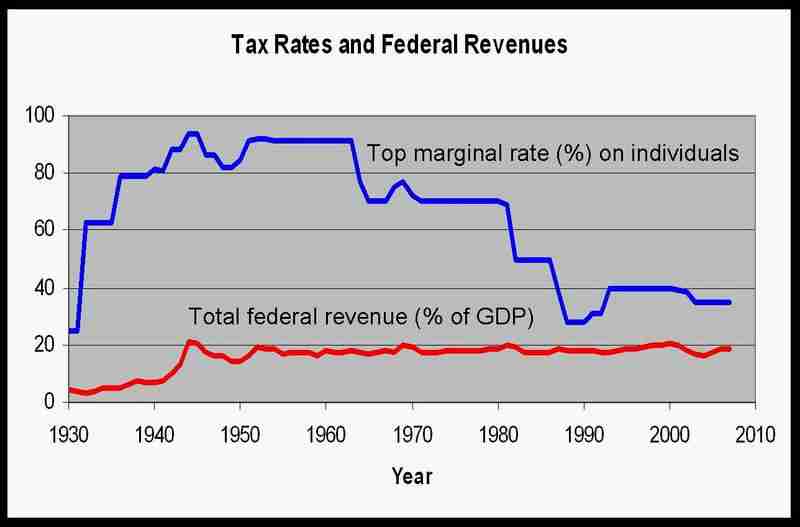
History shows regardless of tax rates, the government averages 18.3% of GDP in revenue.
GDP down = tax receipts down.

If I were the kind of moron who tried to use simplistic graphics without proper context to make points, I'd just say this:
97-02 had higher tax rates and much higher revenues than 88-92. Looks like higher tax rates win. kthxbai.
But if I had half a brain, I'd just say:
Wow, this graph is worthless because it provides no context. Maybe I won't bother posting this nonsense.
I grabbed that chart just to start the thread with. This one illustrates what I have learned some years ago:
The Remarkably Stable Amount of Federal Revenue as a Percentage of GDP
What did you learn?

"runaway spending" as percentage of GDP is same now as 1977.
What WC's misleading bull hides is that the tax burden has shifted dramatically from corporations and the wealthy to the lower 95%, just like the getting-organized VRWC intended 35 years ago. That's why the greedy, predatory, evermore-destructive and powerful VRWC is so intent on smearing FDR, and on destroying SS/Medicare/Medicaid.

There's not alot of analysis going on @ thinkprogress. It's the Faux news of the moonbat left. No wonder boutons is addicted to them.
The numbers don't support this. The percentage of taxes paid by the top 5% of earners has gone up significantly over the last 25 years. The tax burden has been shifting away from the lower 95%, not to it.
http://www.irs.gov/pub/irs-soi/08in05tr.xls (see last table)
The percentage of the population not owing any income taxes has also increased significantly over the last few decades. In the 70's & 80's that percentage was down in the low-20%'s, high teens. Now we're in the high-40%'s.
Last edited by coyotes_geek; 06-29-2011 at 01:01 PM.

It's only natural for businesses to seek strategic advantages, and for the hyper-rich to invest in the businesses that succeed. Even before NAFTA (and certainly after), the trend was already to farm out labor and manufacturing -- it's how me and my old man made our money.
Jobs leave, the % of people not contributing to the tax kitty rises, the tax burden on the rich increases, making them feel persecuted so they continue to invest in businesses that succeed, look for tax shelters, and lobby to diminish taxes. More jobs leave but the tax cuts go through so while the well-to-do are paying more in taxes, it is because they are earning so much more. Still not enough to stave off a deficit (even ignoring our adventurist wars).
More jobs leave, more insufficient taxation of the wealthy follows (in the sense that it doesn't cover the budget because unemployment is so high), more debt ac ulates... rinse, repeat, merrily down the drain.
I know this is an awfully simplistic depiction of the cycle, and I certainly don't blame people for wanting to make money, but it ultimately confirms my su ion that humans are destined for ruin when only a miniscule percentage of the ultra-wealthy are willing to invest in their own country (even if the returns are markedly lower) because they don't have the imagination to see the end-game of their choices.
I wish I could tell these short-sighted investors how much they will hate living in a failed state once the middle class actually does collapse, at which point they can choose between living in a paranoiac siege state in their home countries, or moving to Europe as exiles and losing the sense of home. Either option sucks.
How's that for a post-wet-lunch ramble?
Not bad.
I'd like to thank my speech writers, Messrs Schweppes, Walker, and Rocks.
Messr Walker is a good friend of mine.
Theyve written many a speech for me as well. Most of em were disasters.
I understand the revenue argument. What I'm not getting is the spending argument.
In lay terms explain how you conclude that there isn't also a spending problem.
There are currently 1 users browsing this thread. (0 members and 1 guests)
 Posting Permissions