


 Reply With Quote
Well, it is bull . The government shouldn't be in the business of supporting any business.

I just don't believe government has any business risking tax dollars on business.
Well, it is bull . The government shouldn't be in the business of supporting any business.

The long term economics of this play very well if the price of coal goes up, as it is very likely to do.
Given that China is building something on the order of two coal powered power plants per week, and that looks to continue for the next decade. Further, that rate is fairly likely to increase, as China is STILL experiencing brown-outs, indicating that supply is falling behind demand.
The ultimate impact of the additional Chinese demand on coal can be seen in the fact that even with slowdowns in the west, we haven't seen much slide in prices since 2008, quite the opposite.
I dunno. Oddly enough the ultimate profitability of the plant depends on how badly the real estate bubble that I think is forming in China hits that country, if at all. If it knocks their economy on its ass, you would see the price of coal, and therefor the price of electricity in the US fall, eroding or erasing entirely the benefits of a plant that does not rely on this fuel. Electricity is a bit more complex than this, with the current gas boom, but still, this can be used as a rough tool for thinking about the economic viability of the project over the longer term.
Fair enough. I believe it does.
Every other country on the planet subsidizes R & D. Even if they didn't, I would still be in favor of the largest financial en y in the US shouldering the burden when it comes to grand projects that ultimately benefit us all.
I am willing to take in on the chin on occasion, as the innovation that we are so good at will inevitably produce game-changing revolutionary technologies.
Personally I don't fully trust that CEO's, who admit that they are forced by their boards to think woefully short-term, would have the appe e to really fund something truly worthwhile on a large scale.
This is why the saw "if it were worthwhile, the private sector would do it" doesn't work. The people running the companies you are saying would underwrite, fully admit this is one of the limitations of our free-market system.
Sorry you are unable to see that.
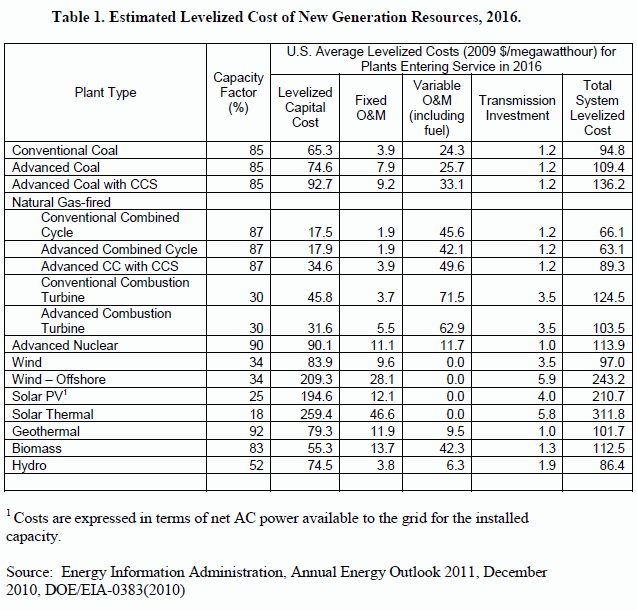
http://en.wikipedia.org/wiki/Levelized_energy_costLevelised energy cost (LEC, also commonly abbreviated as LCOE) is the price at which electricity must be generated from a specific source to break even. It is an economic assessment of the cost of the energy-generating system including all the costs over its lifetime: initial investment, operations and maintenance, cost of fuel, cost of capital, and is very useful in calculating the costs of generation from different sources.[citation needed]
It can be defined in a single formula as:[10]
The entry does have some graphs as well showing the costs of various.
FWIW solar thermal is the most expensive. It is unknown whether this project is included in that, I doubt it though, as the graph notes 2016 as the target date, and this project will be up and running in 2013 or so. Most other solar thermal technologies suffer from some marked inefficiencies.
I will do some poking around the financials to see if I can get an equivalent figure for the project. I have been mulling over putting in a resume to the company anyways, so it will be interesting to see under the hood.
Interesting, that is essentially an NPV calculation. Putting together a spreadsheet now to get the levelized cost.

[QUOTE=RandomGuy;5432781]Essentially what you have here is the US government is backstopping the loans, making the cost of capital a bit cheaper than it would have been otherwise.[/URL]
I wonder what we find if we see who donated to who...
None... at least when we are in such a financial bind, then we can consider it. Again, if this is a worthwhile endeavor, capital venturists will finance it without loan guarantees.
How about we balance the budget first.
If you like gambling, then do it with your money.
Math fail.
Loan gaurantees cost exactly zero dollars on any budget, unless it goes belly up. The entire cost of construction is private sector, if you were to read the project description.
Last edited by RandomGuy; 10-08-2011 at 07:21 PM.
Of course, that never happens.
[QUOTE=RandomGuy;5432868]So you seriously see this turning a profit?
It is gambling, and a poor bet.
LEC of project:
Assuming a 30 year life span:
$125/Mwh
40 year life span (most probable)
$116/Mwh
50 year life span (a good possibility, given the simplicity of systems involved)
$111
LEC of current conventional, dirty coal
$94
LEC of advanced clean coal:
$109
LEC of advanced nuclear:
$111
LEC wind:
$94
LEC gas:
Kinda hard to tell from chart. $66-$134
Overall cost of this plant at about $800M, seems to be pretty compe ive.
(note assumes that the estimated cost $700-$800M comes out closer to $800M, and a cost of capital of 6%)
(edit)
LEC of project, assuming 10% cost of capital, 40 year life span:
$164/Mwh
This is probably more realistic than 6% after looking it over. My best guess.
Last edited by RandomGuy; 10-08-2011 at 07:24 PM.
Sorry, you seriously lack the background to be able to evaluate that to any degree that I would be comfortable with.
This is the internet, and you are en led to your opinion though.
We will get to see, won't we?
Last edited by RandomGuy; 10-08-2011 at 07:15 PM.
If Eternally Dirty Coal were forced to pay for all of its externalities (instead of taxpayers), renewable sources would be very compe ive.
And, you lack the skills to fix broken code in a post.
It doesn't matter if we're able to evaluate the risk; given the record of the administration passing out the money, it's a bad risk today. They told us Solyndra was the company of the future.
They currently are fairly compe ive now.
Given what is likely to happen with coal/gas, they will be very compe ive.
Here is the chart that I was drawing data from, BTW:
LOL Code smack. That's what you are going with? Seriously?
Gawd your is weak.
I might buy that if Solyndra represented 100% of the governments investments in energy.
Since it doesn't, and you are too lazy or dishonest to give me a success rate or ROI, pardon me for not buying your bull .
You do realize the "broken code" came from WC's posts right?
You gonna take that from this joker, WC?
It is the internet.
No weaker than yours.
I didn't overlook this comment either.
The Obama administration has engaged in a deliberate attempt to kill the coal and petroleum industries for just that reason; to make alternative, highly speculative, fuel sources more attractive.
Not a very smart move, IMO; what with 9.1% unemployment and an economy in shambles. He's trying to shove the whole pie in our mouths. It's not going to fit.
I think you're broken.
You show a chart with Solar thermal being the most expensive, and claim it's compe ive... What gives?
(sighs)
Not really. Go back and re-read, I'm not going to explain it again.

Good !
The government absolutely should push solar considering Yoni has no problems with our military protecting the oil resources for our nation in the middle east.
There'd be no need for that if we hadn't re ed our own oil industry over the past few decades.
One would expect experimental tech and test bed projects to be more expensive than proven, older technologies.
Just as one can expect that as the newer technologies develop and mature, their costs will come down, as has been the case with every single thing that human beings have ever produced, and has been the case with wind, as we have gotten into efficiencies of scale, and the people involved have moved down the learning curve.
This project's LEC at roughly $164 is about what one would expect from such a technology.
The next plant will be cheaper, and the next after that, cheaper still. The US southwest is a very big place, so I don't imagine there will be a derth of sites.
Coal will get more expensive, and this technology will get cheaper. It doesn't take a genius to figure out where that ends up.
There are currently 1 users browsing this thread. (0 members and 1 guests)
 Posting Permissions

