

 Reply With Quote
This is why i don't necessarily agree COMPLETELY with paying off ALL debts. I'm currently in the process of refinancing my house at 3.5% and have no intention of paying it off early.

There Are Only 2 Ways to Save the Economy: Innovation or Inflation
[email protected] (Michael Mandel), On Tuesday October 25, 2011, 1:10 pm EDT
It all comes down to this: We have to match growth to debt. If we can't create miracles from growth, we have to consider inflation to reduce the value of our debt
REUTERS
We have only two ways out of our current global economic mess: innovation and inflation. And as the saying goes, we should hope for the best (more innovation) and prepare for the worst (higher inflation).
Looking across the world, the underlying problem is that borrowers--households and governments--have taken on debt that they can't afford to pay back, given the current rate of income and economic growth. In the U.S, too many homeowners are struggling with mortgages that far exceed the value of their homes and cannot be repaid from their current incomes. In Europe, Greece and perhaps other countries have issued bonds that they cannot pay back unless growth unexpectedly skyrockets.
Down the road the same principle of matching growth to debt allows us to perceive potential financial crises to come. Young male college graduates, for example, have seen their real earnings plunge by 19% since 2000, with young female college grads experiencing a similar decline. Meanwhile education borrowing has soared, suggesting that we are on the verge of a student loan crisis, where young grads simply cannot pay back their mountain of debt.
It's not easy to explain why lenders overestimated the ability of debtors to pay. Or, rather, there are too many explanations. Some believe that complicated financial instruments obscured the true amount of debt, as in the case of the U.S. financial crisis. Others think that greedy financiers expected to be bailed out, or worse, simply didn't care. In Greece, the official numbers understated the budget deficits for many years.
An alternative class of explanations points to excess optimism about future growth as the main culprit. In the case of student loans, the conventional wisdom is that education is always a good investment, suggesting to both students and lenders that borrowing for college is always a good idea. In the case of housing, many economists subscribed to the belief that national home prices never go down.
To be truly effective, reinflation would have to be followed by all of the world's major central banks
Another piece of the puzzle is the unexpected innovation shortfall of recent years, which I, Tyler Cowen, and others have do ented. This shortfall, particularly in biosciences, has led to a slowing of growth in the developed countries. What's more, the true extent of the growth slowdown has been masked by flaws in the economic statistics.
But no matter which explanation you favor, the essential mismatch between growth and debt has only two possible solutions: Increase the growth rate or reduce the debt. For a country like the U.S., increasing the growth rate requires innovation, and innovation requires a devotion to investment: Investment in physical capital, investment in human capital, investment in knowledge capital. That increased investment, in turn, should result in higher rates of productivity growth and increased innovation.
In other words, we have to shift from a consumer economy to a production economy. This is partly about a change in spending patterns, but also about a change in at ude. For example, we need to boost R&D and other investment in knowledge capital, but we also need federal regulatory agencies to encourage rather than discourage innovation. We need more infrastructure spending and other investment in physical capital, but it should be directed towards supporting exports and production in the U.S., rather than clearing up bottlenecks of imported consumer goods. This profound shift in policy and behavior is essential over the long run, but it won't be easy or quick.
IF NOT MORE GROWTH, LESS DEBT
The alternative to increasing growth is reducing the outstanding debt. In theory governments can organize a orderly write-down for unpayable debt, getting lenders to accept a deal that acknowledges reality.
In practice, however, an orderly write-down is not so easy to organize in today's multi-layered financial system. Much of Greek debt, for example, is held by European banks, but those banks in turn fund themselves by borrowing abroad. Given that both the U.S. and the European Union are net borrowers, it's clear that the ultimate source of funds is likely to be the big creditor nations such as China and Saudi Arabia. It's difficult to see China--still a poor country--accepting a write-down in the value of its loans to richer countries.
That leaves inflation as an undesirable but feasible mechanism for reducing the burden of debt. By inflation I mean a sustained increase in both wages and prices. For example, an inflation rate of 4% would raise the nominal level of wages by 50% over ten years, making debt much less onerous.
Ben Bernanke addressed exactly this point in a 2000 paper, where he suggested that the Bank of Japan could have targeted an inflation rate of 3-4% to combat the Japanese stagnation of the 1990s. Just this week, Chicago Fed President Charles Evans suggested that the Federal Reserve should target 3% inflation.
The Federal Reserve has the authority to execute such a policy, although it would have a lot of critics. One way is for the Fed simply announce that it will keep rates near-zero until inflation expectations are above 3%. Another way is to target some level of nominal gross domestic product that rises over time. In either case, the expected results would be a reduction in the real value of dollar-denominated debts, a rise in long-term interest rates, and most likely a depreciation of the dollar.
However, to be truly effective, this policy of reinflation would have to be followed by all of the major central banks around the world. Such a synchronized monetary policy would not eliminate the debt overhang right away, but over time would have the effect of balancing the scales between borrowers and lenders.
In adopting a reflationary policy, central banks would have to be very wary of letting inflation get out of control. It's all too easy to keep pumping money into the economy, eventually leading to hyperinflation and a general loss of faith in the financial system. Investors can lose faith and be unwilling to lend.
There's no doubt that innovation is a far superior solution to our problems than inflation. Innovation creates new wealth, raises the living standard of future generations, and potentially solves some of the real problems of our time. Inflation creates no new wealth, but merely pares down the mountain of debt to reasonable levels. However, inflation is something we know how to achieve, while using public and private investment to deliver innovation is a complicated process.
We want innovation, we need innovation. But if we can't have innovation, we may have to accept inflation as the less-desirable but feasible way out.
This is why i don't necessarily agree COMPLETELY with paying off ALL debts. I'm currently in the process of refinancing my house at 3.5% and have no intention of paying it off early.

All they need to do is manage the debt, not necessarily pay it off, I agree. Look at every successful corporation in this country, they always have liabilities, but they're manageable and aren't ballooning like the deficit is.

heh, The majority of my student loans are at 2.7%. I am in no hurry to pay that down either.
It does make for fun when the jackasses that want me to bundle my student loans call. I ask them if they can offer a lower interest rate, and they realize that they can't, then end the call in short order. Been a while since I have gotten one of those calls.

whoa random cuckold, i was always under the impression that you were like 40 years old. student loans?
"Managing the debt" still requires getting to a balanced budget IMHO, something we're nowhere close to achieving.
Started college in 1996, finishing the final stages of a grad degree. I am 41.
son what took you so long to get the degree? lemme guess, you got the CPA and never really felt the need for the masters and eventually just got it for fun?
"We have only two ways out of our current global economic mess: innovation and inflation"
dishonest, misleading framing, incomplete options.
Finished liberal arts degree a decade ago, then got into a grad degree for the money.
Full time job = 1 or 2 courses per semester = slow progress. Add getting sick of school and taking a year or two break... (hence the need to start paying loans)
No hurry. My 20-40 year plan is still on track.
incomplete to be sure. You got there before I did.
Oddly enough, a bursting Chinese property/debt bubble will give a substantial break in the price of oil.
The recent sustained high prices have driven a LOT of investment in production capacity. If Chinese demand slacks that will be a pretty impressive drop in global demand.
Such a thing would not necessarily be bad for the US, given our energy profile.
"a bursting Chinese property/debt bubble will give a substantial break in the price of oil."
false. Wall St speculators determine the price of oil, not supply/demand.

supply and demand determines the price projection, Wall st. speculators magnify it.
Much better.
When it happens expect the price of gold to finally revert to historic norms too.
I can't wait... hehehehehehe.
.
.
.
.
.
.
.
.
.
.
.
.
.
.
<********>
.....<***>.....
.......<>.........
.......<>........
.......<>........
---------------
an oil exec before Congress said speculators add a 40% premium over the supply/demand price
So what you are saying is that speculators are magnifying the price?
Oh Ok, Thank you for your input.
I'm saying the supposed drop in oil price due to China dropping demand won't budge the oil price that much. The speculators know the range where they can keep the price, and they will keep it there.
you're ing welcome
Last edited by boutons_deux; 10-26-2011 at 02:13 PM.
Funny, since in 2008 right before everything started unraveling and demand was still high, the speculators magnified that price action to the tune of $140. However as soon as it was clear that we were heading into a global recession and therefore demand was dropping, oil started to drop.... down to 36 dollars in 2009. Sooooooo, I am guessing the range of which you speak that speculators know is between $36 and $140. Right? I am ok with that range.
boutons likes to convienently ignore the effect speculators have on oil prices when prices are going down........
how long was the price at $36, was it there for a signficant time, and did anybody feel that at the gas pump?
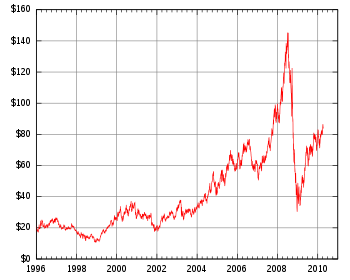
Why aren't you asking "how long was the price at $140 . . .?" Do you have a bias. I gave a low and a high, it was at neither point for very long which is why I said the range was defined as between 36 and 140. Oh and YES we all felt it at the gas pump. Gas was almost $4, then dropped to something like $1.75 or so. You are being as bad as WC, Darrin, or Yoni.
Open your mind, Quaid
so that graph of extremely erratic price swings (but sticky high) represents erratic supply and demand?
in 2008, that peak was when the US was well into the official recession, so demand was down, but the price went nuts high?
It was absolutely into the official recession, but no one really knew it at the time, no one had adjusted their lifestyle yet, as far as we knew at the time it could have been a bump in the road. Also, sticky high??? Um, the high is a point that went down immediately. The low is also a point, but the price stayed just above it for a little while.
the price is certainly stuck in the $80+ range for 2+ years
Yeah, Funny thing about that. If speculators determined the price, then you would think that in 2 years, they might have wanted to make some money. It's almost like some other force is determining the price movement. Liiiiiiiiike oh, like demand.
Wait, I've got it. Demand determines the price action of oil and speculators magnify it.
There are currently 1 users browsing this thread. (0 members and 1 guests)
 Posting Permissions

