Reply With Quote
damn,b. I haven't heard from the beatnuts since 'watch out now'. they still making music?

damn,b. I haven't heard from the beatnuts since 'watch out now'. they still making music?
lol no idea
Interesting vid on Moors
Another interesting vid on the Moors
thanks for the vid
He had just gotten paid & had bought himself a new car so he was speeding down the highway when the police pulled him over and gave him a ticket. He asked the police how much the ticket was and was told $50.00, Jack gave the police $100 and said you might as well take this cuz i'm coming back the same way going the same speed.
Jack Johnson Arthur John (Jack) Johnson (1878 -1946) was the first black, and first Texan, to win the heavyweight boxing championship of the world.
Born in Galveston on March 31, 1878, he was the second of six children of Henry and Tiny Johnson. Henry was a former slave and his family was poor. After leaving school in the fifth grade, Johnson worked odd jobs around South Texas. He started boxing as a sparring partner and fought in the "battles royal," matches in which young blacks entertained white spectators who threw money to the winner.
Johnson turned professional in 1897 following a period with private clubs in Galveston. His family's home was destroyed by the great hurricane of 1900. A year later he was arrested and jailed because boxing was a criminal profession in Texas. He soon left Galveston for good.
Johnson first became the heavyweight champion of Negro boxing. Jim Jeffries, the white champ at the time, refused to fight Johnson because he was black. Then, in 1908, Johnson knocked out Tommy Burns in Australia to become world champion, although he was not officially given the le until 1910 when he finally fought and beat Jeffries in Reno. Jeffries had come out of retirement to become the first of many so-called "great white hopes."
Race rioting was sparked after the Johnson-Jeffries fight. The Texas Legislature banned films of his victories over whites for fear of more riots. In 1913, Johnson fled because of trumped up charges of violating the Mann Act's stipulations against transporting white women across state lines for pros ution.
During his exile from the U.S., Johnson lost his championship to a white man, Jess Willard, in Cuba in 1915. He returned to the U.S. on July 20, 1920 and was arrested. Sentenced to Leavenworth in Kansas, Johnson was appointed athletic director of the prison. Upon his release, he returned to boxing, but only participated in exhibition fights after 1928.
Although married three times to white women, Johnson never had children. He died in a car crash June 10, 1946, near Raleigh, North Carolina.
Bibliography: Wendy Brabner, Ed., Texas Monthly Texas Characters Datebook 1985 (Austin, Texas: Texas Monthly Press, 1984). Ron Tyler, ed., The New Handbook of Texas, Vol. 3 (Austin, Texas: Texas State Historical Association, 1996) pp. 955-56.
Benjamin Carson was born in Detroit, Michigan. His mother Sonya had dropped out of school in the third grade, and married when she was only 13. When Benjamin Carson was only eight, his parents divorced, and Mrs. Carson was left to raise Benjamin and his older brother Curtis on her own. She worked at two, sometimes three, jobs at a time to provide for her boys. Benjamin and his brother fell farther and farther behind in school. In fifth grade, Carson was at the bottom of his class. His classmates called him "dummy" and he developed a violent, uncontrollable temper.
When Mrs. Carson saw Benjamin's failing grades, she determined to turn her sons' lives around. She sharply limited the boys' television watching and refused to let them outside to play until they had finished their homework each day. She required them to read two library books a week and to give her written reports on their reading even though, with her own poor education, she could barely read what they had written. Within a few weeks, Carson astonished his classmates by identifying rock samples his teacher had brought to class. He recognized them from one of the books he had read. "It was at that moment that I realized I wasn't stupid," he recalled later. Carson continued to amaze his classmates with his newfound knowledge and within a year he was at the top of his class.
The hunger for knowledge had taken hold of him, and he began to read voraciously on all subjects. He determined to become a physician, and he learned to control the violent temper that still threatened his future. After graduating with honors from his high school, he attended Yale University, where he earned a degree in Psychology.
From Yale, he went to the Medical School of the University of Michigan, where his interest shifted from psychiatry to neurosurgery. His excellent hand-eye coordination and three-dimensional reasoning skills made him a superior surgeon. After medical school he became a neurosurgery resident at the world-famous Johns Hopkins Hospital in Baltimore. At age 32, he became the hospital's Director of Pediatric Neurosurgery. In 1987, Carson made medical history with an operation to separate a pair of Siamese twins. The Binder twins were born joined at the back of the head. Operations to separate twins joined in this way had always failed, resulting in the death of one or both of the infants. Carson agreed to undertake the operation. A 70-member surgical team, led by Dr. Carson, worked for 22 hours. At the end, the twins were successfully separated and can now survive independently.
Carson's other surgical innovations have included the first intra-uterine procedure to relieve pressure on the brain of a hydrocephalic fetal twin, and a hemispherectomy, in which an infant suffering from uncontrollable seizures has half of its brain removed. This stops the seizures, and the remaining half of the brain actually compensates for the missing hemisphere.
In addition to his medical practice, Dr. Carson is in constant demand as a public speaker, and devotes much of his time to meeting with groups of young people. In 2008, the White House announced that Benjamin Carson would receive the Presidential Medal of Freedom, the nation's highest civilian honor. Dr. Carson's books include a memoir, Gifted Hands, and a motivational book, Think Big. Carson says the letters of "Think Big" stand for the following:
Talent: Our Creator has endowed all of us not just with the ability to sing, dance or throw a ball, but with intellectual talent. Start getting in touch with that part of you that is intellectual and develop that, and think of careers that will allow you to use that.
Honesty: If you lead a clean and honest life, you don't put skeletons in the closet. If you put skeletons in the closet, they definitely will come back just when you don't want to see them and ruin your life. Insight: It comes from people who have already gone where you're trying to go. Learn from their triumphs and their mistakes.
Nice: If you're nice to people, then once they get over the su ion of why you're being nice, they will be nice to you.
Knowledge: It makes you into a more valuable person. The more knowledge you have, the more people need you. It's an interesting phenomenon, but when people need you, they pay you, so you'll be okay in life.
Books: They are the mechanism for obtaining knowledge, as opposed to television.
In-Depth Learning: Learn for the sake of knowledge and understanding, rather than for the sake of impressing people or taking a test.
God: Never get too big for Him.

Beautiful music right there.

Who's the baddest mofo low down around this town?!
Man I used to love this movie as a kid.
lol yea that movie is GOAT. so many quotables.
another classic scene. i-i-i-i want the kniiiifeee...............pleeeeeeease
Good thread. Who are your guys favorite black actors?
I like me some idris elba, denzel, etc. But by far my favorite has to be:


One of the greatest...
Orenthal James "O. J." Simpson (born July 9, 1947), nicknamed "The Juice", is a retired American collegiate and professional football player, football broadcaster, actor, and a currently incarcerated convicted criminal[2].
Originally attaining a public profile in sports as a running back at the collegiate and professional levels, Simpson was the American Football League's Buffalo Bills' first overall pick in the 1969 Common Draft, and the first professional football player to rush for more than 2,000 yards in a season, a mark he set during the 1973 season. While five other players have passed the 2,000 rush yard mark he stands alone as the only player to ever rush for more than 2,000 yards in a 14-game season (professional football changed to a 16-game season in 1978). He also holds the record for the single season yards-per-game average which stands at 143.1 ypg. Simpson was elected to the Pro Football Hall of Fame in 1985. He also had successful careers in acting and sports commentary.
In 1995, Simpson was acquitted of the murder of Nicole Brown Simpson and Ronald Goldman after a lengthy, internationally publicized criminal trial – the People v. Simpson. A 1997 judgment against Simpson for their wrongful deaths was awarded in civil court, and to date he has paid little of the $33.5Luck_The_Fakers_million judgement.[3] His book, If I Did It (2006), which purports to be a first-person fictional account of the murders had he actually committed them, was withdrawn by the publisher just before its release. The book was later released by the Goldman family.[4]
In September 2007, Simpson was arrested in Las Vegas, Nevada, and charged with numerous felonies, including armed robbery and kidnapping.[5] In 2008, he was found guilty[6][2] and sentenced to 33 years imprisonment, with a minimum of 9 years without parole.[7] He is currently serving his sentence at the Lovelock Correctional Center in Lovelock, Nevada
Patricia Bath - (USA) In 1988, Patricia Bath invented the Cataract Laser Probe, a device that painlessly removes cataracts. Prior to this invention, cataracts were surgically removed. Patricia Bath founded the American Ins ute for the Prevention of Blindness.
shame it took this long
1987 - First African-American woman, and first woman, inducted into the Rock & Roll Hall of Fame: Aretha Franklin
A woman and then a black woman had never been inducted into the Rock & Roll Hall of Fame until 1987? This country really isn't as progressive as it likes to think it is.
look familiar?

Woman is working on a "Vengeance" dive bomber Tennessee, February 1943. Reproduction from color slide. Photo by Alfred T. Palmer. Prints and Photographs Division, Library of Congress
There are more pictures here
http://blogs.denverpost.com/captured...939-1943/2363/
and here
http://www.flickr.com/photos/library...7603671370361/
look at this bull

well dayum!

check out gregory hines and his brother

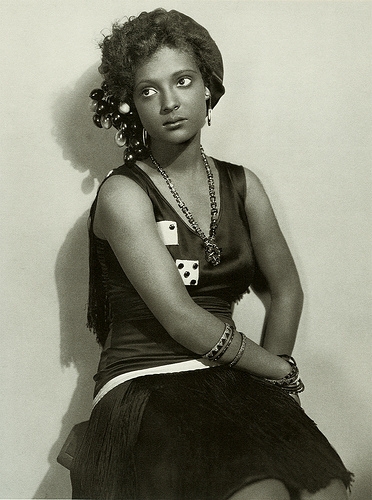
Yo she was finer than frog's hair
Nina Mae McKinney, one of the first African American leading actresses in Hollywood, was born Nannie Mayme McKinney in 1913. The Lancaster, South Carolina native was reared by her great-aunt, Carrie Sanders on the Estate of Colonel LeRoy Sanders, where her family had worked for many generations. She attended Lancaster Industrial School until the age of 13 before relocating to New York to live with her mother, Georgia Crawford McKinney. As an early teen, McKinney performed in Harlem�s nightclubs and eventually on Broadway in the Lew Leslie musical review, Blackbirds of 1928.
Her celebrity began at the age of 16 when director King Vidor, impressed by her vitality in Blackbirds of 1928, hired her to parlay her multi-talented abilities as an actress, dancer, and vocalist in the musical film, Hallelujah (1929). McKinney�s effervescent performance as the seductress, �Chick,� brought her immediate success. Yet despite rave reviews for her vivacious performance and a resulting five-year contract with MGM, McKinney�s career faltered during an era when Hollywood declined to position black actresses in dignified roles.
Determined to break barriers in acting, McKinney immigrated to Europe where she performed in cabarets in Budapest, Dublin, London, and Paris; and appeared in the British films, Congo Road (1930), and Sanders of the River (1935) both opposite Paul Robeson. In between promoting her career abroad, she briefly returned to the states where she appeared in independent films Pie, Pie, Blackbird (1932) and Kentucky Minstrels (1934). Though she had minor roles, she was also involved in other Hollywood films such as Safe in (1931), and Reckless (1935). Her last significant Hollywood role was that of a fierce antagonist in the 1949 film, Pinky.
Throughout her career, McKinney maintained versatility in performing arts. During the last two decades of her life, she appeared in several plays and continued to tour globally. Although her potential as an actress was never established, McKinney carved a path for other black actresses such as Dorothy Dandridge, whose character �Carmen� in the 1954 film, Carmen Jones, was patterned after McKinney�s �Chick.� Nina Mae McKinney died in New York in 1967.

Faulkner sucked.
Last edited by cantthinkofanything; 02-02-2012 at 05:19 PM.
There are currently 1 users browsing this thread. (0 members and 1 guests)
 Posting Permissions