Reply With Quote
And in the background going virtually unnoticed:
http://www.wfaa.com/news/local/AMR-l...138480144.html
13,000 jobs gone. 2000 of them just up the road from me.
Again you have no idea the basis for the reduction in the labor pool. 1/4 of the population will be leaving the labor pool and that exodus only began when the baby boomers started turning 65 in 2011.
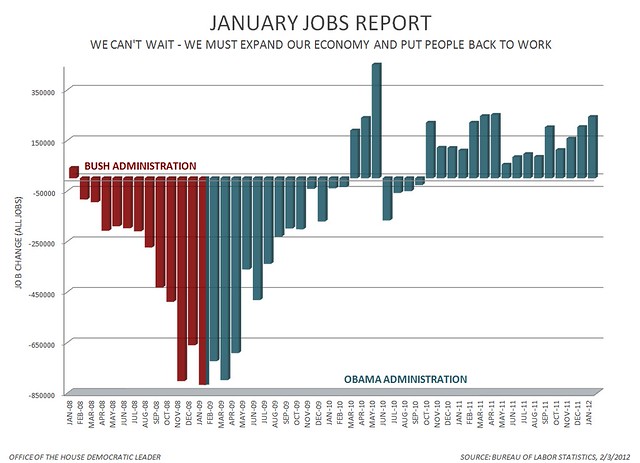
As WH pointed out its not the rate that is important but rather that the total number of jobs increased by over 200k.

And in the background going virtually unnoticed:
http://www.wfaa.com/news/local/AMR-l...138480144.html
13,000 jobs gone. 2000 of them just up the road from me.
things aren't improving. the way the unemployment rate is measured is purposefully misleading.

Denial isn't just a river in Africa anymore....by every measure, observable or not, the US economy is growing...
...and we are doing it without increasing the government payroll (like Dubya's tax cut 'stimulus')
So basically things are back to the way they were when Obama first became president? I guess you could say that's good but it's also bad since it took 3 years to get back to that. If Obama was wonderful and awesome like Bill Maher, Rachel Maddow, and George Clooney think he is, then why is the unemployment basically the same now as it was 3 years ago? If Obama was cool and hip, wouldn't the unemployment rate be lower like 6 or 7 percent?
Wow...

^ ^ and immigrants stand always ahead of natives in the job-awaiting queue
He promised change
It was suppose to be hope and change but it's basically been nope and the same. Why is it that Ron Paul is the only GOP candidate that compares Obama to Bush? Why does the GOP consider that bad strategy?
http://www.economist.com/blogs/freee...as-jobs-report
It certainly feels that way. Before getting into the caveats, let's look at January's solid employment report. Non-farm employment jumped 243,000, or 0.2%, from December, the best in nine months. The unemployment rate fell to 8.3%, a three-year low, from 8.5%.
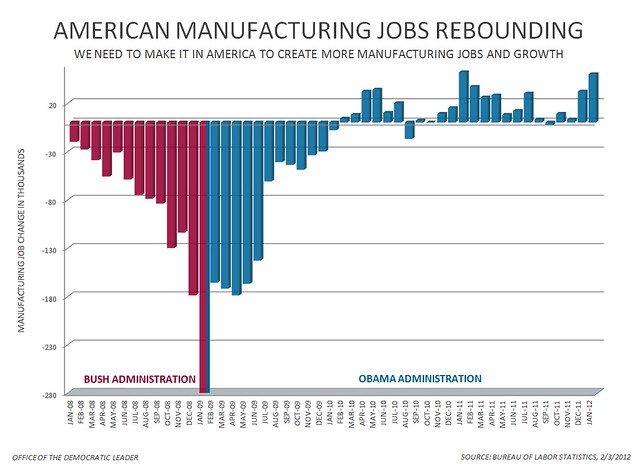
There were no obvious asterisks marring the positive tone of the report. Payroll gains were broad based. Construction rose 21,000, not surrendering any of its mild-weather gains of December. Manufacturing jumped 50,000, corroborating other signs of strength in the industrial sector. Government employment is becoming less of a drag: it fell only 14,000.
Prior declines in the unemployment rate were often the result of people dropping out of the labour force and thus no longer being counted as unemployed. Not this time. In January the number of employed people jumped 631,000, after adjusting for new population estimates. That’s according to the household survey which is used to calculate the unemployment rate, and often produces different results from the bigger and better-known payroll survey.
So the fourth quarter pick-up in growth has not only persisted into the new year, it may be gathering steam. This report is no outlier: other January data, including claims for unemployment insurance, automobile sales, and factory purchasing manager surveys, have been broadly, but not startlingly, positive. Behind the gains are two factors. The first is that at home, pent-up demand is finally being released, with the benefits being felt in particular by producers of durable goods such as cars, and construction. To be sure, the overhang of foreclosed homes and the tightness of mortgage standards militates against sharp gains in home building. But housing starts are currently so far behind the formation of new households that the smallest improvement in affordability and sentiment can't help but boost activity. That’s just what the Federal Reserve has achieved through its no-holds barred attempt to wrestle long-term interest rates (and thus mortgage rates) lower.
The second factor is global trends: emerging-market growth remains decent, boosting demand both for commodities and manufactured products, and the lower dollar has helped American factories both in export markets and against imports. Factory employees worked more overtime and longer hours in January; the total gain in factory hours was the biggest in at least six years, according to Morgan Stanley.
Now, for the caveats. In both 2010 and 2011, a promising early-year upturn in the jobs market was snuffed out by mid-year. Will the same thing happen this time? There are two reasons that could happen: one, unexpected setbacks; two, the underlying strength was never there.
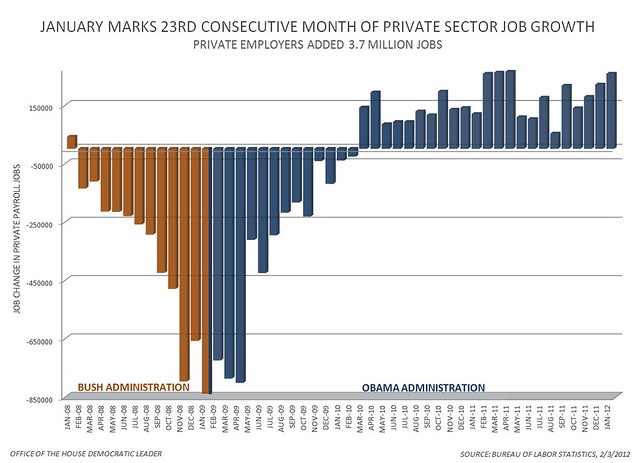
Let's address the second possibility first. The secular forces of deleveraging are a constant threat to post-crisis recoveries and probably helped snuff out previous flickers of animal spirits such as in 2010. I think it's less likely now. There are telltale signs that the data may be underestimating, rather than overestimating, underlying economic strength. Revisions usually track underlying momentum, and lately they have been positive. Job growth in November has been revised up to 157,000 from 120,000. While December’s gain of 203,000 changed little from the first estimate, within the total the statisticians erased an unusual e in package delivery jobs, replacing it with other jobs that will probably last beyond the holiday season. Benchmark revisions have also found that payroll job growth throughout 2011 was a touch stronger than first estimated. Finally, the household survey continues to outrun the payroll survey: it shows jobs up 2.8m in the last 12 months, compared to 1.9m under the payroll survey (after adjusting for new population estimates and for differences in how the two categorise jobs). The payroll survey is larger and more reliable, so do not assume the household survey is a better picture of reality. But a gap of this size ought to close and it could come from better payroll job growth rather than weaker household employment.
Now, the first risk. Last year's recovery was derailed by shocks: a e in oil prices, the earthquake and tsunami in Japan, and the re-eruption of Europe’s sovereign-debt crisis. There's no way to predict what bad luck may befall us this year: war with Iran? Another natural disaster? But at least in the case of Europe, the worst-case scenarios have been averted for now.
Will the better tone to the jobs market deter the Federal Reserve from further monetary easing? Not yet. Ben Bernanke, the Federal Reserve chairman, acknowledged the moderately better tone to economic data yesterday, but the last official Fed statement and press conference strongly suggested the Fed is inclined to do more quan ative easing; we’d have to get more, and better, reports like this one to take that option off the table.
The news is obviously good for Barack Obama. It's not good enough to turn the economy into an asset for his re-election efforts. However, if this performance continues, the economy will be less of a liability. The parallel is 2004 when George Bush entered the year hobbled by stagnant job growth. The economy turned around just in time, and by just enough, to cease being a millstone and enabled him to talk about something else, in his case national security. If the subject changes, what will it change to? I don't know, but the big surprise of 2012 may be how little we talk about the economy in the run-up to November.
Last edited by FuzzyLumpkins; 02-04-2012 at 07:45 AM.
Things were going to (mortgage/Wall St) well before Obama even won office.
You're a typical slanderer trashing Obama for the Jobs Depression that was set off by the Repug/Fed policies for the previous 8 years and whose momemtum is still going. Meanwhile the Repugs have blocked/knee-capped every attempt at job stimulation while proposing none of their own.

The most significant reason that the economy has taken this long to begin showing improvement is that the Fed was out of 'magic bullets' by the time Obama took office. Every time there had been a significant downturn in the economy since the days of GHW Bush, the Fed had been asked to, and had in fact, lowered the price of borrowing. They did it repeatedly during the GW Bush years, even to the point where it was almost impossible to do it anymore.
Easy money and repeated tax cuts kept the economy going through a series of bubbles during the 10 years preceding the debacle of 2007-2008.
The financial crisis that created the 'great recession' was so deep that it would take a long time to get over, unless there was greater monetary stimulus. There was no capacity for that greater stimulus, however, because the Fed had already taken the Prime rate close to zero.
So in the face of the worst recession since the great depression, the Fed couldn't lower rates except by a small amount, to virtually zero, in order to try to get the economy moving again.
Many people (including me) were fearful of huge inflationary pressure following that kind of money policy. The fact that inflation hasn't been run-away is a function of just how deep the recession hit.
Personally, I am satisfied with the pace of economic growth, because, although it is painful, it is the only way to avoid another bubble.
Obama's housing policy has been close to a total failure, imo, but his overall economic policies show a slow and steady hand.
"has been close to a total failure"
the mortgage lenders' fraud and theft has been close to a complete success, as has been their resistance to any and all attempts to lessen the mortage crisis they caused.

It's a virtual guarantee that enough people will "quit looking for work" to get the unemployment "number" below 8% before the election. Smoke and mirrors.

^The insatiable American need for instant fixes in a nuts .

This is funny in a sad way. It would be advantageous for republicans to push for extended unemployment benefits until Nov '12, and for democrats to fight against it. Once a person is off unemployment, why should they respond to saying they are unemployed if polled, but they are automatically counted as unemployed while collecting benefits.
LMAO
in this ed up political environment neither side will ever vote for ending the perpetual unemployment extensions...
And again, the Fox News puppet speaks. The Economist disagrees with your assertion and they are a British publication so no horse about it being 'liberal.'
Fox News puppet...
God, you are SUCH a head.
And yes, the Economist is a good source and I have been reading them for 20+ years but they aren't infallible and also like to present contrasting viewpoints. The fact that you want to pick and choose articles and then declare it "FACT" because it was in the Economist just proves again what an intellectual midget you are.
Jobs Deficit Still More Important Than Budget Deficit
But the U.S. labor market is far from healthy. America's job deficit is still mammoth. Our working-age population has grown by nearly 10 million since the recession officially began in December 2007 but many of these people never entered the workforce. Millions of others are still too discouraged to look for work.
The most direct way of measuring the jobs deficit is to look at the share of the working-age population in jobs. Before the recession, 63.3 percent of working-age Americans had jobs. That employment-to-population ratio reached a low last summer of 58.2 percent. Now it's 58.5 percent. That's better than it was, but not by much. The trend line here isn't quite as encouraging.
Given how many people have lost their jobs and how much larger the total working-age population is now, we've got a long road ahead. At January's rate of job gains - 243,000 - the nation wouldn't return to full employment for another seven years.
When they're not blaming Obama for a bad economy, Republicans are decrying the federal budget deficit and demanding more cuts. But America's jobs deficit continues to be a much larger problem than the budget deficit.
http://readersupportednews.org/opini...budget-deficit
The Repugs, esp at state level, will do everything possible to fire state and county govt employees to make the pain as deep as possible for Nov 2012.
As opposed to what? Assertions by the group think squad and their random blog? All i ever see you do is spout the GOP groupthink.
All I see YOU do is act like an asshole. Grow the up. Get a ing original thought for a change.

Nice info. The January numbers are great, but we still have a long way to go. Barring any seismic events I believe we will get there. I disagree with your last point. I don't believe Republicans are firing state employees to keep the unemployment rate higher for the 2012 election. I do believe some are doing it to cover for foolish tax cuts a la Scott Walker in Wisconsin. Others have had to cut for legitimate reasons as well. Luckily, the government layoffs have not had to large an effect on the numbers. I think government lost around 200,000 jobs last year.
There are currently 1 users browsing this thread. (0 members and 1 guests)
 Posting Permissions