Reply With Quote
Here ya go RG...the thread where you started to foot out some of the potential gains:
http://www.spurstalk.com/forums/showthread.php?t=192011

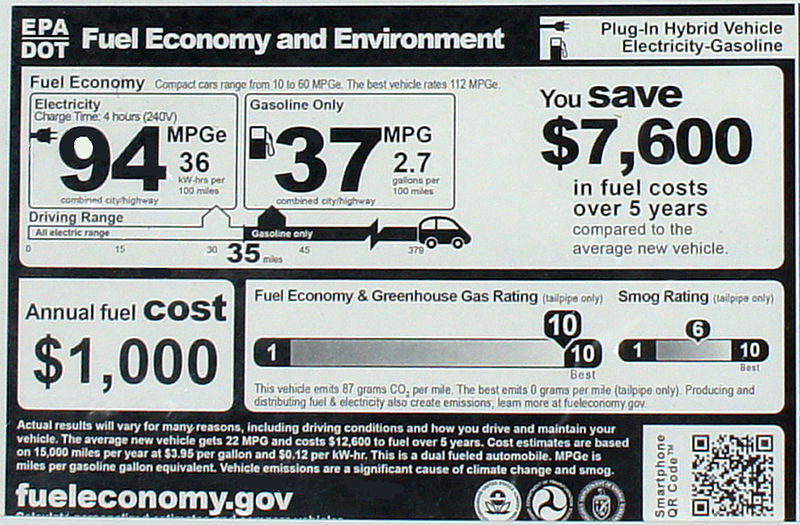
The main thing hurting the Volt is that people don't want to buy it.
For 10K less, you can get a Chevy Malibu that gets around 33 mpg and is probably a much better vehicle.

Here ya go RG...the thread where you started to foot out some of the potential gains:
http://www.spurstalk.com/forums/showthread.php?t=192011
If you can get the costs down (which can be done) and increase the range close to a conventional combustion engine (which looks promising from my previous post), then people will buy 'em....a gazillion of 'em.

Can't speak to the quality of the car, but it is a rolling contradiction -- a zero-emmissions car for environmentalists that runs on coal-fed electricity. It may have charmed some soft-minded celebrities in Hollywood who think electricity comes from magic reactors in Rainbow City, but most people who are willing to be early-adopters for green transportation probably aren't that easily charmed.
Until solar cells and batteries become exponentially better, this car will continue to be a curiosity, and you can be sure petrochem corporations will try and keep any tech that would put them out of business out of the market until they figure out a way to make said tech replace the profit streams they would lose in the transition away from fossil fuel.
I agree. Most people that would be in the market for this type of vehicle are mostly interested in reducing their pain at the pump -- not trying to reduce their "carbon footprint" guilt. Those people aren't looking for 30K-40K vehicles.
But it's not just a GM thing.
Number of electric Ford Focii sold in Feb and March -- zero.
http://www.detroitnews.com/article/2...text|FRONTPAGE

Thanks.
http://www.spurstalk.com/forums/showthread.php?t=192011
They have gotten expoentially better. 2^2 better in the last few years in terms of cost per unit of energy.
This will continue as developed tech hits actual production lines, and efficiencies of scale with learning curves kick in to make it cheaper as we go along.
The economics are changing.
A good PV system on your garage to act as a charging station will go a long way towards obviating the need for power plants.
If you think about how much you spend on gas over ten years, and add that to the cost of the gas powered cars, adding a PV "fueling" system or an electric car makes sense.
BigCoal and BigOil will do everything to hinder movement to solar and wind electricity. It will be subtle, secret, but the hindrance will be there.
eg, why isn't TX doing time-of-day metering and feed-in tariffs like other states and countries? My bet is coal and oil keep those options invisible in TX.
Hmm...
(edit)
Strike that, you need 24 KwH per day. Big difference.
28 traveling days per month (commuting, weekend errands etc) ... 12 months...
You would need 8064 KwH yearly output to provide the energy.
I have a real-world quote of a system with a 34,000 KwH output with a total installed cost of roughly $38,000 after all is said and done.
8064 kwH yearly capacity, based on $1.11 per KwH means I could sink about...
$10K into a system that provides enough power to move me and my car around, with some to spare.
My yearly usage of gasoline is roughly $2000 based on the calculations in the previous thread.. (1500 miles, 3.8 dollars per gallon, 30 mpg)
Payback on this scheme would be about 5 years. Then it would be some serious gravy.
Get a smaller car, require less of a PV system, or sell power back to grid.
Last edited by RandomGuy; 04-17-2012 at 04:50 PM.
The return on such an investment, i.e. avoided gasoline costs, would be essentially indexed to the price of gasoline, so it would rise with, or faster than, inflation.
I don't see oil getting cheaper, given the rise in demand from China/India.
Let Iran close the straights of Hormuz... I make my own transportation energy.
They're doing time of day metering in my community.

Sure, but your consumable providers don't at the moment.
Either way, pretty badass.

Number of Focii available in the retail market during that time: zero.
The Dearborn automaker plans a slow ramp-up as it begins production this spring for retail sales; the New York area and California are the first markets.

Chevy Volt:
Tesla motors Roadster:

Darrin gets pwned, saying something stupid.
SOSDD.
not sure of the point here unless you are saying that the car that costs 150% more than the other car performs slightly better.
Volt-Hybrid
Tesla-Pure Electric.
Apples vs Parachutes. :facepalm
Meh,
Ford Motor Co. sold about 12 Focus Electrics in December and January to fleet customers — and none in February and March
The Roadster has a base price of US$109,000 in the United Stateshttp://en.wikipedia.org/wiki/Tesla_RoadsterAccording to the U.S. EPA, the Roadster can travel 244 miles (393 km) on a single charge[12] of its lithium-ion battery pack, and can accelerate from 0 to 60 mph (0 to 97 km/h) in 3.7 or 3.9 seconds depending on the model. The Roadster's efficiency, as of September 2008[update], was reported as 120 mpgge (2.0 L/100 km). It uses 135 Wh/km (21.7 kW·h/100 mi, 13.5 kW·h/100 km or 490 kJ/km) battery-to-wheel, and has an efficiency of 88% on average.[13]
mmmmm... more data. I can use this to test my previous calculations.
Given the range, I would guess that a great deal of the Roadsters' price and weight is batteries.
Shaving 1/2 from the price of the batteries per unit of energy, and a good percentage of weight would make the car a good deal cheaper. You would need fewer batteries, because you would not be moving as much mass. Synergy at work.

Aptera anyone? 200mpg.
http://auto.howstuffworks.com/aptera-hybrid.htm

That sucks!
I saw a few as originally Apteras were built here in SD.
Seemed like a solid, honest org.
No wonder they failed.
1 John 5:19
Do you remember what they were saying the MSRP would be?
There are currently 1 users browsing this thread. (0 members and 1 guests)
 Posting Permissions