
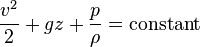
 is the fluid flow
  is the
  is the
  is the
  is the
  where Ψ is the
  , equation (
 or:
or: where:
 is
is 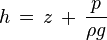 is the
  is the
  The above equations suggest there is a flow speed at which pressure is zero, and at even higher speeds the pressure is negative. Most often, gases and liquids are not capable of negative absolute pressure, or even zero pressure, so clearly Bernoulli's equation ceases to be valid before zero pressure is reached. In liquids – when the pressure becomes too low –
  where p0 is called 'total pressure', and q is '
 which is a Bernoulli equation valid also for unsteady—or time dependent—flows. Here ∂φ/∂t denotes the
  Note that the relation of the potential to the flow velocity is unaffected by this transformation: ∇Φ = ∇φ.
 Reply With Quote
Compressible flow equation
Bernoulli developed his principle from his observations on liquids, and his equation is applicable only to incompressible fluids, and compressible fluids up to approximately Mach number 0.3.[16] It is possible to use the fundamental principles of physics to develop similar equations applicable to compressible fluids. There are numerous equations, each tailored for a particular application, but all are analogous to Bernoulli's equation and all rely on nothing more than the fundamental principles of physics such as Newton's laws of motion or the first law of thermodynamics.
[edit] Compressible flow in fluid dynamics
For a compressible fluid, with a barotropic equation of state, and under the action of conservative forces,
[17] (constant along a streamline)where:
p is the pressureρ is the densityv is the flow speedΨ is the potential associated with the conservative force field, often the gravitational potentialIn engineering situations, elevations are generally small compared to the size of the Earth, and the time scales of fluid flow are small enough to consider the equation of state as adiabatic. In this case, the above equation becomes
[18] (constant along a streamline)where, in addition to the terms listed above:
γ is the ratio of the specific heats of the fluidg is the acceleration due to gravityz is the elevation of the point above a reference planeIn many applications of compressible flow, changes in elevation are negligible compared to the other terms, so the term gz can be omitted. A very useful form of the equation is then:
where:
p0 is the total pressureρ0 is the total density[edit] Compressible flow in thermodynamics
Another useful form of the equation, suitable for use in thermodynamics and for (quasi) steady flow, is:[2][19]
[20]Here w is the enthalpy per unit mass, which is also often written as h (not to be confused with "head" or "height").
Note thatwhere ε is the thermodynamic energy per unit mass, also known as the specific internal energy.
The constant on the right hand side is often called the Bernoulli constant and denoted b. For steady inviscid adiabatic flow with no additional sources or sinks of energy, b is constant along any given streamline. More generally, when b may vary along streamlines, it still proves a useful parameter, related to the "head" of the fluid (see below).
When the change in Ψ can be ignored, a very useful form of this equation is:
where w0 is total enthalpy. For a calorically perfect gas such as an ideal gas, the enthalpy is directly proportional to the temperature, and this leads to the concept of the total (or stagnation) temperature.
When shock waves are present, in a reference frame in which the shock is stationary and the flow is steady, many of the parameters in the Bernoulli equation suffer abrupt changes in passing through the shock. The Bernoulli parameter itself, however, remains unaffected. An exception to this rule is radiative shocks, which violate the assumptions leading to the Bernoulli equation, namely the lack of additional sinks or sources of energy.







 ..
..