


 Reply With Quote
People are sensitive to quite small increases in gas price, esp the 47% who scrape by.
Gas prices cut into spring break travel
http://www.latimes.com/business/mone...,6223561.story

Conservation is really the cheapest, and fastest, way to go. Coupled with wind/solar,
Although Repugs/oilcos will obstruct it, ramping up federal taxes on transport fuel to significant levels would get Americans to switch to higher mileage vehicules, and alternative transport fuel. The revenue could finance all kinds of low-energy infrastructure and research.
But America is operated by corporations that profit from the unsustainable status quo, those profits used to maintain that status quo.
People are sensitive to quite small increases in gas price, esp the 47% who scrape by.
Gas prices cut into spring break travel
http://www.latimes.com/business/mone...,6223561.story

easy as pie, if the information is made more accessible. people care about that stuff now.Conservation is really the cheapest, and fastest, way to go.
25 years ago, not so much.
When gas price exploded after '67 and '73 wars, there was a huge movement to lower mileage cars.
Letting the market (oilcos and traders) set the price is not going to work. Govt tax policy is more stable and out of the control of the market.

I won't be satisfied until we have Dyson spheres. We need to get working on the Space Elevator, asap.

I decided to pull up a report I could find. The Portland area Max (lightrail) had a 2008 passenger revenue of $80,815 thousand. Operating expenses were $462,967 thousand. For every $1.00 provided by riders, $4.33 was subsidized from some other source.
Do you all really want to expand public transportation?
Until the p/t network is fully developed so that people can really get around and can depend on it, the ramp up will be slow
Slow?
Our light system has been operating since the 80's. The subsidies keep becoming a larger percentage. Not smaller.
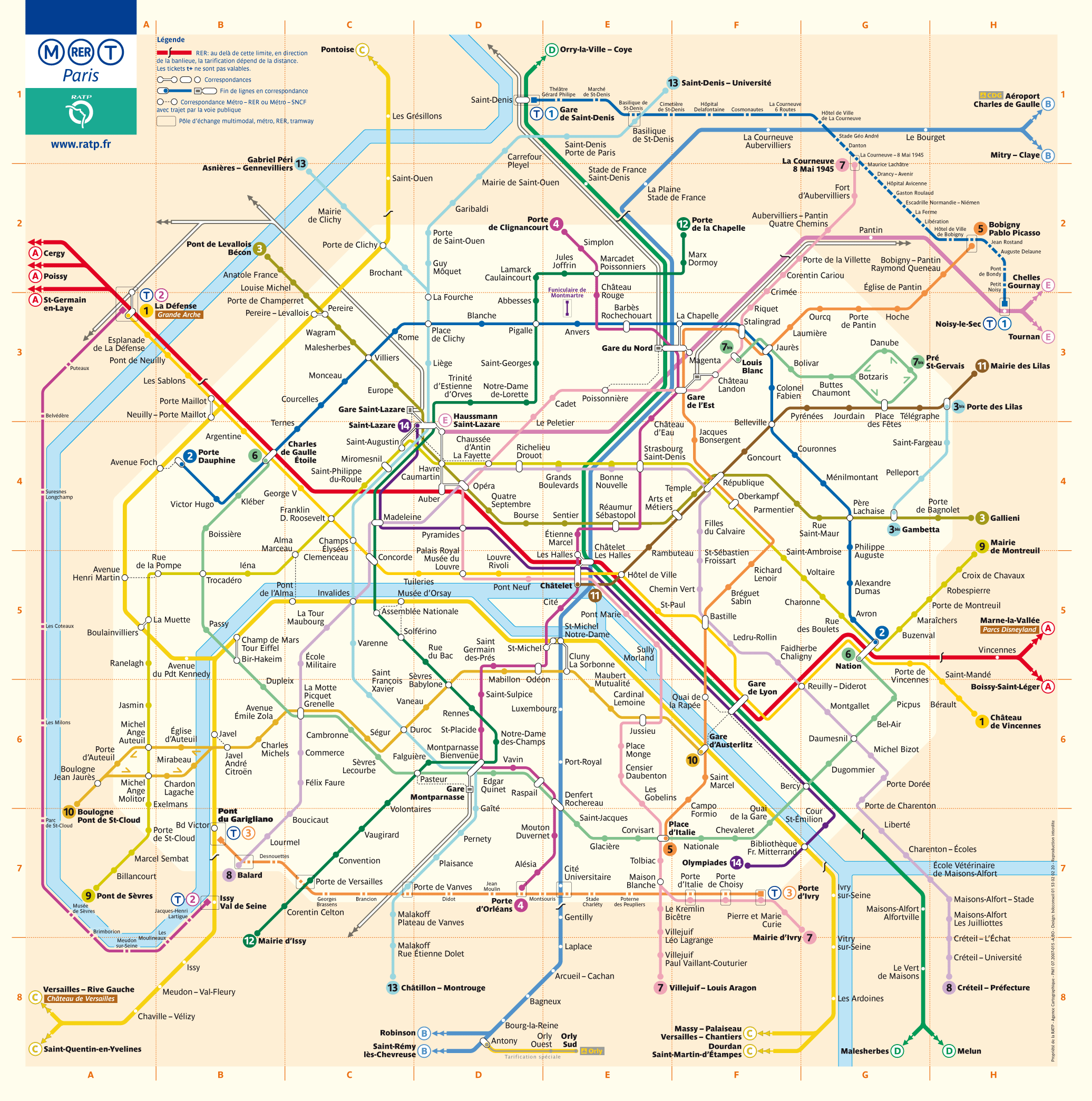
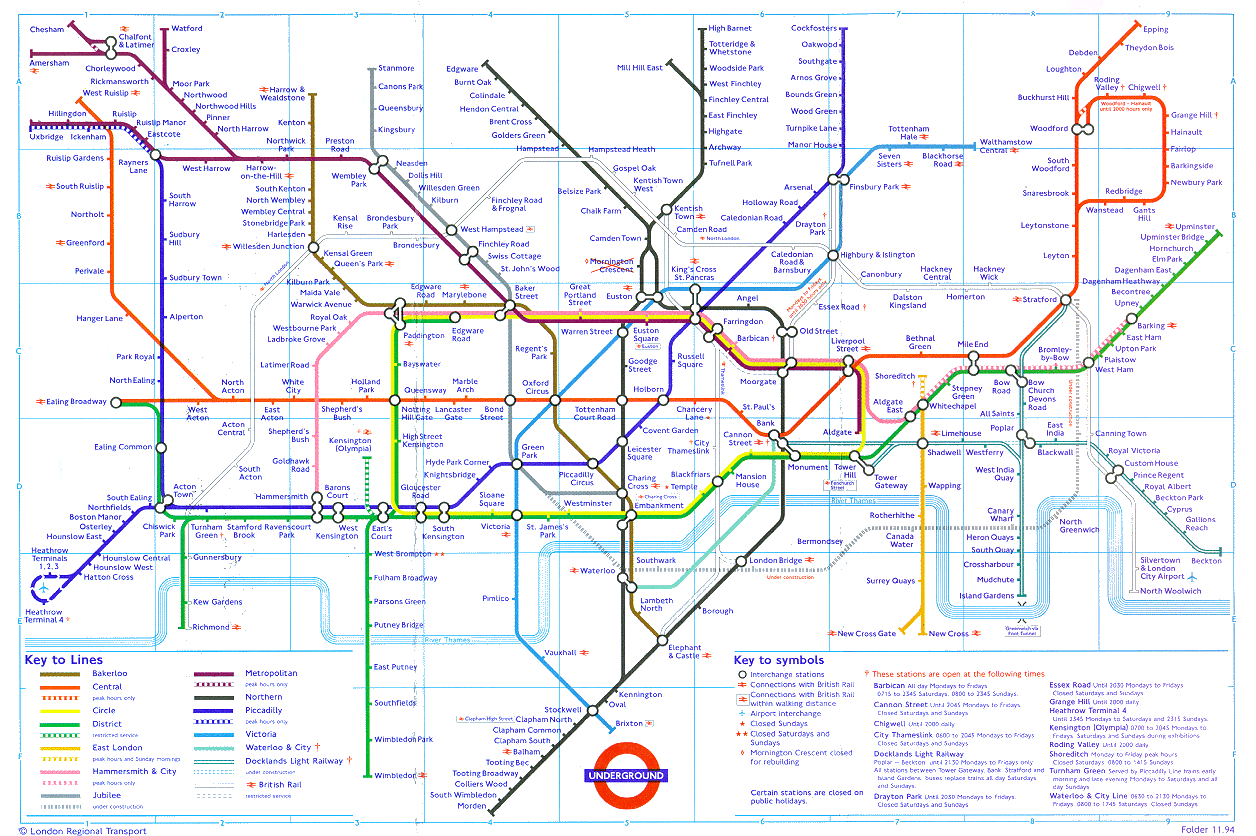
A p/t system has to extensive, all over the center and suburban areas, like London or Paris.
This "plan" looks pretty good
Paris:
London
Paris and London, of course a lot bigger, denser than Portland, have been building for 100+ years, and are not money makers, but keeps 100Ks of cars out of city center, and allow Ms of people to live without being drained by $100s/month in car expenses.
The heavily suburbanized, US sunbelt is pretty much condemned to private car transport for many decades.
Did you see the transport do entary "Who Framed Roger Rabbit"? Explained how GM killed the LA area light rail system decades ago to assure itself a car market.

lol do entary. You manage to make one salient point then go bat- crazy.
http://blogging.la/2007/03/09/top-la...es-streetcars/
http://www.1134.org/stan/ul/GM-et-al.html
lol simpleton.
TBGFY, stalker
lol...you got slapped again.
Nobody wants it. Vancouver says "NO" to the extension. They say they will not help pay for it. So does Lake Oswego. Voters have repeatedly said no to expansion because of the costs, but the city planners keep building it. It is ing expensive. Look at just the riders vs. employee costs. They are paying the Max employees $128 million in wages and collecting $80 million in fares. That's not the end of the operational costs which total $463 million.
So many of these stops become hangouts for gangs, and associated crimes.
Last edited by Wild Cobra; 03-25-2013 at 03:43 PM. Reason: added million
TB
GM didn't kill the LA Rail system. You're dismissed.
"Clearly, GM waged a war on electric traction. It was indeed an all out assault, but by no means the single reason for the failure of rapid transit. Also, it is just as clear that actions and inactions by government contributed significantly to the elimination of electric traction"
http://en.wikipedia.org/wiki/General...car_conspiracy
TB
100 cars in 45 cities...
Wow...
That really had an impact... not...
"nipped in the bud"
"aborted before viability"
lol failiure to read my links.
lol wikipedia.
And thanks for bolstering my point and slapping yourself again. GM did not kill LA light rail.

Your analysis here is incomplete.
Confirmation bias is the seeking and filtering of information that reinforces ones pre-conceived ideas. You have, yet again, done that here.
Missing:
Externalities, e.g. what other benefits might have been provided by the transportation to the wider economy? How much did that contribute to the government coffers?
Alternatives, e.g. how much subsidies did other forms of public spending on transportation cost, relative to their benefits?
Publicly maintained roads subsidize users of those roads, at the expense of those who don't dirctly use them. They have similar economic benefits too.
The issues ever quite end up as simple as people like you would wish us all to believe they are.
Sorry. Your version of reality is dangeriously flawed, IMO.
cost of wind/solar energy has dropped dropped dramatically in the last five years, see page ten @:
http://www.lazard.com/PDF/Levelized%...sion%208.0.pdf
http://www.sciencedaily.com/releases...1207091648.htmAustralia's solar researchers have converted over 40 percent of the sunlight hitting a solar system into electricity, the highest efficiency ever reported. A key part of the prototype's design is the use of a custom optical bandpass filter to capture sunlight that is normally wasted by commercial solar cells on towers and convert it to electricity at a higher efficiency than the solar cells themselves ever could.
another article last week using a different, I think a quantum approach, got conversion up to 60%.
So much of this research now that, unlike fusion research, that it has to pay off much sooner than later.
Energy efficiency could cost U.S. utilities $48 billion
Two trends in the power sector — the expansion of distributed generation and advances in energy efficiency — could cost U.S. utilities up to $48 billion annually by 2025,
based on models that examined improvements in solar panels, electricity storage and other trends that will impact the bottom lines of U.S. utility companies.
Distributed generation refers to power generators – much smaller than typical power plants – installed at or near the sites they serve. They often use renewable resources like solar or wind power and are posing a conundrum for traditional utilities because they allow customers to handle large portions of their power consumption internally.
An Accenture survey found that 61 percent of utility executives expect significant or moderate revenue reductions due to distributed generation technology — up from 43 percent a year ago.
http://fuelfix.com/blog/2014/12/08/r...es-48-billion/
Y'all's Repug assholes are doing everything they can to protect BigCoal and BigElectric, as usual, being on the wrong side of history.
Kill efficiency standards, kill solar/wind subsidies, penalize distributed residential/commercial solar, kill RET/renewable energy targets, etc, etc.
What a deceptive article.
Boutons...
Do you know why, or do I need spell it out?
There are currently 1 users browsing this thread. (0 members and 1 guests)
 Posting Permissions


 Stop stalking me!