

 Reply With Quote
a bible thumper who quotes bible verses trying to call out fox news
that's the pot calling the kettle black

Do you really believe everything on Fox News? If not how much? What percentage


that's the pot calling the kettle black
I'm not a bible thumper, where did you get that? Plus, Fox isn't a Christian channel anyway
Anyone dumb enough to donate 10% of their income to his pastor's ferrari fund is a bible thumper, tbh.


kool abusing his thread making abilities tbh


Y'all know there is a political forum, right?

Do black people really believe everything Al Sharpton and Jesse Jackson tells them?
But yes, Fox News is Neo-Con propaganda 24/7/365. MSNBC is the same , too. Only their Neo-Con propaganda is sugar coated with social justice and class warfare pimping to rally dip bleeding heart lib s. "Never mind the fact Obama is a warmonger and corporate shill, he's black and if he had a son, he'd look like Trayvon. That's pretty cool! [bong hit]."
I like how the first thing MSNBC did when covering Trayvon Martin was act like George "Jorge" Zimmerman is white knowing full well he's some kind of beandip

Banana
From Wikipedia, the free encyclopedia
Jump to: navigation, search
For the plant genus to which bananas belong, see Musa (genus). For other uses, see Banana (disambiguation).

A banana plant on Banana Island in Luxor, Egypt
A banana is an edible fruit produced by several kinds of large herbaceous flowering plants of the genus Musa.[1] (In some countries, bananas used for cooking may be called plantains.) The fruit is variable in size, color and firmness, but is usually elongated and curved, with soft flesh rich in starch covered with a rind which may be yellow, purple or red when ripe. The fruits grow in clusters hanging from the top of the plant. Almost all modern edible parthenocarpic (seedless) bananas come from two wild species – Musa a inata and Musa balbisiana. The scientific names of most cultivated bananas are Musa a inata, Musa balbisiana, and Musa × paradisiaca for the hybrid Musa a inata × M. balbisiana, depending on their genomic cons ution. The old scientific name Musa sapientum is no longer used.
Musa species are native to tropical South and Southeast Asia, and are likely to have been first domesticated in Papua New Guinea.[2][3] They are grown in at least 107 countries,[4] primarily for their fruit, and to a lesser extent to make fiber, banana wine and as ornamental plants. In 2013 bananas were fourth among the main world food crops (after rice, wheat and maize) in financial value.[5]
Worldwide, there is no sharp distinction between "bananas" and "plantains". Especially in the Americas and Europe, "banana" usually refers to soft, sweet, dessert bananas, particularly those of the Cavendish group, which are the main exports from banana-growing countries. By contrast, Musa cultivars with firmer, starchier fruit are called "plantains". In other regions, such as Southeast Asia, many more kinds of banana are grown and eaten, so the simple two-fold distinction is not useful and is not made in local languages.
The term "banana" is also used as the common name for the plants which produce the fruit.[1] This can extend to other members of the genus Musa like the scarlet banana (Musa coccinea), pink banana (Musa velutina) and the Fe'i bananas. It can also refer to members of the genus Ensete, like the snow banana (Ensete glau ) and the economically important false banana (Ensete ventricosum). Both genera are classified under the banana family, Musaceae.
Description

A banana corm, about 25 cm (10 in) across

Banana inflorescence, partially opened.

The female flowers (which can develop into fruit) have petals and other flower parts at the tip of the ovary (the ovary is "inferior").

The Cavendish banana is the most common banana type sold.
The banana plant is the largest herbaceous flowering plant.[6] All the above-ground parts of a banana plant grow from a structure usually called a "corm".[7] Plants are normally tall and fairly sturdy, and are often mistaken for trees, but what appears to be a trunk is actually a "false stem" or pseudostem. The leaves of banana plants are composed of a "stalk" (petiole) and a blade (lamina). The base of the petiole widens to form a sheath; the tightly packed sheaths make up the pseudostem, which is all that supports the plant. The edges of the sheath meet when it is first produced, making it tubular. As new growth occurs in the centre of the pseudostem the edges are forced apart.[8] Cultivated banana plants vary in height depending on the variety and growing conditions. Most are around 5 m (16 ft) tall, with a range from 'Dwarf Cavendish' plants at around 3 m (10 ft) to 'Gros Michel' at 7 m (23 ft) or more.[9][10] Leaves are spirally arranged and may grow 2.7 metres (8.9 ft) long and 60 cm (2.0 ft) wide.[11] They are easily torn by the wind, resulting in the familiar frond look.[12]
When a banana plant is mature, the corm stops producing new leaves and begins to form a flower e or inflorescence. A stem develops which grows up inside the pseudostem, carrying the immature inflorescence until eventually it emerges at the top.[13] Each pseudostem normally produces a single inflorescence, also known as the "banana heart". (More are sometimes produced; an exceptional plant in the Philippines produced five.[14]) After fruiting, the pseudostem dies, but offshoots will normally have developed from the base, so that the plant as a whole is perennial. In the plantation system of cultivation, only one of the offshoots will be allowed to develop in order to maintain spacing.[15] The inflorescence contains many bracts (sometimes incorrectly called petals) between rows of flowers. The female flowers (which can develop into fruit) appear in rows further up the stem (closer to the leaves) from the rows of male flowers. The ovary is inferior, meaning that the tiny petals and other flower parts appear at the tip of the ovary.[16]
The banana fruits develop from the banana heart, in a large hanging cluster, made up of tiers (called "hands"), with up to 20 fruit to a tier. The hanging cluster is known as a bunch, comprising 3–20 tiers, or commercially as a "banana stem", and can weigh from 30–50 kilograms (66–110 lb). Individual banana fruits (commonly known as a banana or "finger") average 125 grams (0.28 lb), of which approximately 75% is water and 25% dry matter.[citation needed]
The fruit has been described as a "leathery berry".[17] There is a protective outer layer (a peel or skin) with numerous long, thin strings (the phloem bundles), which run lengthwise between the skin and the edible inner portion. The inner part of the common yellow dessert variety splits easily lengthwise into three sections that correspond to the inner portions of the three carpels.[citation needed] In cultivated varieties, the seeds are diminished nearly to non-existence; their remnants are tiny black specks in the interior of the fruit.[18]
Bananas are naturally slightly radioactive,[19][20] more so than most other fruits, because of their potassium content and the small amounts of the isotope potassium-40 found in naturally occurring potassium.[21] Proponents of nuclear power sometimes refer to the banana equivalent dose of radiation to support their arguments.[22]
Taxonomy

Banana 'tree' showing fruit and inflorescence.
The genus Musa is in the family Musaceae. The APG III system assigns Musaceae to the order Zingiberales, part of the commelinid clade of the monocotyledonous flowering plants.
Some sources assert that Musa is named for Antonius Musa, physician to the Emperor Augustus.[23] Others say that Linnaeus, who named the genus in 1750, simply adapted an Arabic word for banana, mauz. The word banana is generally said to be derived from the Wolof word banaana.[24] Some 70 species of Musa were recognized by the World Checklist of Selected Plant Families as of January 2013;[25] several produce edible fruit, while others are cultivated as ornamentals.[23]
Banana classification has long been a problematic issue for taxonomists. Linnaeus originally classified bananas into two species based only on their uses as food: Musa sapientum for dessert bananas and Musa paradisiaca for plantains. Subsequently further species names were added. However, this approach proved inadequate to address the sheer number of cultivars existing in the primary center of diversity of the genus, Southeast Asia. Many of these cultivars were given names which proved to be synonyms.[26]
In a series of papers published in 1947 onwards, Ernest Cheesman showed that Linnaeus' Musa sapientum and Musa paradisiaca were actually cultivars and descendants of two wild seed-producing species, Musa a inata and Musa balbisiana, both first described by Luigi Aloysius Colla.[27] He recommended the abolition of Linnaeus' species in favor of reclassifying bananas according to three morphologically distinct groups of cultivars – those primarily exhibiting the botanical characteristics of Musa balbisiana, those primarily exhibiting the botanical characteristics of Musa a inata, and those with characteristics that are the combination of the two.[26] Researchers Norman Simmonds and Ken Shepherd proposed a genome-based nomenclature system in 1955. This system eliminated almost all the difficulties and inconsistencies of the earlier classification of bananas based on assigning scientific names to cultivated varieties. Despite this, the original names are still recognized by some authorities today, leading to confusion.[27][28]
The currently accepted scientific names for most groups of cultivated bananas are Musa a inata Colla and Musa balbisiana Colla for the ancestral species, and Musa × paradisiaca L. for the hybrid M. a inata × M. balbisiana.[29]
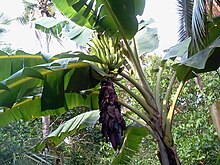
A variety of banana cultivated widely in Indian state of Kerala, locally known as nendran
Synonyms of M. × paradisica include:
- A large number of subspecific and varietial names of M. × paradisiaca, including M. p. subsp. sapientum (L.) Kuntze
- Musa × dacca Horan.
- Musa × sapidisiaca K.C.Jacob, nom. superfl.
- Musa × sapientum L., and a large number of its varietal names, including M. × sapientum var. paradisiaca (L.) Baker, nom. illeg.
Generally, modern classifications of banana cultivars follow Simmonds and Shepherd's system. Cultivars are placed in groups based on the number of chromosomes they have and which species they are derived from. Thus the Latundan banana is placed in the AAB Group, showing that it is a triploid derived from both M. a inata (A) and M. balbisiana (B). For a list of the cultivars classified under this system see List of banana cultivars.
In 2012 a team of scientists announced they had achieved a draft sequence of the genome of Musa a inata.[30]
Bananas and plantains
In regions such as North America and Europe, Musa fruits offered for sale can be divided into "bananas" and "plantains", based on their intended use as food. Thus the banana producer and distributor Chiquita produces publicity material for the American market which says that "a plantain is not a banana". The stated differences are that plantains are more starchy and less sweet; they are eaten cooked rather than raw; they have thicker skin, which may be green, yellow or black; and they can be used at any stage of ripeness.[31] Linnaeus made the same distinction between plantains and bananas when first naming two "species" of Musa.[32] Members of the "Plantain subgroup" of banana cultivars, most important as food in West Africa and Latin America, correspond to the Chiquita description, having long pointed fruit. They are described by Ploetz et al. as "true" plantains, distinct from other cooking bananas.[33] The cooking bananas of East Africa belong to a different group, the East African Highland bananas,[10] so would not qualify as "true" plantains on this definition.
An alternative approach divides bananas into dessert bananas and cooking bananas, with plantains being one of the subgroups of cooking bananas.[34] Triploid cultivars derived solely from M. a inata are examples of "dessert bananas", whereas triploid cultivars derived from the hybrid between M. a inata and M. balbinosa (in particular the Plantain subgroup of the AAB Group) are "plantains".[35][36] Small farmers in Colombia grow a much wider range of cultivars than large commercial plantations. A study of these cultivars showed that they could be placed into at least three groups based on their characteristics: dessert bananas, non-plantain cooking bananas, and plantains, although there were overlaps between dessert and cooking bananas.[37]
In Southeast Asia – the center of diversity for bananas, both wild and cultivated – the distinction between "bananas" and "plantains" does not work, according to Valmayor et al. Many bananas are used both raw and cooked. There are starchy cooking bananas which are smaller than those eaten raw. The range of colors, sizes and shapes is far wider than in those grown or sold in Africa, Europe or the Americas.[32] Southeast Asian languages do not make the distinction between "bananas" and "plantains" that is made in English (and Spanish). Thus both Cavendish cultivars, the classic yellow dessert bananas, and Saba cultivars, used mainly for cooking, are called pisang in Malaysia and Indonesia, kluai in Thailand and chuoi in Vietnam.[38] Fe'i bananas, grown and eaten in the islands of the Pacific, are derived from entirely different wild species than traditional bananas and plantains. Most Fe'i bananas are cooked, but Karat bananas, which are short and squat with bright red skins, very different from the usual yellow dessert bananas, are eaten raw.[39]
In summary, in commerce in Europe and the Americas (although not in small-scale cultivation), it is possible to distinguish between "bananas", which are eaten raw, and "plantains", which are cooked. In other regions of the world, particularly India, Southeast Asia and the islands of the Pacific, there are many more kinds of banana and the two-fold distinction is not useful and not made in local languages. Plantains are one of many kinds of cooking bananas, which are not always distinct from dessert bananas.
Historical cultivation
Early cultivation
See also: Musa a inata

Original native ranges of the ancestors of modern edible bananas. Musa a inata is shown in green and Musa balbisiana in orange.[40]
Southeast Asian farmers first domesticated bananas. Recent archaeological and palaeoenvironmental evidence at Kuk Swamp in the Western Highlands Province of Papua New Guinea suggests that banana cultivation there goes back to at least 5000 BCE, and possibly to 8000 BCE.[2][41] It is likely that other species were later and independently domesticated elsewhere in southeast Asia. Southeast Asia is the region of primary diversity of the banana. Areas of secondary diversity are found in Africa, indicating a long history of banana cultivation in the region.[42]
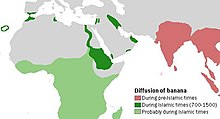
Actual and probable diffusion of bananas during Islamic times (700–1500 CE)[43]
Phytolith discoveries in Cameroon dating to the first millennium BCE[44] triggered an as yet unresolved debate about the date of first cultivation in Africa. There is linguistic evidence that bananas were known in Madagascar around that time.[45] The earliest prior evidence indicates that cultivation dates to no earlier than late 6th century CE.[46] It is likely, however, that bananas were brought at least to Madagascar if not to the East African coast during the phase of Malagasy colonization of the island from South East Asia c. 400 CE.[47]
The banana may have been present in isolated locations of the Middle East on the eve of Islam. There is some textual evidence that Muhammad was familiar with bananas.[citation needed] The spread of Islam was followed by far-reaching diffusion. There are numerous references to it in Islamic texts (such as poems and hadiths) beginning in the 9th century. By the 10th century the banana appears in texts from Palestine and Egypt. From there it diffused into north Africa and Muslim Iberia. During the medieval ages, bananas from Granada were considered among the best in the Arab world.[43] In 650, Islamic conquerors brought the banana to Palestine. Today, banana consumption increases significantly in Islamic countries during Ramadan, the month of daylight fasting.[48]
Bananas were introduced to the Americas by Portuguese sailors who brought the fruits from West Africa in the 16th century.[49] The word banana is of West African origin, from the Wolof language, and passed into English via Spanish or Portuguese.[50]
Many wild banana species as well as cultivars exist in extraordinary diversity in New Guinea, Malaysia, Indonesia, China, and the Philippines.
There are fuzzy bananas whose skins are bubblegum pink; green-and-white striped bananas with pulp the color of orange sherbet; bananas that, when cooked, taste like strawberries. The Double Mahoi plant can produce two bunches at once. The Chinese name of the aromatic Go San Heong banana means 'You can smell it from the next mountain.' The fingers on one banana plant grow fused; another produces bunches of a thousand fingers, each only an inch long.Plantation cultivation in the Caribbean, Central and South America
—Mike Peed, The New Yorker[51]
Main article: History of modern banana plantations in the Americas
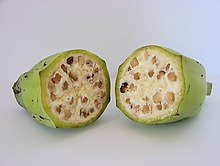
Fruits of wild-type bananas have numerous large, hard seeds.
In the 15th and 16th centuries, Portuguese colonists started banana plantations in the Atlantic Islands, Brazil, and western Africa.[52] North Americans began consuming bananas on a small scale at very high prices shortly after the Civil War, though it was only in the 1880s that it became more widespread.[53] As late as the Victorian Era, bananas were not widely known in Europe, although they were available.[52] Jules Verne introduces bananas to his readers with detailed descriptions in Around the World in Eighty Days (1872).
The earliest modern plantations originated in Jamaica and the related Western Caribbean Zone, including most of Central America. It involved the combination of modern transportation networks of steamships and railroads with the development of refrigeration that allowed bananas to have more time between harvesting and ripening. North America shippers like Lorenzo Dow Baker and Andrew Preston, the founders of the Boston Fruit Company started this process in the 1870s, but railroad builders like Minor C Keith also participated, eventually culminating in the multi-national giant corporations like today's Chiquita Brands International and Dole.[53] These companies were monopolistic, vertically integrated (meaning they controlled growing, processing, shipping and marketing) and usually used political manipulation to build enclave economies (economies that were internally self-sufficient, virtually tax exempt, and export oriented that contribute very little to the host economy). Their political maneuvers, which gave rise to the term Banana republic for states like Honduras and Guatemala, included working with local elites and their rivalries to influence politics or playing the international interests of the United States, especially during the Cold War, to keep the political climate favorable to their interests.[54]
Peasant cultivation for export in the Caribbean
Main article: History of peasant banana production in the Americas
The vast majority of the world's bananas today are cultivated for family consumption or for sale on local markets. India is the world leader in this sort of production, but many other Asian and African countries where climate and soil conditions allow cultivation also host large populations of banana growers who sell at least some of their crop.[55]
There are peasant sector banana growers who produce for the world market in the Caribbean, however. The Windward Islands are notable for the growing, largely of Cavendish bananas, for an international market, generally in Europe but also in North America. In the Caribbean, and especially in Dominica where this sort of cultivation is widespread, holdings are in the 1–2 acre range. In many cases the farmer earns additional money from other crops, from engaging in labor outside the farm, and from a share of the earnings of relatives living overseas. This style of cultivation often was popular in the islands as bananas required little labor input and brought welcome extra income.[citation needed] Banana crops are vulnerable to destruction by high winds, such as tropical storms or cyclones.[56]
After the signing of the NAFTA agreements in the 1990s, however, the tide turned against peasant producers. Their costs of production were relatively high and the ending of favorable tariff and other supports, especially in the European Economic Community, made it difficult for peasant producers to compete with the bananas grown on large plantations by the well capitalized firms like Chiquita and Dole. Not only did the large companies have access to cheap labor in the areas they worked, but they were better able to afford modern agronomic advances such as fertilization. The "dollar banana" produced by these concerns made the profit margins for peasant bananas unsustainable.[citation needed]
Caribbean countries have sought to redress this problem by providing government supported agronomic services and helping to organize producers' cooperatives. They have also been supporters of the Fair Trade movement which seeks to balance the inequities in the world trade in commodities.[citation needed]
East Africa
Main article: East African Highland bananas
Most farms supply local consumption. Cooking bananas represent a major food source and a major income source for smallhold farmers. In east Africa, highland bananas are of greatest importance as a staple food crop. In countries such as Uganda, Burundi, and Rwanda per capita consumption has been estimated at 45 kilograms (99 lb) per year, the highest in the world.[citation needed]
Modern cultivation
All widely cultivated bananas today descend from the two wild bananas Musa a inata and Musa balbisiana. While the original wild bananas contained large seeds, diploid or polyploid cultivars (some being hybrids) with tiny seeds are preferred for human raw fruit consumption.[57] These are propagated asexually from offshoots. The plant is allowed to produce two shoots at a time; a larger one for immediate fruiting and a smaller "sucker" or "follower" to produce fruit in 6–8 months. The life of a banana plantation is 25 years or longer, during which time the individual stools or planting sites may move slightly from their original positions as lateral rhizome formation dictates.[citation needed]
Cultivated bananas are parthenocarpic, i.e. the flesh of the fruit swells and ripens without its seeds being fertilized and developing. Lacking viable seeds, propagation typically involves farmers removing and transplanting part of the underground stem (called a corm). Usually this is done by carefully removing a sucker (a vertical shoot that develops from the base of the banana pseudostem) with some roots intact. However, small sympodial corms, representing not yet elongated suckers, are easier to transplant and can be left out of the ground for up to two weeks; they require minimal care and can be shipped in bulk.[citation needed]
It is not necessary to include the corm or root structure to propagate bananas; severed suckers without root material can be propagated in damp sand, although this takes somewhat longer.[citation needed]
In some countries, commercial propagation occurs by means of tissue culture. This method is preferred since it ensures disease-free planting material. When using vegetative parts such as suckers for propagation, there is a risk of transmitting diseases (especially the devastating Panama disease).[citation needed]
As a non-seasonal crop, bananas are available fresh year-round.[citation needed]
Cavendish

Cavendish bananas are the main commercial banana cultivars sold in the world market.
In global commerce in 2009, by far the most important cultivars belonged to the triploid AAA group of Musa a inata, commonly referred to as Cavendish group bananas. They accounted for the majority of banana exports,[57] despite only coming into existence in 1836.[58] The cultivars Dwarf Cavendish and Grand Nain (Chiquita Banana) gained popularity in the 1950s after the previous mass-produced cultivar, Gros Michel (also an AAA group cultivar), became commercially unviable due to Panama disease, caused by the fungus Fusarium oxysporum which attacks the roots of the banana plant.[57] Cavendish cultivars are resistant to the Panama Disease but in 2013 there were fears that the Black Sigatoka fungus would in turn make Cavendish bananas unviable.[5]
Ease of transport and shelf life rather than superior taste make the Dwarf Cavendish the main export banana.[citation needed]
Even though it is no longer viable for large scale cultivation, Gros Michel is not extinct and is still grown in areas where Panama disease is not found.[59] Likewise, Dwarf Cavendish and Grand Nain are in no danger of extinction, but they may leave supermarket shelves if disease makes it impossible to supply the global market. It is unclear if any existing cultivar can replace Cavendish bananas, so various hybridisation and genetic engineering programs are attempting to create a disease-resistant, mass-market banana.[57]
nono with the healthy, delicious goods

i always thought he was part Jewish and part Guatemalan or whatever the he is. Zimmerman is a classic Jew name, plus his dad is a judge, which means he was a lawyer. but it's a lot more convenient to just say he is white.
That's precisely why I stay away from mainstream media outlets for my political information. They practice what Chomsky calls, "The bounding of debate," serving up "political analysis" in easily comprehended soundbites that appeal to emotion above all else.
And it's not that the American people are necessarily too stupid to further their political education, it's more to do with the apathy most people have toward the system. Politicians have purposely made things so convoluted and muddled, that a person would literally need to devote 8 hours a day just to keep pace with and understand all the developments that happen in Washington daily. Thus the politicians' use of those appeal to emotion strategies to connect to their voters, since they camouflaged the real issues with a complexity your average voter simply doesn't have the time to wade through.


Cable news is all bull , basically the TV version of tabloids....

no.
But that's mainly because I'm a conservative, not another mindless black sheep.

I'm progressive but I don't listen to them. You act like they go on tour and blacks have conferences for them to guide our race

I never get how black people can be Christians. How can black people take their masters' religion?
I AM a black conservative, but I'm mostly just trolling right now tbh.
Oh shiii.......
19 pages


I certainly don't believe everything on Fox News, but I believe more of it than I do the other, liberal, media.
Serious question. How can a black person be a Christian when that was the tool massa used to control them in the days of slavery? It would be like a woman marrying her rapist.
Do religious black people look back at slavery with fondness since it introduced them to white man's God? Was the genocide worth it so that you got the privilege of donating 10% of your income after your ancestors effectively donated 100%??
Last edited by baseline bum; 05-26-2013 at 08:17 PM.

that is all

considering their own people who sold them were into some Zulu Voodoo , they may not feel fond of the old stuff either.
There are currently 1 users browsing this thread. (0 members and 1 guests)
 Posting Permissions


