Page 1 of 6 12345 ... LastLast
Results 1 to 25 of 132
  1. #1
    I am that guy RandomGuy's Avatar
    My Team
    San Antonio Spurs
    Join Date
    Jun 2005
    Post Count
    51,121
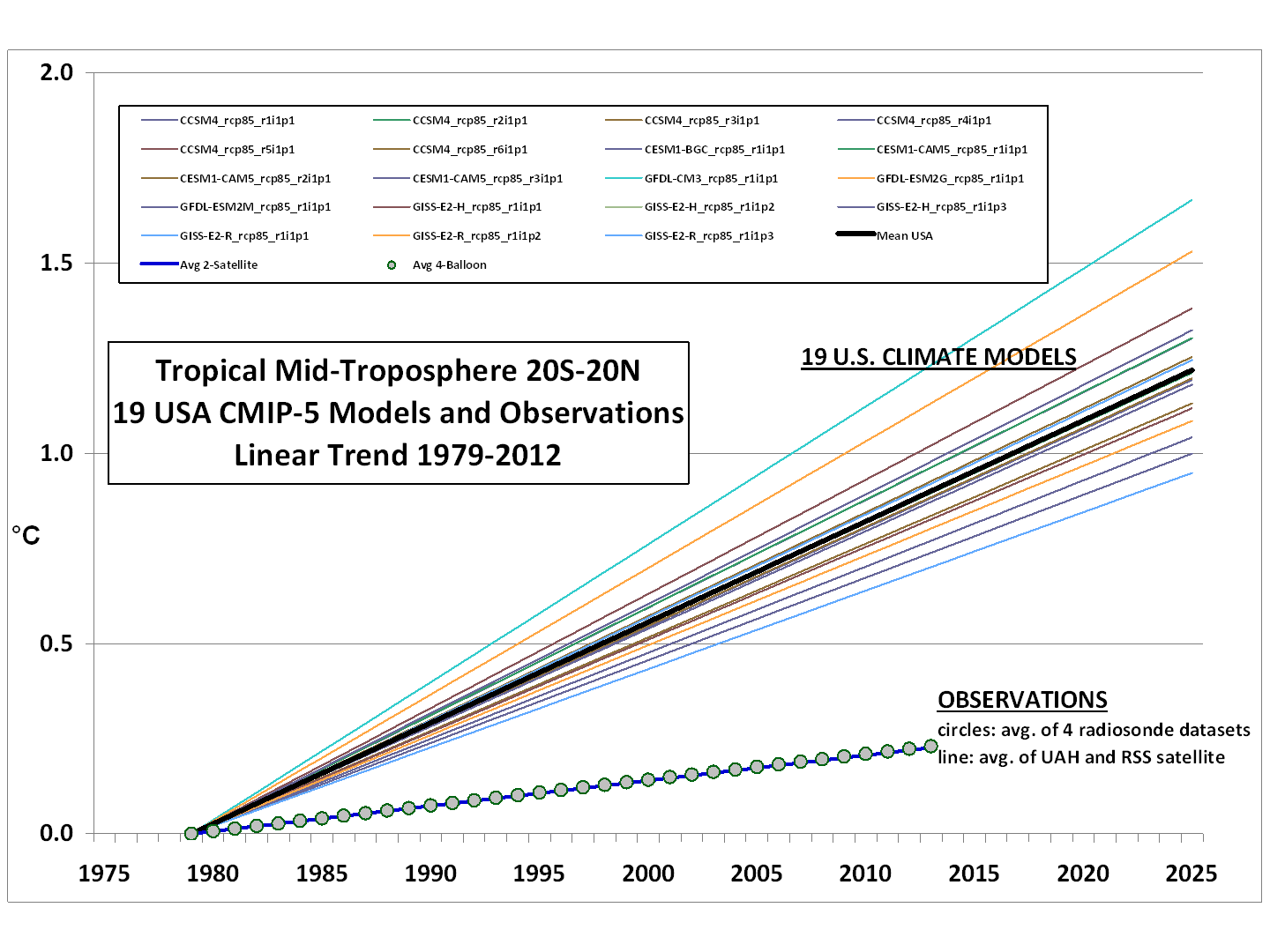
    GLOBAL warming has slowed. The rate of warming of over the past 15 years has been lower than that of the preceding 20 years. There is no serious doubt that our planet continues to heat, but it has heated less than most climate scientists had predicted. Nate Cohn of the New Republic reports: "Since 1998, the warmest year of the twentieth century, temperatures have not kept up with computer models that seemed to project steady warming; they’re perilously close to falling beneath even the lowest projections".


    Mr Cohn does his best to affirm that the urgent necessity of acting to re warming has not abated, as does Brad Plumer of the Washington Post, as does this newspaper. But there's no way around the fact that this reprieve for the planet is bad news for proponents of policies, such as carbon taxes and emissions treaties, meant to slow warming by moderating the release of greenhouse gases. The reality is that the already meagre prospects of these policies, in America at least, will be devastated if temperatures do fall outside the lower bound of the projections that environmentalists have used to create a panicked sense of emergency. Whether or not dramatic climate-policy interventions remain advisable, they will become harder, if not impossible, to sell to the public, which will feel, not unreasonably, that the scientific and media establishment has cried wolf.

    Dramatic warming may exact a terrible price in terms of human welfare, especially in poorer countries. But cutting emissions enough to put a real dent in warming may also put a real dent in economic growth. This could also exact a terrible humanitarian price, especially in poorer countries. Given the so-far unfathomed complexity of global climate and the tenuousness of our grasp on the full set of relevant physical mechanisms, I have favoured waiting a decade or two in order to test and improve the empirical reliability of our climate models, while also allowing the economies of the less-developed parts of the world to grow unhindered, improving their position to adapt to whatever heavy weather may come their way. I have been told repeatedly that "we cannot afford to wait". More distressingly, my brand of sceptical empiricism has been often met with a bludgeoning dogmatism about the authority of scientific consensus.

    Of course, if the consensus climate models turn out to be falsified just a few years later, average temperature having remained at levels not even admitted to be have been physically possible, the authority of consensus will have been exposed as rather weak. The authority of expert consensus obviously strengthens as the quality of expertise improves, which is why it's quite sensible, as matter of science-based policy-making, to wait for a callow science to improve before taking grand measures on the basis of it's predictions.


    Anyway, Mr Cohn cites a few scientists who are unruffled by the surprisingly slow warming.

    It might seem like a decade-long warming plateau would cause a crisis for climate science. It hasn’t. Gerald Meehl, a Senior Scientist at the National Center for Atmospheric Research, has seen hiatus periods before. They “occur pretty commonly in the observed records,” and there are climate models showing “a hiatus as long as 15 years.” As a result, Isaac Held, a Senior Research Scientist at NOAA’s Geophysical Fluid Dynamics Laboratory, says “no one has ever expected warming to be continuous, increasing like a straight line.” Those much-cited computer models are composed of numerous simulations that individually account for naturally occurring variability. But, Meehl says, “the averages cancel it out.”

    Isn't this transparently ad hoc. The point of averaging is to prune off exceedingly unlikely possibilities. It does not vindicate a model to note that it gives no weight—that it "cancels out"—its only accurate cons utive simulations.

    If "hiatus periods are commonly observed" is the right way to think about the current warming plateau, then the rest of Mr Cohn's article, examining various explanations of the puzzle of the hiatus would be unnecessary. But, as all the pieces discussing the warming plateau make perfectly clear, climate scientists are actually pretty baffled about the failure of their predictions. Is it the oceans? Clouds? Volcanoes? The sun? An artifact of temperature data?

    As a rule, climate scientists were previously very confident that the planet would be warmer than it is by now, and no one knows for sure why it isn't. This isn't a crisis for climate science. This is just the way science goes. But it is a crisis for climate-policy advocates who based their arguments on the authority of scientific consensus. Mr Cohn eventually gets around to admitting that

    In the end, the so-called scientific consensus on global warming doesn’t look like much like consensus when scientists are struggling to explain the intricacies of the earth’s climate system, or uttering the word “uncertainty” with striking regularity.
    But his attempt to minimise the political relevance of this is unconvincing. He writes:

    The recent wave of news and magazine articles about scientists struggling to explain the warming slowdown could prolong or deepen the public’s skepticism.
    But the “consensus” never extended to the intricacies of the climate system, just the core belief that additional greenhouse gas emissions would warm the planet.

    If this is true, then the public has been systematically deceived. As it has been presented to the public, the scientific consensus extended precisely to that which is now seems to be in question: the sensitivity of global temperature to increases in atmospheric carbon dioxide. Indeed, if the consensus had been only that greenhouse gases have some warming effect, there would have been no obvious policy implications at all. As this paper has maintained:

    If ... temperatures are likely to rise by only 2°C in response to a doubling of carbon emissions (and if the likelihood of a 6°C increase is trivial), the calculation might change. Perhaps the world should seek to adjust to (rather than stop) the greenhouse-gas splurge. There is no point buying earthquake insurance if you do not live in an earthquake zone. In this case more adaptation rather than more mitigation might be the right policy at the margin. But that would be good advice only if these new estimates really were more reliable than the old ones. And different results come from different models.
    We have not been awash in arguments for adaptation precisely because the consensus pertained to now-troubled estimates of climate sensitivity. The moralising stridency of so many arguments for cap-and-trade, carbon taxes, and global emissions treaties was founded on the idea that there is a consensus about how much warming there would be if carbon emissions continue on trend. The rather heated debates we have had about the likely economic and social damage of carbon emissions have been based on that idea that there is something like a scientific consensus about the range of warming we can expect. If that consensus is now falling apart, as it seems it may be, that is, for good or ill, a very big deal.

    http://www.economist.com/blogs/democ...6d37c30b6f1709

    ------------------------------------
    FWIW. I thought it well written commentary.

    Cue the usual people saying the usual things in 3, 2, 1...

  2. #2
    e^(i*pi) + 1 = 0 MannyIsGod's Avatar
    My Team
    San Antonio Spurs
    Join Date
    Mar 2003
    Post Count
    57,943
    If "hiatus periods are commonly observed" is the right way to think about the current warming plateau, then the rest of Mr Cohn's article, examining various explanations of the puzzle of the hiatus would be unnecessary. But, as all the pieces discussing the warming plateau make perfectly clear, climate scientists are actually pretty baffled about the failure of their predictions. Is it the oceans? Clouds? Volcanoes? The sun? An artifact of temperature data?


    Pretty stupid thing to say, honestly. The reason he provides possible explanations is for context as to understand why the system moves in an uneven "herky jerky" fashion and to better understand it. Not to mention that SO much of the focus outside of the scientific community tends to be in atmospheric temperatures when oceanic heat content is the far more important metric regarding the Earth's energy budget.

  3. #3
    Veteran Wild Cobra's Avatar
    My Team
    Portland Trailblazers
    Join Date
    May 2007
    Post Count
    43,117
    Pretty stupid thing to say, honestly. The reason he provides possible explanations is for context as to understand why the system moves in an uneven "herky jerky" fashion and to better understand it. Not to mention that SO much of the focus outside of the scientific community tends to be in atmospheric temperatures when oceanic heat content is the far more important metric regarding the Earth's energy budget.
    Wow...

    We agree. the oceans are more important.

    So tell me Manny. Since sea water is optically opaque within about a 1mm depth to the spectra from CO2, how does it warm the oceans? My understanding is that there isn't enough heat transfer before radiated back upward, and the extra water vapor created is calculated actually cools the ocean.

    We are back to solar being the key for changes in my view.

  4. #4
    I am that guy RandomGuy's Avatar
    My Team
    San Antonio Spurs
    Join Date
    Jun 2005
    Post Count
    51,121
    Pretty stupid thing to say, honestly. The reason he provides possible explanations is for context as to understand why the system moves in an uneven "herky jerky" fashion and to better understand it. Not to mention that SO much of the focus outside of the scientific community tends to be in atmospheric temperatures when oceanic heat content is the far more important metric regarding the Earth's energy budget. [/COLOR]
    Yeah, that was the part of the piece that I found a bit dodgy as well.

    My hunch is the the "missing" heat is in the oceans, given the specific heat of water when compared to oceans.

    We are talking about long term trends, so I am not going to hang my hat on any 5-10 year period for anything.

    I would also agree with the blogger in the OP that the data has not changed the public policy calculus yet.

  5. #5
    I am that guy RandomGuy's Avatar
    My Team
    San Antonio Spurs
    Join Date
    Jun 2005
    Post Count
    51,121
    Wow...

    We agree. the oceans are more important.

    So tell me Manny. Since sea water is optically opaque within about a 1mm depth to the spectra from CO2, how does it warm the oceans? My understanding is that there isn't enough heat transfer before radiated back upward, and the extra water vapor created is calculated actually cools the ocean.

    We are back to solar being the key for changes in my view.
    "Extra water vapor"... wouldn't that trap more heat close in?

  6. #6
    Veteran
    My Team
    San Antonio Spurs
    Join Date
    Mar 2009
    Post Count
    97,536
    15 years is a squiggle, not long enough to counter the longer term anthropogenic global warming.

    arctic sea ice and glacier melt continue to worsen every year.

  7. #7
    Believe. AntiChrist's Avatar
    My Team
    San Antonio Spurs
    Join Date
    Oct 2008
    Post Count
    1,369
    Good description of these computer models


  8. #8
    Veteran Wild Cobra's Avatar
    My Team
    Portland Trailblazers
    Join Date
    May 2007
    Post Count
    43,117
    "Extra water vapor"... wouldn't that trap more heat close in?
    Why?

    At the current levels, it's already at optical opacity. I believe the net water vapor change is about 1% from a low to high value. I can look up accepted values if you like, but the change is very small. Now considering sensitivity is based on doubling of a value... How much merit do you really think this might have?

  9. #9
    Veteran Wild Cobra's Avatar
    My Team
    Portland Trailblazers
    Join Date
    May 2007
    Post Count
    43,117
    So tell me Manny. Since sea water is optically opaque within about a 1mm depth to the spectra from CO2, how does it warm the oceans? My understanding is that there isn't enough heat transfer before radiated back upward, and the extra water vapor created is calculated actually cools the ocean.

    We are back to solar being the key for changes in my view.


    CO2 spectra is about 4.5 um and about 12-17 um. These are at less that 100 microns of penetration.

    Just how does this limited increase in surface skin temperature convect so much change to the mass of the ocean?

    Is it magic?
    Last edited by Wild Cobra; 06-26-2013 at 03:40 AM.

  10. #10
    Veteran Wild Cobra's Avatar
    My Team
    Portland Trailblazers
    Join Date
    May 2007
    Post Count
    43,117
    Good description of these computer models

    LOL...

    Yep...

    I also found an interesting acknowledgement from Dr. Roy Spencer. First paragraph of an article:

    Dr. Roy Spencer, a world-renowned climatologist, admits he is “open to the possibility” the greenhouse gas theory is in 'error': is a paradigm shift imminent?
    link: Dr Roy Spencer Signals Greenhouse Gas Theory Paradigm Shift

  11. #11
    I am that guy RandomGuy's Avatar
    My Team
    San Antonio Spurs
    Join Date
    Jun 2005
    Post Count
    51,121
    Why?

    At the current levels, it's already at optical opacity. I believe the net water vapor change is about 1% from a low to high value. I can look up accepted values if you like, but the change is very small. Now considering sensitivity is based on doubling of a value... How much merit do you really think this might have?
    I have no idea. I am not an expert, nor have I spent the time to understand it.

    One of the reasons I don't wander into the trenches on this. My interests lie elsewhere.

  12. #12
    I am that guy RandomGuy's Avatar
    My Team
    San Antonio Spurs
    Join Date
    Jun 2005
    Post Count
    51,121
    LOL...

    Yep...

    I also found an interesting acknowledgement from Dr. Roy Spencer. First paragraph of an article:


    link: Dr Roy Spencer Signals Greenhouse Gas Theory Paradigm Shift
    Already argued and dismissed long ago, if memory serves. Dr. Spencer believes nothing of the sort, but gets trotted out by people like you taking it out of context, per par, hypocrite.

  13. #13
    Veteran Wild Cobra's Avatar
    My Team
    Portland Trailblazers
    Join Date
    May 2007
    Post Count
    43,117
    Already argued and dismissed long ago, if memory serves. Dr. Spencer believes nothing of the sort, but gets trotted out by people like you taking it out of context, per par, hypocrite.
    I think he just knows if he is a heretic to the dogma, his job is in jeopardy. He can only push against the agenda so much before being a problem for them.
    Last edited by Wild Cobra; 06-27-2013 at 03:24 AM.

  14. #14
    Veteran Wild Cobra's Avatar
    My Team
    Portland Trailblazers
    Join Date
    May 2007
    Post Count
    43,117
    Already argued and dismissed long ago, if memory serves. Dr. Spencer believes nothing of the sort, but gets trotted out by people like you taking it out of context, per par, hypocrite.
    You should perhaps visit his web site before denying his words. He believes in the AGW effect of CO2, he just doesn't believe the positive feedback associated with it is as strong as others claim.

    Link to his site: Dr. Roy Spencer dot com

    Read in his words, what he believes. I suggest reading his links within led Global Warming: Natural or Manmade?, and Global Warming 101.

    Here is something of interest at his site as well:


  15. #15
    I am that guy RandomGuy's Avatar
    My Team
    San Antonio Spurs
    Join Date
    Jun 2005
    Post Count
    51,121
    You should perhaps visit his web site before denying his words. He believes in the AGW effect of CO2, he just doesn't believe the positive feedback associated with it is as strong as others claim.

    Link to his site: Dr. Roy Spencer dot com

    Read in his words, what he believes. I suggest reading his links within led Global Warming: Natural or Manmade?, and Global Warming 101.
    Thanks for the link. The man may have actually hit on the solution to our energy problem in the June 27th post.

    From what I can tell, he may be trying to tap into the energy produced by your posting on the subject:


    hehehehehehe..... j/k man. Gentle poke in the ribs, 'cause the humor seemed to goog to pass up.

    The good doctor is all well and good, until he goes outside his field:


    Affordable, abundant energy is required to generate wealth, and without wealth, you can’t help those who can’t help themselves. I thought that’s what our President wanted to do..help the poor? But how can we do that if we punish the wealth generators at every turn?

    In fact, I can’t imagine a better plan for purposely destroying the economy. Strike it at its heart, the availability of abundant low-cost energy.

    Until we come up with affordable and widely deployable renewable energy sources, a war on fossil fuels is a war on the poor. Basic Economics 101. Wealth diverted to wasteful projects (or wealth destroyed) is no longer available for more deserving projects.
    Sorry, when he starts bloviating about "punishing wealth creators", that is where I stop taking him very seriously on his choice of public policy.

    It is obvious the man thinks he knows far more about economics than he actually does. Par for the course from the right wing, IMO.

  16. #16
    I am that guy RandomGuy's Avatar
    My Team
    San Antonio Spurs
    Join Date
    Jun 2005
    Post Count
    51,121
    Wind, solar, and biomass all have very low energy densities compared to fossil fuels or nuclear, which are very dense concentrations of energy. Generating a substantial (i.e. realistic) amount of renewable energy is VERY expensive in materials and land. How many poor kids you want to take food and medical care from to pay for it?
    The "energy density" sawhorse gets trotted out as if it is meaningful in and of itself, without context, it is one of Darrins' favorites, because it sounds, to him, like the most convincing argument.

    Cost, cost, cost. It comes down to the economics. LEC. Cost trends.

    This isn’t a science fiction movie we are living in. I’m afraid the low-information voter won’t “get it” until we have brownouts and blackouts. As more coal-fired power plants are shut down, that day is fast approaching.
    The coal power plants in the US are old, old, old, and need replacing anyway.

    He has a very solid tell here, when he bemoans this, but the fracking boom has done more to kill the coal industry than anything else.

    Those coal plants are simply being replaced with natgas generators, and to a limited extent wind, both of which have become a LOT cheaper relative to coal.

    He talks about how expensive "land" is for all the renewable energy, but what about the land needed for coal?

    Mountaintop removal, ash sludge, heavy metals leaked into streams. Coal has its own set of unique costs that he does not touch on.


    Why do you think he doesn't mention those costs, WC?

  17. #17
    Veteran
    My Team
    San Antonio Spurs
    Join Date
    Mar 2009
    Post Count
    97,536
    The first decade of 21st century was warmest since 1850.


    http://www.treehugger.com/climate-ch...mest-1850.html

  18. #18
    Veteran
    My Team
    San Antonio Spurs
    Join Date
    Mar 2009
    Post Count
    97,536
    Most Comprehensive Paleoclimate Reconstruction Confirms Hockey Stick


    The past 2000 years of climate change have now been reconstructed in more detail than ever before by the PAGES 2k project. The results reveal interesting regional differences between the different continents, but also important common trends. The global average of the new reconstruction looks like a twin of the original “hockey stick”, the first such reconstruction published fifteen years ago.


    Green dots show the 30-year average of the new PAGES 2k reconstruction. The red curve shows the global mean temperature, according HadCRUT4 data from 1850 onwards. In blue is the original hockey stick of Mann, Bradley and Hughes (1999 ) with its uncertainty range (light blue). Graph by Klaus Bitterman.

    78 researchers from 24 countries, together with many other colleagues, worked for seven years in the PAGES 2k project on the new climate reconstruction. “2k” stands for the last 2000 years, while PAGES stands for the Past Global Changes program launched in 1991. Recently, their new study was published in Nature Geoscience. It is based on 511 climate archives from around the world, from sediments, ice cores, tree rings, corals, stalagmites, pollen or historical do ents and measurements (Fig. 1). All data are freely available .

    http://thinkprogress.org/climate/201...-hockey-stick/


  19. #19
    Veteran Wild Cobra's Avatar
    My Team
    Portland Trailblazers
    Join Date
    May 2007
    Post Count
    43,117
    The coal power plants in the US are old, old, old, and need replacing anyway.
    Yes, and many of them cannot be cleanly updated to meet the new coal burning standards. Just don't discount that new technology allows for coal to be a good source of energy still.


    Those coal plants are simply being replaced with natgas generators, and to a limited extent wind, both of which have become a LOT cheaper relative to coal.
    I will dispute the claim that wind is cheaper. Right now, the equipment is still new and it's highly subsidized. As with anything, when we start having to perform more repairs, rebuilds, etc. on them, it will be costly.


    He talks about how expensive "land" is for all the renewable energy, but what about the land needed for coal?
    An inconsequential point in my view since we normally place windmills in places not used, but it probably has merit. A single coal mine, which is normally underground, has a smaller footprint than thousands of acres of solar farms for the same energy a coal mine furnishes.


    Mountaintop removal, ash sludge, heavy metals leaked into streams. Coal has its own set of unique costs that he does not touch on.
    Not with modern regulations. If you wish to compare new technology against coal, is there really cause to bias it with past practices? Is the argument weak enough that the truth needs bending?


    Why do you think he doesn't mention those costs, WC?
    I would need to read that part over. Have no plans to. I'm not against alternate means of power, but I do think wind will be far more trouble than its worth. I hope time shows my su ions wrong rather than right.

  20. #20
    I am that guy RandomGuy's Avatar
    My Team
    San Antonio Spurs
    Join Date
    Jun 2005
    Post Count
    51,121
    Yes, and many of them cannot be cleanly updated to meet the new coal burning standards. Just don't discount that new technology allows for coal to be a good source of energy still.


    I will dispute the claim that wind is cheaper. Right now, the equipment is still new and it's highly subsidized. As with anything, when we start having to perform more repairs, rebuilds, etc. on them, it will be costly.


    An inconsequential point in my view since we normally place windmills in places not used, but it probably has merit. A single coal mine, which is normally underground, has a smaller footprint than thousands of acres of solar farms for the same energy a coal mine furnishes.


    Not with modern regulations. If you wish to compare new technology against coal, is there really cause to bias it with past practices? Is the argument weak enough that the truth needs bending?


    I would need to read that part over. Have no plans to. I'm not against alternate means of power, but I do think wind will be far more trouble than its worth. I hope time shows my su ions wrong rather than right.
    Sigh.

    You are arguing for the sake of arguing, and no small amount of what you posted here is, respectfully, based on some ignorance about coal mining, and coal usage. If you spent a fraction of the time reading about real world coal mining as you do ing about global warming scams, you might learn it isn't worth protecting. We can do better.

    It isn't as cheap as you think it is, especially once you start adding in all the hidden costs. Even removing the CO2 restrictions, coal is very dirty to mine, dirty to burn, and dirty to store the ash.

    All that pollution requires $$$$$$. We have to use the big, bad EPA to force the companies to pay for these externalities, otherwise they won't, and end up essentially stealing from some people to make profits and sell to others. Pollution is one thing where the free market fails miserably.

    But, since we have a strong enough government to force these companies, even in Texas, to pay the full costs of their dirty fuel, it is simply not economically viable.

    It is the free market making coal obsolete, and CO2 emission restrictions currently have very little to do with that.

    If you like, I will be happy to put together some decent, non-partisan stuff for you to read.

  21. #21
    Veteran Wild Cobra's Avatar
    My Team
    Portland Trailblazers
    Join Date
    May 2007
    Post Count
    43,117
    Random, I have seen how coal produced energy is getting more and more expensive, and this is because of the added environmental regulations. It is still and on demand energy source not to be suddenly removed. It appears we now have enough natural gas to stop building coal plants, and slowly phase them out. As for things like disposing of the waste material, I don't know what they do, but perhaps we should bury it in older mines.

    I just hope we don't make inferior drywall out of it like the Chinese do.

  22. #22
    Veteran
    My Team
    San Antonio Spurs
    Join Date
    Mar 2009
    Post Count
    97,536
    WC,

    strip mining takes entire mountains down, fills the valleys and rivers with crap. And in the case of Appalachia, the land is not unused land like solar and wind, but pristine mountains, forests, wildlife, destroyed forever.

    Even coal in underground mines produce mountains of tailings.

    Coal, coal industry, coal company mgmt are dirty filthy crap.

  23. #23
    Veteran Wild Cobra's Avatar
    My Team
    Portland Trailblazers
    Join Date
    May 2007
    Post Count
    43,117
    WC,

    strip mining takes entire mountains down, fills the valleys and rivers with crap. And in the case of Appalachia, the land is not unused land like solar and wind, but pristine mountains, forests, wildlife, destroyed forever.

    Even coal in underground mines produce mountains of tailings.

    Coal, coal industry, coal company mgmt are dirty filthy crap.
    Do we still strip mine?

  24. #24
    Veteran Wild Cobra's Avatar
    My Team
    Portland Trailblazers
    Join Date
    May 2007
    Post Count
    43,117
    OK, now called surface mining, but law requires restoration.

    Do you really think it's that bad?

  25. #25
    Veteran Wild Cobra's Avatar
    My Team
    Portland Trailblazers
    Join Date
    May 2007
    Post Count
    43,117
    So Boutons.

    What is your cost effective solution to replace the fact that about 50% of US electrical power generation is done by burning coal?

Thread Information

Users Browsing this Thread

There are currently 1 users browsing this thread. (0 members and 1 guests)

Posting Permissions

  • You may not post new threads
  • You may not post replies
  • You may not post attachments
  • You may not edit your posts
  •