


 Reply With Quote
Kind of OT but when are we going back to the moon? Hard to believe it's been 30 years or so...use money from the public safety net to help fund a few new expeditions imo

Our cosmos was “bruised” in collisions with other universes. Now astronomers have found the first evidence of these impacts in the cosmic microwave background
There’s something exciting afoot in the world of cosmology. Last month, Roger Penrose at the University of Oxford and Vahe Gurzadyan at Yerevan State University in Armenia announced that they had found patterns of concentric circles in the cosmic microwave background, the echo of the Big Bang.
This, they say, is exactly what you’d expect if the universe were eternally cyclical. By that, they mean that each cycle ends with a big bang that starts the next cycle. In this model, the universe is a kind of cosmic Russian Doll, with all previous universes contained within the current one.
That’s an extraordinary discovery: evidence of something that occurred before the (conventional) Big Bang.
Today, another group says they’ve found something else in the echo of the Big Bang. These guys start with a different model of the universe called eternal inflation. In this way of thinking, the universe we see is merely a bubble in a much larger cosmos. This cosmos is filled with other bubbles, all of which are other universes where the laws of physics may be dramatically different to ours.
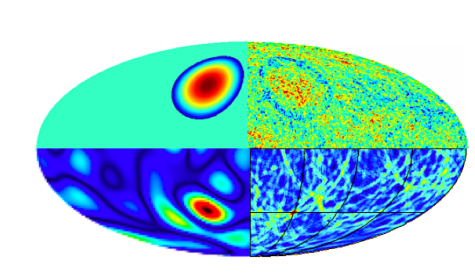
These bubbles probably had a violent past, jostling together and leaving “cosmic bruises” where they touched. If so, these bruises ought to be visible today in the cosmic microwave background.
Now Stephen Feeney at University College London and a few pals say they’ve found tentative evidence of this bruising in the form of circular patterns in cosmic microwave background. In fact, they’ve found four bruises, implying that our universe must have smashed into other bubbles at least four times in the past.
Again, this is an extraordinary result: the first evidence of universes beyond our own.
So, what to make of these discoveries. First, these effects could easily be a trick of the eye. As Feeney and co acknowledge: “it is rather easy to fifind all sorts of statistically unlikely properties in a large dataset like the CMB.” That’s for sure!
There are precautions statisticians can take to guard against this, which both Feeney and Penrose bring to bear in various ways.
But these are unlikely to settle the argument. In the last few weeks, several groups have confirmed Penrose’s finding while others have found no evidence for it. Expect a similar pattern for Feeney’s result.
The only way to settle this will be to confirm or refute the findings with better data. As luck would have it, new data is forthcoming thanks to the Planck spacecraft that is currently peering into the cosmic microwave background with more resolution and greater sensitivity than ever.
Cosmologists should have a decent data set to play with in a couple of years or so. When they get it, these circles should either spring into clear view or disappear into noise (rather like the mysterious Mars face that appeared in pictures of the red planet taken by Viking 1 and then disappeared in the higher resolution shots from the Mars Global Surveyor).
Planck should settle the matter; or, with any luck, introduce an even better mystery. In the meantime, there’s going to be some fascinating discussion about this data and what it implies about the nature of the Universe. We’ll be watching.
http://arxiv.org/abs/1012.1995: First Observational Tests of Eternal Inflation
http://arxiv.org/abs/1011.3706: Concentric Circles In WMAP Data May Provide Evidence Of Violent Pre-Big-Bang Activity

Kind of OT but when are we going back to the moon? Hard to believe it's been 30 years or so...use money from the public safety net to help fund a few new expeditions imo

no, there's robots there

armenians coming through in the clutch imo
borrrring.
If they can find a way to overcome the minimal-G environment than Adam Silver should be looking at expansion. There's money to be made

To be fair, Armenias technology is behind. The scientists assistant probably looked like this tbh


I've often thought they are billions of other universes out there. If our own universe contains 100 billion + galaxies and each galaxy has 100 billion+ stars, then why couldn't there be a 100 billion + universes? Such hubris to think there is only one universe.

Wow, big discovery.By that, they mean that each cycle ends with a big bang that starts the next cycle. In this model, the universe is a kind of cosmic Russian Doll, with all previous universes contained within the current one.
Do you have a link to the article above? The links provided don't take you there. Thanks.
Maybe our universe is just one of the many marbles that an alien plays with, like what's shown in the end of Man In Black 1
What frustrates me is the lack of evidence of outer life, I mean how is that possible given the fact there's billions of galaxies out there? Or whichever number is the correct one, doesnt matter.
You answered your own question - the universe is infinite. Bigger than we can fathom and putting the finding of life out of our grasp. For now at least.

There's a few billion planets in our galaxy located in habitable zones according to this:
http://www.theguardian.com/science/2...xy-life-kepler
So I figure there has to be life somewhere in those zones.
Not sure if there's life as advanced as us though.

Wow this is huge news.

So, what to make of these discoveries. First, these effects could easily be a trick of the eye. As Feeney and co acknowledge: “it is rather easy to find all sorts of statistically unlikely properties in a large dataset like the CMB.” That’s for sure!
There are precautions statisticians can take to guard against this, which both Feeney and Penrose bring to bear in various ways.
But these are unlikely to settle the argument. In the last few weeks, several groups have confirmed Penrose’s finding while others have found no evidence for it. Expect a similar pattern for Feeney’s result.
Welcome to science. Hardly open and shut at present.
There are other dimensions.

11, theoretically iirc

The article is from 2010: http://www.technologyreview.com/view...her-universes/
The good news is that from an astronomical perspective, the article is not very old at all...

Depends on how you define "universe". If defined as "all energy and matter that exists" then there's only one, but then saying there's only one universe is no different than saying there's only one reality. You can say there are more, but you've automatically destroyed them by claiming to know they exist.
Other than what?
Outside of quantum theory, there are 3. We as humans exist in 3 spatial dimensions.
Let's not confuse quantum theory with science fiction.
Last edited by DMC; 02-16-2014 at 03:19 PM.

there are 4 dimensions actually, time being the 4th one.
Last edited by gnsf0946; 02-16-2014 at 04:15 PM.
I'm too dumb to understand that tbh

now that idea is a......stretch.
There are currently 1 users browsing this thread. (0 members and 1 guests)
 Posting Permissions

