Reply With Quote
the trend of your posting seems to speak otherwise at times, but thanks for disclosing.

There's actually a spectrum of belief about AGW. I would place myself in the bucket labeled "luke warmers".

the trend of your posting seems to speak otherwise at times, but thanks for disclosing.
greenwashing
You moved on to your current tactic of mitigate rather then deny. You were crying about intolerance though. I did not realize that you were doing it from the guise of a martyr.
You are changing the subject. Rejecting disproven hypothesis is what it is. Empiricism is an objective standard.

Of course oil and gas companies bankroll AGU: its a place where they can do a lot of hiring. Energy companies are some of the largest - if not the largest - employers of all kinds of geoscientists. Trying to show that their support of the conference and group as some kind of attempt to show they aren't a big factor in fighting regulation over CO2 is pretty ing laughable.
Not quite as laughable as showing the Koch funding of BEST as some kind of way to show they support AGW research. They were pretty damn sure that BEST was going to show that pesky temperature record was wrong. Oops.
Darrin loves to say he believes in global warming but he never has said what he believes is a reasonable expectation of temperature increase and has never told us why studies who disagree with him are wrong. The reason Darrin finds himself flip flopping so much (LOL regretting a vote before someone even takes office) is because he displays incredibly shallow decision making.
As if 1000s of CLIMATE FACTS would have any "intelligence increasing effect" on AGW deniers
http://www.motherjones.com/environme...d-grow-monster
http://www.reuters.com/article/2014/...e=domesticNews
http://www.nationalmemo.com/un-weath...limate-change/
enviro-catastrophe? CA's drought is looking like the worst in 500 years, and shooting at 1000 years. ( tree ring FACTS!)
Good science doesn't depend on political ideology or who signs your paychecks. If you make reasonable assumptions, use appropriate methods, and your work can be replicated by others, then it is good science.
What is a reasonable expectation of temperature increase? I don't know.
But, I DO know, that what was predicted by computer models doesn't comport with observation.

Evidence of Acceleration of Anthropogenic Climate Disruption on All Fronts
http://truth-out.org/news/item/22999...ate-disruption
the planet is warming rapidly, but:
"Ignoring anthropogenic and other possible sources of variation acting at frequencies higher than one cycle per 19,000 years, this model predicts that the long-term cooling trend that began some 6,000 years ago will continue for the next 23,000 years."
http://en.wikipedia.org/wiki/Milan?kovitch_cycles
When one doesn't know then its best for them to STFU and not say the people are wrong.
On that basis, a whole lot of people need to STFU.
That strip of 40 degrees is about 15% of the earths crust. The CMIP estimates are whole earth. Now I do not know where the disconnect is because who knows what is data points they plucked from CMIPs data but that is ty misleading bull . Just like I expect from you.
It's cute that you saved graphs from the UAH guy on your cloud though.
Also here is the graph that the IPCC uses to present their case:
and here is the graphs legend:
http://www.ipcc.ch/publications_and_...n/faq-8-1.htmlErrata FAQ 8.1, Figure 1. Global mean near-surface temperatures over the 20th century from observations (black) and as obtained from 58 simulations produced by 14 different climate models driven by both natural and human-caused factors that influence climate (yellow). The mean of all these runs is also shown (thick red line). Temperature anomalies are shown relative to the 1901 to 1950 mean. Vertical grey lines indicate the timing of major volcanic eruptions. (Figure adapted from Chapter 9, Figure 9.5. Refer to corresponding caption for further details.)
That strip of 40 degrees is about 15% of the earths crust. The CMIP estimates are whole earth. Now I do not know where the disconnect is because who knows what the data points UAH guy plucked from CMIPs or how he selected the weather balloons but that is misleading bull .
It's cute that you saved graphs from the UAH guy on your cloud though.
Also here is the graph that the IPCC uses to present their case:
and here is the graphs legend:
http://www.ipcc.ch/publications_and_...n/faq-8-1.htmlErrata FAQ 8.1, Figure 1. Global mean near-surface temperatures over the 20th century from observations (black) and as obtained from 58 simulations produced by 14 different climate models driven by both natural and human-caused factors that influence climate (yellow). The mean of all these runs is also shown (thick red line). Temperature anomalies are shown relative to the 1901 to 1950 mean. Vertical grey lines indicate the timing of major volcanic eruptions. (Figure adapted from Chapter 9, Figure 9.5. Refer to corresponding caption for further details.)

as if anyone believes that
Actually, I still agree with most of it, up until you start talking about "tipping points" and Biblical-style catastrophes.
The Climate Deniers Are Using the Same Tactics as the Tobacco Industry
As it becomes increasingly obvious that global warming is entering doomsday scenario territory, the fossil fuel industry is ramping up the propaganda war.
Last week, the so-called Nongovernmental International Panel on Climate Change (NIPCC)
According to the NIPCC report, which was published by the conservative think tank the Heartland Ins ute, global warming is nothing to worry about. It's just a natural process that's happened hundreds of times before. If anything, the report concludes, global warming could be a good thing because extra CO2 in the atmosphere means more air for plants to breath.
Seriously.
Not surprisingly, Fox So-Called News has picked up on the NIPCC report and is treating it like real science.
But if you're wondering why 97 percent of scientists disagree with the NIPCC on global warming, Heartland Ins ute President Joseph Bast says it's because the entire climate science community has been "corrupted" by environmentalists.
In reality, though, it's the NIPCC and the Heartland ins ute that are corrupt and dishonest.
To quote Deep Throat, just follow the money.
The Heartland Ins ute, the think tank that published the NIPCC report, is largely funded by the fossil fuel industry and its allies. In fact, it's received around $67 million dollars over the past thirty years from donors like Exxon Mobil, the Koch Brothers, and the Scaife Foundation. All stand to get very, very rich if we continue pumping greenhouse gasses into the atmosphere.
The NIPCC report's leading authors, meanwhile, are a virtual who's who of the climate denial industry.
Dr. Fred Singer, the group's founder, has been pushing the lie that global warming isn't a big deal for decades now, and fossil fuel companies have helped him out all along the way.
Another author, Craig Idso, actually used to work for coal giant Peabody Energy.
Make no mistake about it: the NIPCC report is one giant scam created by the fossil fuel industry to trick the public into thinking global warming is a lie.
History, it seems, is repeating itself in the worst possible way. Back in the 1990s, the people behind the NIPCC climate change denial machine used to shill for another not-so-reputable industry: the tobacco industry.
As lawsuits and Congressional hearings turned public opinion turned against the tobacco industry, the Heartland Ins ute pushed out bunk study after bunk study claiming that there was no connection between secondhand smoke and cancer.
In 1998, for example, current Heartland President Joseph Bast argued in a piece for the think tank's website that the "EPA had to twist and torture its data to find a public health risk from secondhand smoke."
The Heartland Ins ute's PR campaign was so crucial to the tobacco industry's cause that Phillip Morris executive Tom Borelli actually listed supporting the Heartland Ins ute as one of his company's most important strategies in a 1993 memo called the "Five Year Plan"
At the same time as Heartland towed the big tobacco party line, NIPCC founder Fred Singer was busy pumping out some blatant pro-tobacco of his own. In 1993, he joined up with the Philip Morris' favorite PR firm APCO Associates to "debunk" studies showing the link between secondhand smoke and cancer.
All this, of course, was done to protect the interests of giant tobacco companies who denied in front of Congress that nicotine was addictive.
There are few coincidences in history. The fossil fuel industry today appears to be following the exact same script used by the tobacco industry in the 1990s.
http://truth-out.org/opinion/item/23...bacco-industry
you suckered, shilling AGW deniers are in company of some really nasty s.

Is global warming just a giant natural fluctuation?
Statistical analysis rules out natural-warming hypothesis with more than 99% certainty
An analysis of temperature data since 1500 all but rules out the possibility that global warming in the industrial era is just a natural fluctuation in the earth’s climate, according to a new study by McGill University physics professor Shaun Lovejoy.
The study, published online April 6 in the journal Climate Dynamics, represents a new approach to the question of whether global warming in the industrial era has been caused largely by man-made emissions from the burning of fossil fuels. Rather than using complex computer models to estimate the effects of greenhouse-gas emissions, Lovejoy examines historical data to assess the competing hypothesis: that warming over the past century is due to natural long-term variations in temperature.
“This study will be a blow to any remaining climate-change deniers,” Lovejoy says. “Their two most convincing arguments – that the warming is natural in origin, and that the computer models are wrong – are either directly contradicted by this analysis, or simply do not apply to it.”
Lovejoy’s study applies statistical methodology to determine the probability that global warming since 1880 is due to natural variability. His conclusion: the natural-warming hypothesis may be ruled out “with confidence levels great than 99%, and most likely greater than 99.9%.”
To assess the natural variability before much human interference, the new study uses “multi-proxy climate reconstructions” developed by scientists in recent years to estimate historical temperatures, as well as fluctuation-analysis techniques from nonlinear geophysics. The climate reconstructions take into account a variety of gauges found in nature, such as tree rings, ice cores, and lake sediments. And the fluctuation-analysis techniques make it possible to understand the temperature variations over wide ranges of time scales.
For the industrial era, Lovejoy’s analysis uses carbon-dioxide from the burning of fossil fuels as a proxy for all man-made climate influences – a simplification justified by the tight relationship between global economic activity and the emission of greenhouse gases and particulate pollution, he says. “This allows the new approach to implicitly include the cooling effects of particulate pollution that are still poorly quantified in computer models,” he adds.
While his new study makes no use of the huge computer models commonly used by scientists to estimate the magnitude of future climate change, Lovejoy’s findings effectively complement those of the International Panel on Climate Change (IPCC), he says. His study predicts, with 95% confidence, that a doubling of carbon-dioxide levels in the atmosphere would cause the climate to warm by between 2.5 and 4.2 degrees Celsius. That range is more precise than – but in line with -- the IPCC’s prediction that temperatures would rise by 1.5 to 4.5 degrees Celsius if CO2 concentrations double.
“We’ve had a fluctuation in average temperature that’s just huge since 1880 – on the order of about 0.9 degrees Celsius,” Lovejoy says. “This study shows that the odds of that being caused by natural fluctuations are less than one in a hundred and are likely to be less than one in a thousand.
“While the statistical rejection of a hypothesis can’t generally be used to conclude the truth of any specific alternative, in many cases – including this one – the rejection of one greatly enhances the credibility of the other.”
http://www.mcgill.ca/research/channe...tuation-235236
Good post, pusher, but the debate is not whether it has warmed or whether CO2 contributes to that warming. It's whether AGW is a "crisis".
Here's an actual debate on that question.
http://www.youtube.com/playlist?list=PL15C1190908095519
Yeah that is why you liked trotting out that graph and said that it hadn't warmed in a decade. You were a 'true believer' when? The 1980s?
This is all from the first few hundred posts of this thread:With all the "overwheming evidence" to support AGW, a sci-fi docudrama by a Nobel-winning ex vice president, and a more than willing mainstream media, you'd think that more than a third of the population would believe that humans cause climate change.
Why is getting harder and harder to sell this ROCK SOLID science?
http://www.spurstalk.com/forums/show...163637&page=10
Now everyone repeat after me, "Darrin is a lying piece of that cannot be trusted to tell the truth."
So when did you believe all of it? Give a specific year.
Darrin being Darrin.
It's whether AGW is a "crisis".
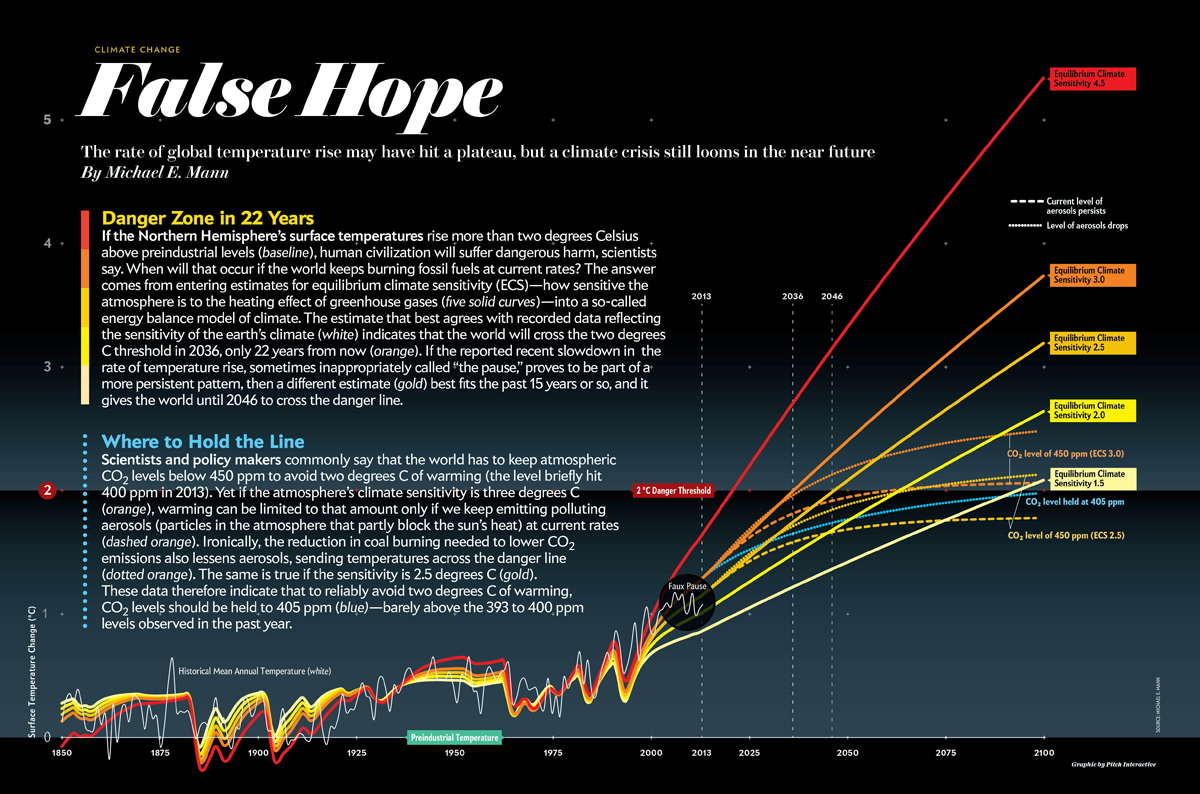
There are FACTS of the increasing CRISIS all around. The trajectory of global warming since coal and oil burning started in the 19th industrial revolution is well do ented, like a hockey stick to the head.
AGW facts and the initiations of multi-dimensional CRISES falls on WILLFULLY IGNORANT, IDEOLOGICALLY STUFFED ears.
http://www.nakedcapitalism.com/2014/04/gaius-publius-climate-scientist-michael-mann-dont-stop-now-well-surpass-2c-global-warming.html?utm_source=feedburner&utm_medium=feed &utm_campaign=Feed%3A+NakedCapitalism+%28naked+cap italism%29
BigCarbon has the power to confuse the public, has the $Bs to buy politicians, and so has power to block even discussion of AGW.
Greenland ice cores show industrial record of acid rain, success of U.S. Clean Air Act
The rise and fall of acid rain is a global experiment whose results are preserved in the geologic record.
By analyzing samples from the Greenland ice sheet, University of Washington atmospheric scientists found clear evidence of the U.S. Clean Air Act. They also discovered a link between air acidity and how nitrogen is preserved in layers of snow, according to a paper published this week in the Proceedings of the National Academy of Sciences.
Forty-five years ago, acid rain was killing fish and dissolving stone monuments on the East Coast. Air pollution rose beginning with the Industrial Revolution and started to improve when the U.S. Clean Air Act of 1970 required coal power plants and other polluters to scrub sulfur out of their smokestacks.
UW researchers began their study of ice cores interested in smog, not acid rain. They discovered a link between the two forms of pollution in the geologic record.
The rise and fall of acid rain is a global experiment whose results are preserved in the geologic record.By analyzing samples from the Greenland ice sheet, University of Washington atmospheric scientists found clear evidence of the U.S. Clean Air Act. They also discovered a link between air acidity and how nitrogen is preserved in layers of snow, according to a paperpublished this week in the Proceedings of the National Academy of Sciences.
suggests that ratio is sensitive to the same chemicals that cause acid rain.
“This shows that the relationship between emissions and the isotopes is less direct than we thought, and the final signal recorded in the
Greenland ice cores is actually not just the nitrogen emission, but the combined effect of sulfur and nitrogen emissions,”
Read more at http://scienceblog.com/71653/greenla...brF3Kprm3BG.99
hmm, a GOVT POLICY caused a change in CORPORATE BEHAVIOR that reduced pollution?
Kock Suckers most certainly disagree
Climate Panel Stunner: Avoiding Climate Catastrophe Is Super Cheap — But Only If We Act Now
You read that right, the annual growth loss to preserve a livable climate is 0.06% — and that’s “relative to annualized consumption growth in the baseline that is between 1.6% and 3% per year.” So we’re talking annual growth of, say 2.24% rather than 2.30% to save billions and billions of people from needless suffering for decades if not centuries. As always, every word of the report was signed off on by every major government in the world.
Global mitigation costs for stabilization at a level “likely” to stay below 2°C (3.6°F). Cost estimates shown in this table do not consider the benefits of reduced climate change as well as co-benefits of mitigation. The green columns show the consumption loss in the years 2030, 2050, and 2100 relative to a baseline development without climate policy. The light green column shows that the annualized consumption growth reduction over the century is 0.06%. Source: IPCC 2014.
Moreover, this does not even count the economic benefit of avoiding climate catastrophe. Afew years ago, scientists calculated that benefit as having a net present value of $615 to $830 trillion. That means our current do-nothing plan is actually far, far costlier than aggressive climate mitigation.
And the IPCC warns “Delaying is estimated to … substantially increase the difficulty of the transition to low, longer-term emissions levels and narrow the range of options consistent with maintaining temperature change below 2 degrees C.”
These are not new findings. In its previous Fourth Assessment (AR4) in 2007, the IPCC found the cost of stabilizing at 445 ppm CO2-eq corresponded to “slowing average annual global GDP growth by less than 0.12 percentage points.”
These conclusions should not be a surprise since they are based on a review of the literature — and every major independent study has found a remarkably low net cost for climate action — and a high cost for delay. Back in 2011, the International Energy Agency warned“Delaying action is a false economy: for every $1 of investment in cleaner technology that is avoided in the power sector before 2020, an additional $4.30 would need to be spent after 2020 to compensate for the increased emissions.”
As German economist Ottmar Edenhofer, a co-chair of the IPCC committee that wrote the new report, put it, “We cannot afford to lose another decade. If we lose another decade, it becomes extremely costly to achieve climate stabilization.”
http://www.dailykos.com/story/2014/0...28Daily+Kos%29
Of course, BigCarbon, and their proxies like ALEC, US CoC, etc will block ALL AGW mitigation.
There are currently 1 users browsing this thread. (0 members and 1 guests)
 Posting Permissions