Reply With Quote
So basically he'd be the exact same as any other soccer player, except with a legit injury?


Higuita, the colombian goalkeeper, did his best Westchimp impression in the 90 worlds. All the another 10 Durants just stared a tosb Milla doing it.


So basically he'd be the exact same as any other soccer player, except with a legit injury?
Some soccer players are faster than any NBA player. Most of the soccer players have better vertical than most of the NBA player. For example, Cristiano Ronaldo can reach 30.7086614 inches of vertical impulsion, Arjen Robben can reach 22.9907341 miles/hour in a sprint.
I don't like soccer, I think it make people dumb and nationalistic. But there are lots of bull here.
Last edited by PingPong; 07-15-2014 at 11:30 AM.
I'd like to see LeCramps running 26,5325499 miles in four games in six days. LOL.
Pretending that soccer players don't waste half the game time celebrating, pouting, and rolling around on the ground faking injuries instead of running

You see what you want to see. Brazilians, argentinians do it a lot because of their soccer school. Europeans like Germans, britons, don't waste much time faking injuries or anything else. And the premier league is more brutal than any american sport.
It doesn't mean if you don't put the inequality in the table. The european countries have more equal societies, without big income disparities. Almost everyone have good living standards. In the U.S. millions of citizens live under the poverty line and some makes billions. In the Latin America, the disparities are even bigger than U.S.
For example, Brazil is the 5th country with most billionaires in the world, ahead of U.K, France, Italy, Canada, Australia, South Korea, Japan, Switzerland, Sweden. But most of the brazilians are living in low living standards, being one of most inequal countries of the world.
Last edited by PingPong; 07-15-2014 at 03:20 PM.


You have a good point. I won't watch nearly as many games as I have this past month but I will still catch a game when possible. I watched the Sounders vs. Timber on Sunday and it was pretty entertaining with Dempsey and Yedlin looking like they were the best on the pitch and Dempsey scored a tremendous goal. I will catch as many Arsenal/Barca games as I can since I do have the Soccer Channel and all the other channels that will have the EPL. I follow the NFL, NBA, NHL, and MLB on a regular basis. If i'm not watching the games, I'm reading up and keeping an eye on the scores.
Spanish and italians flop all the time too. But in the english premier league...
The kid almost had his feet amputed. The skin was the only thing holding it. Volleyball and basketball players are injured more often because the hard ground generates more impact than grass, but soccer can be brutal too.

Which is why it would be best suited for USA to split up into 3 or more separate nations. Then the disparities wouldn't be city to city or even in some cases neighborhood to neighborhood.


It appears you don't know how polls work.
Most European countries are taxed higher, at every level, this is why their "wealth inequality" (in itself a spurious term) is closer. Canada (which has a European style universal healthcare system) taxes the average family 10K per year to pay for their "free" healthcare.very cute but monstrously skewed. It doesn't account :
- taxation, especially federal tax
In 2013, a typical Canadian family of four can expect to pay $11,320 for public health care insurance. For the average family of two parents with one child that bill will be $10,989, and for the average family of two adults (without children) the bill comes to $11,381. As a result of lower average incomes and differences in taxation, the bills are smaller for the average unattached individual ($3,780), for the average one-parent-one-child family ($3,905), and the average one-parent two-child family ($3,387). But no matter the family type, the bill is not small, much less free.
http://www.huffingtonpost.ca/nadeem-...b_3733080.html
Somewhat true, but overstated. Idiots like you look at the number of vacation days that are legally required by the Government for employers to give their employees and conclude "Oh my God, US workers get no days off!" Since we're not a Nanny State, the number of vacation days to give an employee is determined by the employer, which is the way it should be. What if a firm needs their workers to work straight through a month to meet a deadline? Or to work 16 hour shifts? I can already hear you bemoaning the "inhumanity" of this, but I'm not talking about a retail job at Walmart here. In a corporate environment, sometimes workers need to sacrifice like this, and usually, they're up for it, since they're ambitious and trying to climb the proverbial corporate ladder. This is why little innovation comes out of Europe and an overwhelming number of companies on the Forbes 500 are American. Even the highly touted "German Engineering" isn't what it once was. The Japs and even American cars are outperforming Germany in most classes.- productivity per hour : americans work more per day and have much fewer vacation days than europeans. You can look it up if you want, all the figures show it. Please don't troll and take the EU figures which include the economic powerhouses of Poland, Estonia or Bulgaria.
http://www.autoguide.com/auto-news/2...gineering.html
http://www.consumerreports.org/cro/m...2014/index.htm
And when is the last time anything of note has come out of the digital/electronics space from Europe? (I'm sure there's something, but I can't think of anything off the top of my head, which demonstrates Europe's irrelevancy here. Meanwhile, Samsung, Sony, Google, Microsoft, Apple, are worldwide household names)
Healthcare is fine here. Even illegal immigrants can have babies in an American hospital and the tax payers pick up the bill. And here in Southern California, there's a host of socialized healthcare options that are quite good. On the safety issues, I agree that European countries/large cities are overall safer. I can't argue against that fact.- the benefits of a working social system which include but are not limited to a functional health care. How is that medicare working for you? I heard it is quite expensive tbh and not that efficient. Or how about safety? How do you compare New york to Paris? Miami to Barcelona? Berlin to Los Angeles? Chicago to Vienna? Detroit to Copenhagen?
Jesus, shut up about "wealth inequality," I don't think you understand how that doesn't relate to quality of life at all. Cost of living should be the foundational metric here. So what if the "ebil 99%" controls all the wealth (which isn't really true). Take a fictional society where it costs 1000.00 a year to live a decent, healthy life. 98% of these citizens make 50K per year while the top 2% make 1 billion per year. On "paper," the wealth inequality is deplorable, but the country's standard of living is fine.- the fact that the quality of life, human development index and all the other quality metrics out there put all these european cities much higher on their lists which means that the administration must be more efficient in spending the tax revenue resulting in indirect purchasing power. Of course those metrics should be used with their inequality adjusted variants as to represent a statstical reality closer to the median than to the mean.
Gini coefficient is yet another political tool used to manipulate policy. It's a flawed metric, as explained:
Gini coefficients are simple, and this simplicity can lead to oversights and can confuse the comparison of different populations; for example, while both Bangladesh (per capita income of $1,693) and the Netherlands (per capita income of $42,183) had an income Gini index of 0.31 in 2010,[53] the quality of life, economic opportunity and absolute income in these countries are very different, i.e. countries may have identical Gini coefficients, but differ greatly in wealth. Basic necessities may be available to all in a developed economy, while in an undeveloped economy with the same Gini coefficient, basic necessities may be unavailable to most or unequally available, due to lower absolute wealth.
You've obviously never lived in the US for any extended period of time. Our "poor" have a wealth (no pun intended) of social programs available to them that put their standard of living well above the OECD average.
http://www.forbes.com/sites/timworst...t-of-humanity/
Our HDI is also 3rd highest in the world.
If you think the average american lives better than the average german / austrian/ dutchman/ dane/ swede/ finn you are wrong tbh. I recommend visiting those countries to experience another reality. And if you think the average american compares to the average swiss/norwegian/luxembourgian you are out of your mind. Go there to experience first hand dudes selling you hamburgers at mcdonalds who drive a brand new audi like I saw in oslo or in zurich... these dudes are way way way ahead, not even a discussion.
Please don't. Your whole "argument" has been nothing but spouting subjective bull . You back nothing up with facts and figures, and simply commit the "argument from experience" fallacy over and over again.I won't even go into cultural things and their implications in the quality of life discussion because I tried to keep this a pure economics argument, it would make this one a laugher.

They tried that once. Didn't work out so well.

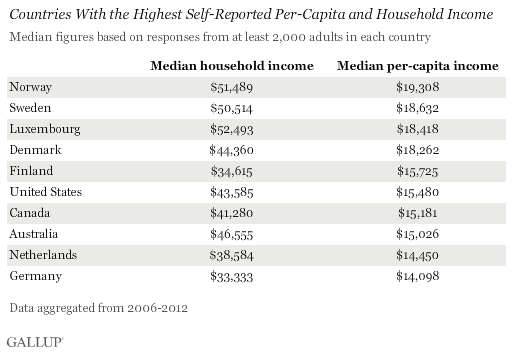
it appears you don't understand how statistics work and what is a meaningful sample size. 2000 for a population of 300+ million is a absolutely too low and too bias prone. https://en.wikipedia.org/wiki/Sample_size_determination
http://scalar.usc.edu/works/growing-...can-inequality cry me a river.
https://en.wikipedia.org/wiki/Income..._United_States
https://en.wikipedia.org/wiki/Tax_po..._United_States
so basically the entire civilized world understands that high taxation of wealth leads to a better balance in capitalism and a better balanced free market but you take the most basic form of the equation and realize that the absolute difference is lower on high taxation and only that affects inequality.
Tbh I think you are either an idiot or a troll. Why not go back to working in the mines since the country is in recession to help her? Nevermind said recession came from predatory unchecked economics in which the average joe had 0% control and from which he got fired in the layoffs that came after the nice dividents. But the company needs him
How about providing a decent life and a balance for a family?. Nobody gives a about who invented what, the only thing that matters is for a state to provide for its citizens. LMAO thinking people in south korea/japan are close to happy when their suicide rates trumple all in oecd.
Apple payed 2% of profit in taxes for the last 10 years. All the other big companies are comparable. All that worker hard work is finally coming back as economic value to the community
@engineering... look at detroit and then look at stuttgart/munich. You tell me which manufacturer is doing a better job for his workers... that's economy right? People working for living better. Or do you prefer the food-for-oil sustainable process?
Also Nokia, Bayer, german cars, AirBus, Maersk, Deutche Bank etc are household names too.
And generally from a market standpoint: http://blogs.reuters.com/great-debat...urope-contest/
quote:
"It marshals an impressive army of facts and comparative statistics to show that the United States is behind Europe in nearly every socio-economic category that can be measured and that neither America’s trickle-down, Wall Street-driven capitalism nor China’s state capitalism hold the keys to the future. While China’s growth has been impressive, says Hill, the country remains, in essence, a sub-contractor to the West and is racked by internal contradictions.
“When I talk to American audiences,” Hill said in an interview, “many find the figures I cite hard to believe. They haven’t heard them before. U.S. businesses making more profits in Europe than anywhere else, 20 times more than in China? 179 of the world’s top companies are European compared with 140 American? That does not fit the preconceptions.”
how about reading instead of living in a fairytale?
http://www.commonwealthfund.org/~/media/Files/Publications/Issue%20Brief/2011/Jul/1532_Squires_US_hlt_sys_comparison_12_nations_intl _brief_v2.pdf
http://dpeaflcio.org/the-u-s-health-...l-perspective/
it seems other healthcare systems perform significanty better while having lower overall costs per individual.
Direct quote:
- Despite the relatively high level of health expenditure, in the U.S. there are fewer physicians per capita than in most other OECD countries. In 2011, the U.S. had 2.4 practicing physicians per 1,000 people—below the OECD average of 3.1.[64]
- In the U.S., there are only about 1.2 primary care physicians per 1,000 people. Projections indicate that the U.S. will need 52,000 more primary care physicians by 2025 to meet demand.[65] While population growth and aging make up a substantial proportion of this increased need, expanded access to insurance under the Affordable Care Act means more people will seek out treatment. Therefore, there are provisions in the legislation to increase the number of primary care physicians in the U.S.
- There is a significant spatial mismatch within the United States for physicians as well. While the U.S. averages 226 doctors active in patient care per 100,000 people in 2012, there is a wide variance across states; Massachusetts ranks highest with 324.1 active doctors per 100,000 people, while Mississippi has only 164.4.[66]
- In 2011, the U.S. infant mortality rate was 6.1 per 1,000 live births, while the OECD median was 4.1.[67]
- The obesity rate among adults in the U.S. was 36.5 percent in 2011, up from 33.8 percent in 2008. This is the highest rate among OECD countries. The average for the OECD countries was 17.6 percent in 2011.[68]
http://www.washingtonpost.com/blogs/...s-ranked-34th/
http://www.economist.com/blogs/butto...ife-expectancy
http://www.nytimes.com/2012/01/05/us...anted=all&_r=0
http://20somethingfinance.com/american-hours-worked-productivity-vacation/
https://en.wikipedia.org/wiki/List_of_countries_by_inequality-adjusted_HDI .... in reality it is 16th not bad but a far cry from norway/sweden/germany.
how about using data from right now? http://www.oecdbetterlifeindex.org/t...-satisfaction/
quality of life in cities, usa nowhere to be found..
https://en.wikipedia.org/wiki/Mercer..._Living_Survey
https://en.wikipedia.org/wiki/World%...livable_cities
http://www.businessinsider.com/monoc...fe-2011-6?op=1
other links:
http://www.eoionline.org/blog/myth-6...united-states/
Reality son.
I only gave the argument from experience once, as it was very revealing and not some statistical aberration. People really live very very nice in norway/swiss/luxembourg, far far far better than us and better than the rest of eu/oecd.
But whatever re , if the facts &links are not enough for you you can continue enjoying the american dream, and god bless tbh, hope some be@ner/ won't gun you down for 10 bucks.
Official Census statistics has the US Median Income (as of 2014) at 53K
http://quickfacts.census.gov/qfd/states/00000.html
Polls are good for an estimate and usually prove to be rather accurate when compared to harder data. So actually, the "harder data" has the US at 9K higher
Is this where you blather on about "wealth inequality" again?
Also, poverty rate:
US: 14.9
Germany: 15.1
EU: 16.4
http://www.wsws.org/en/articles/2014.../germ-j06.html
http://www.inequalitywatch.eu/spip.php?article99
http://scalar.usc.edu/works/growing-...can-inequality cry me a river.
https://en.wikipedia.org/wiki/Income..._United_States
https://en.wikipedia.org/wiki/Tax_po..._United_States
so basically the entire civilized world understands that high taxation of wealth leads to a better balance in capitalism and a better balanced free market but you take the most basic form of the equation and realize that the absolute difference is lower on high taxation and only that affects inequality.
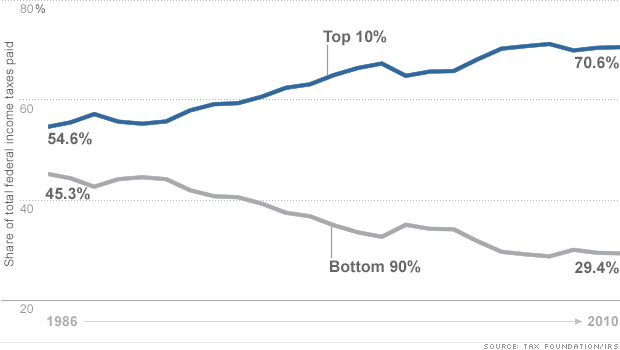
http://money.cnn.com/2013/03/12/news...my/rich-taxes/
Anyhow, you're going off on a tangent. You stated that the figure (median income) I posted can't be taken seriously because it isn't after tax (which it is, see above data figure) and that the American Middle Class pays more in taxes than their European counterparts. Not true at all.
Europe’s top marginal tax rates kick in at middle-income levels (Belgium at $46,000, Netherlands at $72,000, and France at $92,000). Only in Germany does it register at an income level ($326,000) comparable to the United States ($379,000). Europe applies its highest marginal income tax rates to middle class incomes by U.S. standards. The European middle class pays marginal tax rates similar to the highest tax rates in the United States.
http://www.forbes.com/sites/paulrode...tlement-state/
And here's an OP-ED that examines how the middle-class would have to pay MORE in taxes so that we can fund a European-Style Welfare State for the purpose of helping the poor.
http://www.american.com/archive/2013...the-98-percentThe only way to finance a big European-style state is to have it paid for by massive taxation of everyone, mostly the middle class. Right now, we are avoiding honest debate on this fact.
The second truth is that you cannot pay for the Life of Julia, or any vision of a cradle-to-grave welfare state, without massive and increasingly regressive middle-class taxes. The poor don't have the money to pay for a European-style welfare state, and the rich, rich as they are, don't have anywhere near enough.
The author even argues AGAINST over-taxing the rich:
but soaking the rich means taxing investments. Investments are complicated and can be restructured to minimize taxes. Also, investments are the lifeblood of economic growth. Raising significantly more taxes from the rich also requires higher marginal tax rates — and their rates are already quite high. High marginal rates distort the economy and yield less revenue than anticipated because they increase the rewards for legal and illegal tax avoidance.
And a truth bomb:
Klein is mild compared to Eduardo Porter, who writes in the New York Times on November 27th, “Many Americans may find this hard to believe, but the United States already has one of the most progressive tax systems in the developed world” and “Taxes on American households do more to redistribute resources and reduce inequality than the tax codes of most other rich nations.” Mr. Porter, it is shocking to see you argue in the New York Times that the United States is a progressive paragon! Those in the Occupy Wall Street movement must be surprised to learn that you, one of their standard-bearers, think the United States already does considerably more redistribution than Western Europe!
These pundits know the math. To achieve anything like the European-style en lement state they advocate, we need to tax everyone a lot more, not just the 1 percent. Despite all the drum circles protesting the inequitable distribution of resources, the wealthy just don’t have enough. The middle class and even the poor must step up to carry more of the burden if this is our desired endgame.
In other words, that's how Europe pays for its Nanny State, by heavily taxing the middle-class on the same level as the rich (again, refer to the Forbes article that illustrates this).
Conclusion: The average Middle Class American has more purchasing power than the average Middle Class European. All the data supports this, from PPP (per capita) to Median (after tax) Income. As for the poor, the social programs are quite generous and are shown to raise their standard of living well above the OECD average.
Tbh I think you are either an idiot or a troll. Why not go back to working in the mines since the country is in recession to help her? Nevermind said recession came from predatory unchecked economics in which the average joe had 0% control and from which he got fired in the layoffs that came after the nice dividents. But the company needs him
How about providing a decent life and a balance for a family?. Nobody gives a about who invented what, the only thing that matters is for a state to provide for its citizens. LMAO thinking people in south korea/japan are close to happy when their suicide rates trumple all in oecd.
Apple payed 2% of profit in taxes for the last 10 years. All the other big companies are comparable. All that worker hard work is finally coming back as economic value to the community
@engineering... look at detroit and then look at stuttgart/munich. You tell me which manufacturer is doing a better job for his workers... that's economy right? People working for living better. Or do you prefer the food-for-oil sustainable process?
Also Nokia, Bayer, german cars, AirBus, Maersk, Deutche Bank etc are household names too.
And generally from a market standpoint: http://blogs.reuters.com/great-debat...urope-contest/
quote:
"It marshals an impressive army of facts and comparative statistics to show that the United States is behind Europe in nearly every socio-economic category that can be measured and that neither America’s trickle-down, Wall Street-driven capitalism nor China’s state capitalism hold the keys to the future. While China’s growth has been impressive, says Hill, the country remains, in essence, a sub-contractor to the West and is racked by internal contradictions.
“When I talk to American audiences,” Hill said in an interview, “many find the figures I cite hard to believe. They haven’t heard them before. U.S. businesses making more profits in Europe than anywhere else, 20 times more than in China? 179 of the world’s top companies are European compared with 140 American? That does not fit the preconceptions.”
The US population isn't as dense as the European population. Of course we're going to have lesser physicians per capita. And as far your "metrics" go:
how about reading instead of living in a fairytale?
http://www.commonwealthfund.org/~/media/Files/Publications/Issue%20Brief/2011/Jul/1532_Squires_US_hlt_sys_comparison_12_nations_intl _brief_v2.pdf
http://dpeaflcio.org/the-u-s-health-...l-perspective/
it seems other healthcare systems perform significanty better while having lower overall costs per individual.
Direct quote:
- Despite the relatively high level of health expenditure, in the U.S. there are fewer physicians per capita than in most other OECD countries. In 2011, the U.S. had 2.4 practicing physicians per 1,000 people—below the OECD average of 3.1.[64]
- In the U.S., there are only about 1.2 primary care physicians per 1,000 people. Projections indicate that the U.S. will need 52,000 more primary care physicians by 2025 to meet demand.[65] While population growth and aging make up a substantial proportion of this increased need, expanded access to insurance under the Affordable Care Act means more people will seek out treatment. Therefore, there are provisions in the legislation to increase the number of primary care physicians in the U.S.
- There is a significant spatial mismatch within the United States for physicians as well. While the U.S. averages 226 doctors active in patient care per 100,000 people in 2012, there is a wide variance across states; Massachusetts ranks highest with 324.1 active doctors per 100,000 people, while Mississippi has only 164.4.[66]
- In 2011, the U.S. infant mortality rate was 6.1 per 1,000 live births, while the OECD median was 4.1.[67]
- The obesity rate among adults in the U.S. was 36.5 percent in 2011, up from 33.8 percent in 2008. This is the highest rate among OECD countries. The average for the OECD countries was 17.6 percent in 2011.[68]
http://www.washingtonpost.com/blogs/...s-ranked-34th/
http://www.economist.com/blogs/butto...ife-expectancy
http://www.nytimes.com/2012/01/05/us...anted=all&_r=0
http://20somethingfinance.com/american-hours-worked-productivity-vacation/
[B]We need to go behind those numbers though and have a look at how they are calculated. It's not all that unusual for international statistics of these kinds to contain some, well, how to put this, odd assumptions. The answers to that are here. This is what the WHO uses to calculate those numbers and the weightings they put upon them.
1. Health Level: 25%
2. Health Distribution: 25%
3. Responsiveness: 12.5%
4. Responsiveness Distribution: 12.5%
5. Financial Fairness: 25%
As you can see, there's a great deal of assuming going on there about what makes a decent health care system. In fact, only 37.5% of the weighting is actually about health care itself: the other 62.5% is about distribution and fairness, how equal or unequal it all is.
I take it from that that what the (yes, hugely expensive) US health care system actually offers is responsiveness. That when we desire to be looked at, we get looked at. When we need or desire treatment then we get it faster than any place else on the planet. That's simply an extremely expensive thing to provide.
http://www.examiner.com/article/amer...care-the-world
http://oregoncatalyst.com/2594-Chart...han-world.html
And citing obesity rates and life expectancy has more to do with life style choices than quality of healthcare.
Our healthcare system is a miracle considering the geographic size and population of this country. This is what you Euros don't understand. You compare a 320 million population country the size of a continent with a country like Sweden, the size of a small state with the population of a large American city. We also have some of the openest borders on the planet, which means they're will always be a poor immigrant underclass. Why should we further tax our citizens to "provide" services for these people? You might think I'm being callous, but the fact of the matter is, these immigrants are far better off here, even without these social benefits, than they are selling gum in a Mexican border town.
I'm not claiming our healthcare system is the best in the world, but it's pretty good, all things considered.
I already demonstrated the flaws in Income Inequality metrics. From the IHDI Wiki:
https://en.wikipedia.org/wiki/List_of_countries_by_inequality-adjusted_HDI .... in reality it is 16th not bad but a far cry from norway/sweden/germany.
how about using data from right now? http://www.oecdbetterlifeindex.org/t...-satisfaction/
This is an experimental measure that will be subject to changes in the future. One issue is in the inequality adjusted income index, which forms a third of the overall index. Effectively countries with much lower inequality adjusted GNI will score higher in the income index than other countries who have higher inequality adjusted GNI, but higher inequality. For example, country A has GNI per capita of $40,000 (index= .858), inequality adjusted GNI per capita of $30,000 (index=.816), and country B has a GNI per capita of $18,000 (.743), inequality adjusted GNI per capita of $16,000 (.735). So country A is clearly better off by both measures. However, this is not the way the inequality adjusted income index is calculated. As the text says, "The HDI income index is adjusted for inequality in income distribution based on data from household surveys." [3] It is the index itself which is adjusted for inequality. Thus, for country A, the index of (.858) gets multiplied by the ratio (.1478/.166)=.642. For country B, the index of (.735) gets multiplied by the ratio (16,000/18,000)=.661. Therefore, country B has a higher income index in terms of income even though it actually receives about half the income of country B
Quit using ty inequality metrics.
As for "using data from right now."
Sure:
Only 4 European countries can post a "Better Life" than the US.
http://www.oecdbetterlifeindex.org/#/55555555555
Considering those countries are the size of some American cities compared to our 320 million large melting pot, it's a damn miracle we're this functional. Speaks to our greatness.
I would admit large European cities are more livable than large American cities, since elements like public safety and pollution are better in European cities. But I'd still rather live in an American city/Suburb because cost of living is much cheaper while the quality of life isn't much worse. 8 US cities still made the top 50:quality of life in cities, usa nowhere to be found..
https://en.wikipedia.org/wiki/Mercer..._Living_Survey
https://en.wikipedia.org/wiki/World%...livable_cities
http://www.businessinsider.com/monoc...fe-2011-6?op=1
other links:
http://www.eoionline.org/blog/myth-6...united-states/
https://en.wikipedia.org/wiki/Mercer..._Living_Survey
The stats don't show that. Sorry. Better? Maybe. Far better? No.I only gave the argument from experience once, as it was very revealing and not some statistical aberration. People really live very very nice in norway/swiss/luxembourg, far far far better than us and better than the rest of eu/oecd.
But whatever re , if the facts &links are not enough for you you can continue enjoying the american dream, and god bless tbh, hope some be@ner/ won't gun you down for 10 bucks.
http://chalcedon.edu/Research/Articl... sexuality/
Last edited by midnightpulp; 07-15-2014 at 09:13 PM.

Europe would've been head and shoulders ahead of USA right now if they didn't play around with Socialism, tbh. When much of Europe was having cute little 'economic' revolutions, Americans were busy innovating, selling, and making money. It's amazing what America has actually achieved in just over 200 years of independence.

People totally ignoring the fact that the recently crowned NBA championships borrowed elements of soccer (futbol) into the offense, using team work, skills, and ball movement to neutralize athleticism.

is there a team sport outside of baseball that doesn't stress ball movement/passing, tbh?
What is funny is the ignorance of the general Americans about sports outside of the big 4 (mostly big 3) sports.
http://www.thenational.ae/thenationa...-of-basketball
http://www.examiner.com/article/san-...ootball-part-1
http://butthegameison.com/5037/tiki-taka/
Well, the NBA in the 90s and 00s.

There are currently 1 users browsing this thread. (0 members and 1 guests)
 Posting Permissions