Reply With Quote
Raiu is wrong on this, IMO. It's actually not that hard to reverse-engineer the flash, which is not encrypted, btw. Especially with limitless resources. It's been actually done many times before on emulation projects.

http://www.reuters.com/article/2015/...0LK1QV20150217
(Reuters) - The U.S. National Security Agency has figured out how to hide spying software deep within hard drives made by Western Digital, Seagate, Toshiba and other top manufacturers, giving the agency the means to eavesdrop on the majority of the world's computers, according to cyber researchers and former operatives.
That long-sought and closely guarded ability was part of a cluster of spying programs discovered by Kaspersky Lab, the Moscow-based security software maker that has exposed a series of Western cyberespionage operations.
Kaspersky said it found personal computers in 30 countries infected with one or more of the spying programs, with the most infections seen in Iran, followed by Russia, Pakistan, Afghanistan, China, Mali, Syria, Yemen and Algeria. The targets included government and military ins utions, telecommunication companies, banks, energy companies, nuclear researchers, media, and Islamic activists, Kaspersky said. (reut.rs/1L5knm0)
The firm declined to publicly name the country behind the spying campaign, but said it was closely linked to Stuxnet, the NSA-led cyberweapon that was used to attack Iran's uranium enrichment facility. The NSA is the U.S. agency responsible for gathering electronic intelligence.
A former NSA employee told Reuters that Kaspersky's analysis was correct, and that people still in the spy agency valued these espionage programs as highly as Stuxnet. Another former intelligence operative confirmed that the NSA had developed the prized technique of concealing spyware in hard drives, but said he did not know which spy efforts relied on it.
NSA spokeswoman Vanee Vines said the agency was aware of the Kaspersky report but would not comment on it publicly.
Kaspersky on Monday published the technical details of its research on Monday, a move that could help infected ins utions detect the spying programs, some of which trace back as far as 2001. (bit.ly/17bPUUe)
The disclosure could hurt the NSA's surveillance abilities, already damaged by massive leaks by former contractor Edward Snowden. Snowden's revelations have upset some U.S. allies and slowed the sales of U.S. technology products abroad.
The exposure of these new spying tools could lead to greater backlash against Western technology, particularly in countries such as China, which is already drafting regulations that would require most bank technology suppliers to proffer copies of their software code for inspection.
Peter Swire, one of five members of U.S. President Barack Obama's Review Group on Intelligence and Communications Technology, said the Kaspersky report showed that it is essential for the country to consider the possible impact on trade and diplomatic relations before deciding to use its knowledge of software flaws for intelligence gathering.
"There can be serious negative effects on other U.S. interests," Swire said.
TECHNOLOGICAL BREAKTHROUGH
According to Kaspersky, the spies made a technological breakthrough by figuring out how to lodge malicious software in the obscure code called firmware that launches every time a computer is turned on.
Disk drive firmware is viewed by spies and cybersecurity experts as the second-most valuable real estate on a PC for a hacker, second only to the BIOS code invoked automatically as a computer boots up.
"The hardware will be able to infect the computer over and over," lead Kaspersky researcher Costin Raiu said in an interview.
Though the leaders of the still-active espionage campaign could have taken control of thousands of PCs, giving them the ability to steal files or eavesdrop on anything they wanted, the spies were selective and only established full remote control over machines belonging to the most desirable foreign targets, according to Raiu. He said Kaspersky found only a few especially high-value computers with the hard-drive infections.
Kaspersky's reconstructions of the spying programs show that they could work in disk drives sold by more than a dozen companies, comprising essentially the entire market. They include Western Digital Corp, Seagate Technology Plc, Toshiba Corp, ***, Micron Technology Inc and Samsung Electronics Co Ltd.
Western Digital, Seagate and Micron said they had no knowledge of these spying programs. Toshiba and Samsung declined to comment. *** did not respond to requests for comment.
GETTING THE SOURCE CODE
Raiu said the authors of the spying programs must have had access to the proprietary source code that directs the actions of the hard drives. That code can serve as a roadmap to vulnerabilities, allowing those who study it to launch attacks much more easily.
"There is zero chance that someone could rewrite the [hard drive] operating system using public information," Raiu said.
Concerns about access to source code flared after a series of high-profile cyberattacks on Google Inc and other U.S. companies in 2009 that were blamed on China. Investigators have said they found evidence that the hackers gained access to source code from several big U.S. tech and defense companies.
It is not clear how the NSA may have obtained the hard drives' source code. Western Digital spokesman Steve Shattuck said the company "has not provided its source code to government agencies." The other hard drive makers would not say if they had shared their source code with the NSA.
Seagate spokesman Clive Over said it has "secure measures to prevent tampering or reverse engineering of its firmware and other technologies." Micron spokesman Daniel Francisco said the company took the security of its products seriously and "we are not aware of any instances of foreign code."
According to former intelligence operatives, the NSA has multiple ways of obtaining source code from tech companies, including asking directly and posing as a software developer. If a company wants to sell products to the Pentagon or another sensitive U.S. agency, the government can request a security audit to make sure the source code is safe.
"They don't admit it, but they do say, 'We're going to do an evaluation, we need the source code,'" said Vincent Liu, a partner at security consulting firm Bishop Fox and former NSA analyst. "It's usually the NSA doing the evaluation, and it's a pretty small leap to say they're going to keep that source code."
The NSA declined to comment on any allegations in the Kaspersky report. Vines said the agency complies with the law and White House directives to protect the United States and its allies "from a wide array of serious threats."
Kaspersky called the authors of the spying program "the Equation group," named after their embrace of complex encryption formulas.
The group used a variety of means to spread other spying programs, such as by compromising jihadist websites, infecting USB sticks and CDs, and developing a self-spreading computer worm called Fanny, Kaspersky said.
Fanny was like Stuxnet in that it exploited two of the same undisclosed software flaws, known as "zero days," which strongly suggested collaboration by the authors, Raiu said. He added that it was "quite possible" that the Equation group used Fanny to scout out targets for Stuxnet in Iran and spread the virus.
Raiu is wrong on this, IMO. It's actually not that hard to reverse-engineer the flash, which is not encrypted, btw. Especially with limitless resources. It's been actually done many times before on emulation projects.
thanks for sharing.... Snowden really opened up a trove of information about this stuff.

http://www.wired.com/2015/02/kapersk...quation-group/Kaspersky has found 500 victims in some 30 countries infected with EquationLaser, EquationDrug and GrayFish components. But having been active for more than a decade, it’s likely the spy tools have infected tens of thousands of systems. Each time a machine is infected, the malware places a timestamp in the victim’s registry along with a counter that increases with each victim. Based on counters found on victim machines, the victims appear to increase at a rate of about 2,000 a month.
The largest number of victims have been targeted in Iran, but there are also victims in Russia, Afghanistan, Pakistan, Belgium, Germany, Sudan, Lebanon, the Palestinian Territories, the United States and the UK. They include military, government and diplomatic targets, as well as telecoms, nuclear research facilities and individuals, Islamic activists and scholars, the media, and those working on nanotechnology and encryption technologies. Victims found in the U.S. and UK are all Islamic activists or scholars, Raiu says, some with known extremist leanings.
Yet another answer, among 100s, to the question: "Why Do They Hate Us?"

If Iran and N Korea are buying and using Seagate, Toshiba, etc drives, then the joke is on them tbh
same thing with Intel or AMD chips
IMO spying can still be controlled with a good firewall and sniffer in place to monitor your traffic.

but how does stuxnet put the software onto these hdd unless they are installed during the production process
or when drives going through customs for international sales, they going to open and install their onto it"?
THE GREAT SIM HEIST
HOW SPIES STOLE THE KEYS TO THE ENCRYPTION CASTLE
AMERICAN AND BRITISH spies hacked into the internal computer network of the largest manufacturer of SIM cards in the world, stealing encryption keys used to protect the privacy of cellphone communications across the globe, according to top-secret do ents provided to The Intercept by National Security Agency whistleblower Edward Snowden.The hack was perpetrated by a joint unit consisting of operatives from the NSA and its British counterpart Government Communications Headquarters, or GCHQ. The breach, detailed in a secret 2010 GCHQdo ent, gave the surveillance agencies the potential to secretly monitor a large portion of the world’s cellular communications, including both voice and data.
The company targeted by the intelligence agencies, Gemalto, is a multinational firm incorporated in the Netherlands that makes the chips used in mobile phones and next-generation credit cards. Among its clients are AT&T, T-Mobile, Verizon, Sprint and some 450 wireless network providers around the world. The company operates in 85 countries and has more than 40 manufacturing facilities. One of its three global headquarters is in Austin, Texas and it has a large factory in Pennsylvania.
In all, Gemalto produces some 2 billion SIM cards a year. Its motto is “Security to be Free.”
https://firstlook.org/theintercept/2...ushpmg00000003
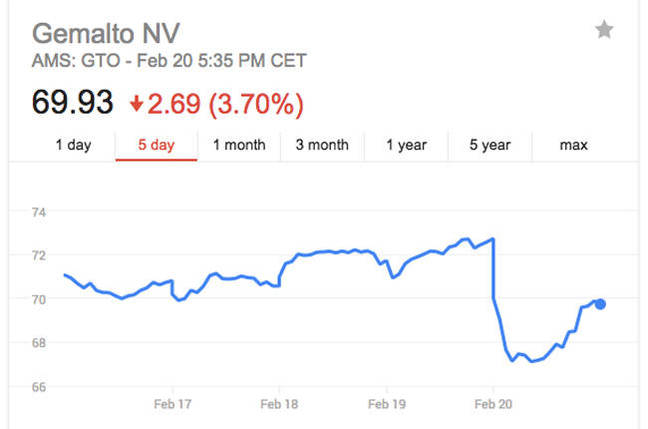
'NSA, GCHQ-ransacked' SIM maker Gemalto takes a $500m stock hit
http://www.theregister.co.uk/2015/02...lance_fallout/
NSA snooping is bad for US business. the security upside is unproven.

So would a summary be that while the NSA used it's snooping for good purposes, example the UnIslamic Re s, they wayy abused their authority and took snooping to ridiculous levels?
The most probable assmption is that CIA/FBI/NSA respect no limitations, no respect for anybody's privacy, will be not restricted by any laws, anointing themselves as A Few Good Men on the ramparts, defending themselves against any intrusions on their snooping power.
Last edited by boutons_deux; 03-01-2015 at 03:09 PM.
From the comments section:
http://spritesmods.com/?art=hddhack&page=3
What i mean is, with all their abuses did they now limit themselves to spy on the real assholes, ie UnIslamic murderers etc? I want them spying on UnIslamic dumb .
Threw the baby out with the bathwater type of screw up?
I'm pretty sure NOTHING HAS CHANGED. Obama has proposed a Citizens Privacy act, but the Repugs will obstruct it.
What i mean is now, with this report, is UnIslamic DF going to stop using electronics that previously the NSA could have tracked?
http://arstechnica.com/security/2015...group-hackers/Researchers from Moscow-based Kaspersky Lab have uncovered more evidence tying the US National Security Agency to a nearly omnipotent group of hackers who operated undetected for at least 14 years.
"Equation Group" ran the most advanced hacking operation ever uncovered.
The Kaspersky researchers once again stopped short of saying the hacking collective they dubbed Equation Group was the handiwork of the NSA, saying only that the operation had to have been sponsored by a nation-state with nearly unlimited resources to dedicate to the project. Still, they heaped new findings on top of a mountain of existing evidence that already strongly implicated the spy agency. The strongest new tie to the NSA was the string "BACKSNARF_AB25" discovered only a few days ago embedded in a newly found sample of the Equation Group espionage platform dubbed "EquationDrug." "BACKSNARF," according to page 19 of this undated NSA presentation, was the name of a project tied to the NSA's Tailored Access Operations.
and USA Congress or Judicial will stop "A Few Good Men" of the NSA!
There are currently 1 users browsing this thread. (0 members and 1 guests)
 Posting Permissions