Reply With Quote
There are now twice as many solar jobs as coal jobs
http://grist.org/climate-energy/sola..._campaign=feed

Glad to be an irritant.And BTW, my neighbors transformer is on the same pole only about 2 feet from mine. Not much transmission cost THERE.
There are now twice as many solar jobs as coal jobs
http://grist.org/climate-energy/sola..._campaign=feed

OK, and if your lines aren't very long to your fuse box your power to him might have only a 3% loss.
Who pays for the line maintenance?
Damn, WC. This has gotten too stupid to even discuss. Therefore, you get to win the internet today by forfeit.
LOL...
Yes, it is, isn't it!
Of course, it's a REPUG Congress, doing what it's paymasters want, now what We The People want.
Poll: Voters Want Pretty Much The Opposite Of What Congress Is Doing
A majority of U.S. voters think the government should be advancing policies that promote the growth of renewable energy, protect public lands, and strengthen protections against pollution of drinking water and air, according to a poll released Thursday by the Center for American Progress.
Conducted by national research firm Hart Research Associates, the poll of 1,101 American voters found that 72 percent strongly support more pollution controls, 70 percent strongly support protecting public lands like monuments and wildlife refuge areas, and 66 percent support the expansion of wind, solar, and renewable energy development. Sixty percent of voters surveyed also said they strongly supported setting limits on greenhouse gas emissions from power plants — a number that rose to 82 percent when including voters who said they somewhat support that proposal.
As noted by the Center in its press release accompanying the survey results, these opinions differ greatly from the policies being proposed and advanced by the Republican leaders of the new 114th Congress. Those include efforts to repeal the Environmental Protection Agency’s proposed limits on greenhouse gases from power plants; efforts to increase the amount of Canadian tar sands oil entering the United States via approval of the Keystone XL pipeline; and a bill to lengthen and complicate the process for designating national monuments.
When it comes to energy and environment, large majorities of voters support progressive policy proposals, according to the poll.
CREDIT: CENTER FOR AMERICAN PROGRESS
The poll, which had a 3.1 percent margin of error, also showed that the Keystone XL pipeline was a low priority for American voters concerned with energy issues. When asked a question about what Congress should be focusing on when it comes to energy policy, 11 percent said that they wanted more renewable energy, while 10 percent cited less dependence on foreign oil. Only 7 percent mentioned allowing the Keystone XL pipeline.
When thinking about energy or the environment,
voters want the president and Congress to focus on
alternative and renewable energy.
While some may argue that approving the Keystone XL pipeline would reduce dependence on foreign oil, that issue has been hotly debated, most notably because the oil that would be transported in the Keystone XL pipeline comes from Canada, a foreign country. Some have argued that the pipeline would reduce oil imports from the Middle East, but the Washington Post’s Fact Checker notes that the pipeline’s oil is expected to replace crude from Venezuela or Mexico. Either way, still foreign oil.
Achieving energy independence is one top priority for voters when it comes to energy policy, the poll said, but it also noted a sharp partisan divide when it comes to how energy independence can be achieved. Overall, more voters believe that can be accomplished by the development of America’s fossil fuel reserves as opposed to developing renewable energy resources, but only by a small margin — 44 to 41 percent. When divided by party, though, fifty-eight percent of Democrats believe renewable energy is the best way to go, while 60 percent of Republicans think more American fossil fuels should be developed. Independents are split on the issue, with 44 percent in favor of renewable and 43 percent in favor of fossil fuels.
The poll showed sharp partisan divides on the best route to achieving U.S. energy independence.
CREDIT: CENTER FOR AMERICAN PROGRESS
When the issue of energy independence is taken out of the equation, though, the poll showed that 87 percent of voters are at least somewhat in support of expanding developing of solar, wind, and other renewable energy sources in the United States. An increase in the development of renewable energy is expected to be one effect of the EPA’s proposed regulations on carbon emissions from fossil fuel power plants. One of the ways states can meet their carbon reduction goals is to increase their use of energy efficiency targets and renewable energy.
As for the type of energy American voters most want to see expanded in the United States, solar topped the list, with 80 percent of voters saying it should be relied on more compared with other 9 percent of voters who said solar power should be relied on less. Seventy-three percent of voters said wind should be expanded, with only 14 percent of voters saying it should be cut back. Hydropower came in as the third most-recommended energy source for expansion, with 59 percent of voters wanting more and 10 percent of voters wanting less.
http://thinkprogress.org/climate/201...te+Progress%29
Repugs ideology:
privatize ( ) lands
increase pollution by defunding, killing EPA
re , penalize, block RET (renewable energy targets) and distributed solar
etc, etc, etc.
Repugs ALWAYS wrong, ALWAYS on the wrong side of history, ALWAYS against progress.
The idea itself is supported, until the details are revealed.
Largest-ever study quantifies the value of rooftop photovoltaics
A multi-ins utional research team of scientists led by the U.S. Department of Energy's Lawrence Berkley Laboratory (Berkeley Lab), in partnership with Sandia National Laboratories, universities, and appraisers found that home buyers consistently have been willing to pay more for homes with host-owned solar photovoltaic (PV) energy systems —averaging about $4 per watt of PV installed—across various states, housing and PV markets, and home types.
This equates to a premium of about $15,000 for a typical PV system.
The team analyzed almost 22,000 sales of homes, almost 4,000 of which contained PV systems in eight states from 1999 to 2013—producing the most authoritative estimates to date of price premiums for U.S. homes with PV systems.
Read more at: http://phys.org/news/2015-01-largest...taics.html#jCp
Last edited by boutons_deux; 01-17-2015 at 09:46 AM.
For comparison:
One of the biggest solar power stories of the past year — if not the biggest — was the record-low price of solar power that was bid in Dubai toward the end of the year. ACWA Power bid 5.98 cents per kWh, well below the cost of natural gas in the region (which is 9 cents per kWh).
http://cleantechnica.com/2015/01/24/...eanTechnica%29
... includes a TX project selling KWH for $0.071
CPS REALLY made its owners, residents of San Antonio, a horrible deal.
Last edited by boutons_deux; 01-26-2015 at 04:41 PM.
I came across this by accident, and thought I would share:
“There is significant momentum in Congress now for eliminating many of the 42 existing energy tax subsidies,”
with Republicans largely against subsidies for renewables and
Democrats largely against those for fossil fuels, "
http://www.nytimes.com/2015/01/26/business/worry-for-solar-projects-after-end-of-tax-credits.html?partner=rss&emc=rss&_r=0
Thanks, Repugs, y'all always ing everything up.
In 42 of the 50 biggest U.S. cities, rooftop solar is now cheaper than the grid!
http://www.treehugger.com/renewable-...aper-grid.html
Google invests $300 million in fund for residential solar power
Goggle Inc. is making another large investment in renewable energy, but this time average homeowners could be the ones reaping the benefits.
The Mountain View, Calif.-based Internet search giant said Thursday it would invest $300 million in a new SolarCity Corp. fund that would help finance the installation of residential solar power systems.
Solar City said the fund would cover the cost of the installation, solar panels and other equipment. Homeowners either pay SolarCity for electricity produced by the solar panels or monthly rent for the panels if they are leasing.
The new fund will cover the upfront cost of solar panel installations for thousands of homeowners in 14 states including California, Google said.
“We’re happy to support SolarCity’s mission to help families reduce their carbon footprint and energy costs,” said Sidd Mundra, Renewable Energy Principal at Google. “It’s good for the environment, good for families and also makes good business sense.”
Google will be a tax-equity investor in the fund, meaning the company can claim a federal credit for 30% of the cost of the solar projects.
Tax equity investments in solar usually yield annual returns of 8% to 10%, though details of this particular deal are not being made public,
http://www.latimes.com/business/la-f...226-story.html
Phase 3 of 400 MW Alamo Solar Project in Texas Now Online
http://cleantechnica.com/2015/02/27/...eanTechnica%29
Upcoming solar eclipse to wreak havoc on Germany's solar power output
The partial solar eclipse slated to take place throughout Europe on March 20 may delight skywatchers, but it's presenting a significant headache for the operators of Germany's electricity grid. The country is a world leader in solar energy, boasting a huge edge over the U.S. in installed solar power generation.
When the eclipse occurs between about 9:30 a.m. and 12 p.m., local time, on the 20th, electric utilities in Germany will have to contend with rapid swings in energy production. First, there will be a steep drop-off in generation, followed by a sudden e.
These fluctuations, and how utilities choose to cope with them, provide a preview of what utilities in the U.S. and other nations face, as renewable energy production soars in coming decades, according to an analysis from Opower, a software company that uses data to help utilities improve the customer experience.
Germany gets about 7% of its electricity each year from solar panels, compared to 0.5% in the U.S., according to Barry Fischer, a writer and analyst at Opower. On the sunniest days, Germany can meet half of its electricity demand through solar power alone, he told Mashable in an interview.
http://www.altenergymag.com/stories/2015/03/upcoming-solar-eclipse-to-wreak-havoc-on-germanys-solar-power-output/905
Shows utility PV at $0.11/KwH
Progress Report: Advancing Solar Energy Across America
http://energy.gov/articles/progress-report-advancing-solar-energy-across-america
CC, where did you get CPS paying $0.14? I found and E-N article whining about it at $0.11, vs much lower in CA.
http://www.mysanantonio.com/opinion/editorials/article/CPS-Energy-s-high-cost-of-secrecy-4673087.php
My guess is that ALL of the CPS panels will be replaced before their 25-year guaranteed life span as huge breakthroughs in panel efficiency arrive in the next few years, making the less efficient panels uncompe ive.
Last edited by boutons_deux; 03-13-2015 at 09:58 AM.
The One Chart That Shows Why 2014 Was a Breakthrough Year for Utility-Scale Solar in America
http://www.greentechmedia.com/articl...r-for-us-solar
Better get your solar panels installed by end of 2016, because it's a safe bet that the Repugs, always ing up America, will block extending both the solar and wind tax breaks, while increasing MIC corporate welfare spending by $50B+ per year.

It will be a fairly safe bet. China is starting to scale back its coal use, as they have vastly overbuilt their steel-making capacity, and are pushing to produce electricity from less polluting sources, i.e. anything other than coal. This means that coal prices will start to fall and taper off, even more than they have now.
This will leave coal producers in the US in a bad position. They will be faced with utilities replacing aging coal plants with nat gas, wind and solar, while at the same time their export market will look to be hammered as well.
Places like India and Sub-Saharan Africa will reap the real benefit of this as they have yet to really build a lot of their infrastructure. Sheer economic growth will mean these countries will benefit from the West and China's knowledge and experience with such systems, i.e. they will get to bypass the coal phase almost entirely.
What Would Happen If Wind Power Got The Same Tax Breaks As The Fossil Fuel Industry
Oil and gas companies receive a number of permanent tax incentives, totaling $18.5 billion in 2013, according to a report from the environmental group Oil Change International. Taxpayers also permanently subsidize some costs of the coal industry.
The historical reasoning for these tax breaks, according to the Houston Chronicle, has been “to attract investment into an industry deemed high risk, and to promote employment.”
The wind industry, by contrast, has had a rough go of getting permanent tax incentives. Even before Republicans were in control of both chambers, Congress has repeatedly refused to revive the Wind Production Tax Credit (PTC), a $13 billion yearly tax break to the wind industry that has historically helped it compete with fossil fuels. The wind PTC is a subsidy that’s been built into the tax code since 1992 to encourage growth in the industry.
At one point, the PTC had a pretty good run. After it was reinvigorated by the 2009 stimulus, wind energy started booming. According to the AWEA, U.S. wind energy capacity saw a 140 percent growth rate from 25,000 megawatts (MW) to more than 61,000 MW since 2009. And that’s just capacity — the actual electricity generated from those turbines grew at a rate of 200 percent. In 2013, wind power accounted for 4 percent of all electricity generated in the U.S.
But that tax credit was set to expire in 2012, and since then, Congress has been caught in gridlock over whether to renew it. It eventually expired at the end of 2013, and — coincidentally or not — wind has not been growing as fast.
As it looks now, it’s unlikely that a Republican-controlled Congress will renew the PTC. Generally, Republicans oppose giving tax breaks to the wind industry on the grounds that they amount to a form a “welfare” that unfairly props up an industry present in some states but not others.
http://thinkprogress.org/climate/201...te+Progress%29
But Repugs demanding the MIC corporate welfare budget be increased by $50B+ / year
F-35?
Last edited by boutons_deux; 03-15-2015 at 07:55 AM.

hey you clowns that are into energy efficiency...
how about water? u guys have any system installed at home?
Last edited by TDMVPDPOY; 03-15-2015 at 07:53 AM.
Those are pretty easy to do but the payback is pretty long without subsidies. You still have to have conventional heat source to supplement in cold cloudy weather and freeze protection can get complicated.
The solar water heating I looked at here in TX was VERY expensive, right up there with the solar panel installation, so made no sense with the low price of gas water heating.
LOL...
So, you aren't one who practices what he preaches...
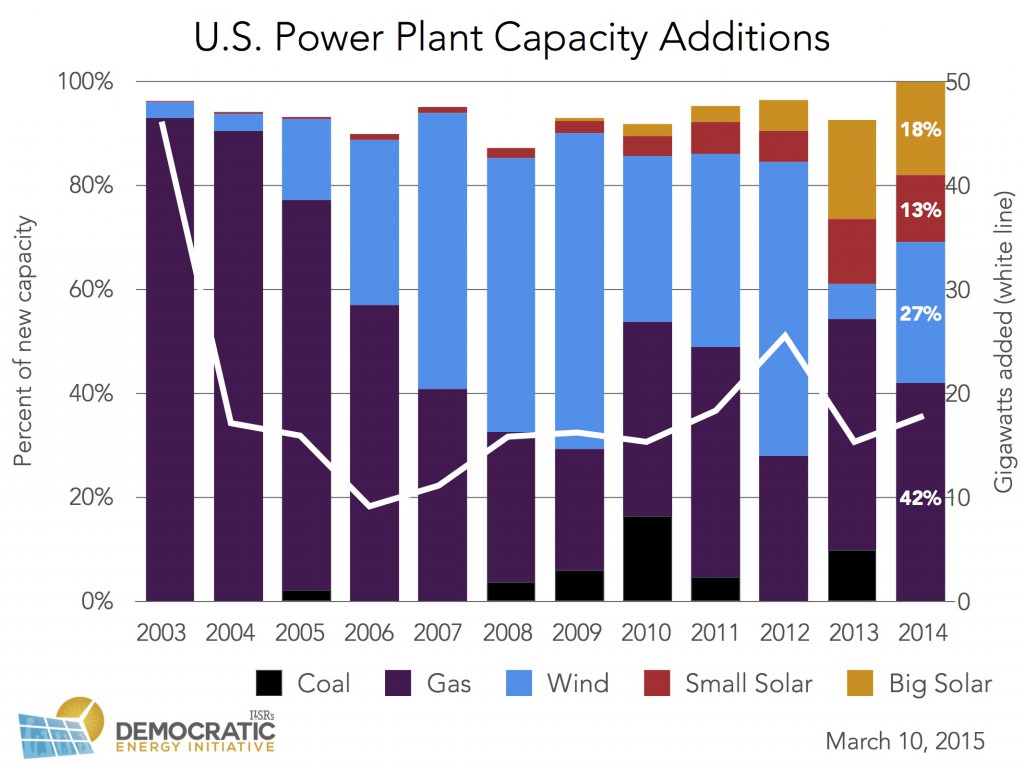
Small Solar Surging: 13% Of New US Power Plant Capacity In 2014
http://cleantechnica.com/2015/03/16/...eanTechnica%29
expect a huge surge over the next 20 months as the Federal tax credit expires at end of 2016 and Repugs refuse to renew it.
Last edited by boutons_deux; 03-16-2015 at 01:27 PM.
Solar eclipse is unprecedented test, says European power grid
The loss of solar power generation during Friday’s eclipse will be an unprecedented test for the European grid but is very unlikely to cause problems for electricity users, according to electricity providers in the UK and Europe.
If the weather is clear on Friday morning the European grid will suddenly lose the equivalent generation of eight to ten very large coal power plants as the moon passes between solar panels and the sun. The loss of generation will occur over a much shorter period than it takes to get dark at night. The eclipse will cover about 85% of the sun from the centre of the viewing zone.
The event presents a serious challenge to a grid designed originally to carry consistent power supplied by large power stations. Technicians from theEuropean Network of Transmission System Operators for Electricity (Entso-E)have been working for more than a year on how to cope with the potential loss of 35,000MW of generating capacity.
Forecasters are predicting largely cloudy weather for much of Europe, meaning the dip in power will be less pronounced than it would be in sunshine. But a spokeswoman for Entso-E said engineers were “very confident” the system would cope, even if conditions are sunny.
“The risk is serious but we are taking all measures to mitigate them. It is very unlikely there will be any incidents,” she said.
http://www.theguardian.com/environme...ean-power-grid
There are currently 1 users browsing this thread. (0 members and 1 guests)
 Posting Permissions