Reply With Quote
Do you think such a cause would never happen. They could easily argue there is no actual harm.

Advocating for the abuse of the less empowered, yep, that sounds like a liberal point of view to me.

Do you think such a cause would never happen. They could easily argue there is no actual harm.

I can see what you mean by me straw manning now. I'm talking about just some PC people (the PC police). If it seemed like I was referring to all PC people I apologize because that is not what I meant. I thought I was doing a good job of showing this, but i guess I just wasn't clear enough. I will try to be more clear about differentiating the subsects of PC culture in my future posts, because I'm not really am not attempting to mislead or mischaracterize. I'm going to make some clarification edits to my older posts.
Last edited by All Mighty Janitor; 04-04-2016 at 05:28 PM. Reason: add a word

Then reevaluate everyone. Franklin and Jefferson did more to promote slavery in the US than Lee ever did. Lee fought because that was his job -- not because he wanted slavery to continue. He was racists as , but he didn't stick out. You know who did stick out? Confederate VP Alexander Stephens. Do you even know who he is? If not, it's probably because history already wiped that dude's stain off the books.
When the Confederacy seceded, it wasn't clear that they couldn't. It was even less clear where loyalty should lie for individuals in the South. People handled the split differently. Sam Houston resigned as governor and died in relative obscurity -- and he was a former figurehead for a war fought to keep slaves himself. West Virginia seceded from the rest of the State. Lee remained loyal to his state rather than the government, which seems silly now but hadn't been up until that point. Why was fighting with the Union the right thing to do? While protecting the ins ution of slavery was why the South seceded, it really wasn't the reason why most people fought. And ending slavery wasn't even an official element of Lincoln's platform until 1863. He was fine with it when he won the presidency in 1860.Since Douglass and MLK were never involved in any active role fighting against gay rights, I don't think we're anywhere close to that level of political correctness and if we get there, then that's something worth pushing back against. Big difference between opposing historical figures for what they were known for doing vs. their personal beliefs that were unrelated.
Lee on the other hand may have done some tangential good things in his life but he's primarily known as a commanding general for the army that fought against the United States and for causes like slavery, while continuing to oppose the rights of black people even after the Civil War. It's not unreasonable to see him as a negative icon in this country's history nor to expect that the state ins utions stop paying tribute to him on publicly-funded ins utions.
Our founding fathers created a situation where slavery could continue to existed and could only be expunged with war. They all decided that poor white, minorities and women couldn't vote. They decided wives didn't have rights and that the voters couldn't be trusted in directly voting for their senators and presidents. They gave us a country on a platter, and we've been trying to pick up the pieces ever since. Where is the retroactive condemnation of their actions and beliefs? It's not part of the public narrative, because it's much easier to pick at the South instead.
How could they do that? Do explain.
Maybe someday we will. But it's still a stretch to suggest that Franklin or Jefferson's legacies are defined by their support of slavery. It's still tangential in terms of what they are primarily known for. What are we ignoring about Robert E. Lee that would be his primary legacy if not for his efforts against the Union and freedom for slaves?
This is all fine and good and can be taught in history class and read about in books. It doesn't tell me why schools should pay tribute to him. What did he do that is worth protecting and continuing that kind of honor? Would we name a school after Lee today?When the Confederacy seceded, it wasn't clear that they couldn't. It was even less clear where loyalty should lie for individuals in the South. People handled the split differently. Sam Houston resigned as governor and died in relative obscurity -- and he was a former figurehead for a war fought to keep slaves himself. West Virginia seceded from the rest of the State. Lee remained loyal to his state rather than the government, which seems silly now but hadn't been up until that point. Why was fighting with the Union the right thing to do? While protecting the ins ution of slavery was why the South seceded, it really wasn't the reason why most people fought. And ending slavery wasn't even an official element of Lincoln's platform until 1863. He was fine with it when he won the presidency in 1860.
For better or worse, their legacy is giving birth to the United States. The perception is we have our Founding Fathers to thank for living in a great country.Our founding fathers created a situation where slavery could continue to existed and could only be expunged with war. They all decided that poor white, minorities and women couldn't vote. They decided wives didn't have rights and that the voters couldn't be trusted in directly voting for their senators and presidents. They gave us a country on a platter, and we've been trying to pick up the pieces ever since. Where is the retroactive condemnation of their actions and beliefs? It's not part of the public narrative, because it's much easier to pick at the South instead.
For what it's worth, and to my earlier point, I'm not even sure we would name a school after Thomas Jefferson today. There would probably be some controversy over that. And ultimately there's no real harm in the controversy or the dialogue it creates..
Because 1) The Union wasn't trying to end slavery at the beginning of the war 2) Lee's legacy is just now being seen as particularly racist. Legacies are relative to who's viewing them, and it's extremely self-centered to change things based on how we feel about them now. At least things that aren't harming anyone (and no, being offended is not the same thing). In the past, when everyone was relatively fine with people being racist, Lee was just seen as a brilliant tactician. , his legacy for YEARS was his opposition to slavery (sort of like with Jefferson now).
I don't think we would. I feel like schools are named after living or just recently dead people nowadays. And yes, I think some of those people hold/held views that would "taint their legacies" if they came out.This is all fine and good and can be taught in history class and read about in books. It doesn't tell me why schools should pay tribute to him. What did he do that is worth that kind of honor? Would we name a school after Lee today?
I feel like this is a cop-out. If legacy is simply the most important thing people remember about a person, then it's relative. Jefferson may have left a legacy of a nation to you, but for many others, he was a guy who was too chicken to go against his economic and political interests. To some, it's the Declaration. To others, it's the Louisiana Purchase. The truth is that it's all of those.For better or worse, their legacy is giving birth to the United States. The perception is we have our Founding Fathers to thank for living in a great country.
For what it's worth, and to my earlier point, I'm not sure we would name a school after Thomas Jefferson today.
What the founders was a nation that enslaved, displaced and disfranchised the large a majority of the people within its borders. People after them improved and strengthen it, but the "flaws" in their philosophical thinking were very clear through their work. Lee was a man who did his job as a general and is remembered because he was good at it. He didn't maintain slavery, and indeed, had he been defeated quickly, the South probably would have been allowed back in without abolition being a condition. That's a of a lot more than guys like Bowie and Crockett did. It's a better legacy than Stephen F. Austin or Sam Houston have.
Why is it self centered and not just a sign of changing times? It's not like future generations are going to be robbed of a piece of our history if we change the names on a few schools. And that doesn't harm anyone either, so essentially we're stuck with the choice of unharmfully keeping a name that doesn't reflect our values anymore or unharmfully changing it. Why is it worth fighting for the former?
It's not a cop-out, I'm just defining the legacies as they're seen today. I don't attach sainthood or infallibility to any of our Founding Fathers and I think it's good to continually re-evaluate their motivations, since we're still governing today on a lot of what they wrote. If Jefferson High School students and others want to change the name of that school, I wouldn't put up a huge fight. But I don't think the discussion of whether Lee is worth honoring requires us to also make an immediate decision on anyone else.I feel like this is a cop-out. If legacy is simply the most important thing people remember about a person, then it's relative. Jefferson may have left a legacy of a nation to you, but for many others, he was a guy who was too chicken to go against his economic and political interests. To some, it's the Declaration. To others, it's the Louisiana Purchase. The truth is that it's all of those.
Agree to disagree but I fundamentally disagree with the idea that someone deserves permanent ins utional honor for being good at what they do regardless of what that is. He was a great strategic general who used his skills to fight for the side that opposed what our country valued then (regardless of private feelings), and especially now.What the founders was a nation that enslaved, displaced and disfranchised the large a majority of the people within its borders. People after them improved and strengthen it, but the "flaws" in their philosophical thinking were very clear through their work. Lee was a man who did his job as a general and is remembered because he was good at it. He didn't maintain slavery, and indeed, had he been defeated quickly, the South probably would have been allowed back in without abolition being a condition. That's a of a lot more than guys like Bowie and Crockett did. It's a better legacy than Stephen F. Austin or Sam Houston have.

Wait wut
It's self-centered because it pretends that this era is objectively better than the previous one. It's like we're looking at the past going "look how backward those people were to name a school after Robert E. Lee" while pretending that the people we support nowadays might not be remembered just as unfavorably. Sure, we can assume that's because we just don't know what the future people do, but I think it's much easier to look at it as moral standards sliding depending on the current conditions and not as being on a single track toward perfection.
For all we know, men will end up having to have a rights movement and that after it happens, people will turn their nose at guys like Obama that suggested that women being hit was worse than men being hit. Or that a man had no choice in whether his offspring lived or whether to pay for a kid he didn't want. You just don't know, so it's best to try to not judge people against your time period and calling it being objective.
Of course it does. Again, this is a cultural question, not a legal one. Americans have to decide what kind of people they want to be going forward, and becoming a group of snooty psuedo-intellectuals label everything and everyone they disagree with as ignorant or evil is a real possibility if that hasn't always been the case. Once we start trying to change our view of history to match our ideals, we end up in a situation not unlike 1984. And yes, I know that sounds extreme as and I hope it always does. But those types of worlds don't just show up out of nowhere. They come from a series of extremely popular sanctions that eventually snowball to the point that they don't stop even when they stop being popular.It's not a cop-out, I'm just defining the legacies as they're seen today. I don't attach sainthood or infallibility to any of our Founding Fathers and I think it's good to continually re-evaluate their motivations, since we're still governing today on a lot of what they wrote. If Jefferson High School students and others want to change the name of that school, I wouldn't put up a huge fight. But I don't think the discussion of whether Lee is worth honoring requires us to also make an immediate decision on anyone else.
My point is that it doesn't matter if the person is still on their pedestal. Most people don't care about the person after whom their school was named. What does matter is people thinking that being part of the confederacy is a scornful offense. It's lazy.Agree to disagree but I fundamentally disagree with the idea that someone deserves permanent ins utional honor for being good at what they do regardless of what that is.
You keep saying this. You really do. But it's not true. The South freaked out about the North's growing population, believing they were eventually going to be outvoted and forced to industrialize. They wanted to keep being who they are, which meant having slaves for sure, and they saw the North as a threat to that. But Lincoln didn't run on a stance to get rid of slavery. He didn't run arguing for blacks as equal humans to whites. He died holding the view of "Slavery is wrong, but..." just like nearly every political figure from that time.He was a great strategic general who used his skills to fight for the side that opposed what our country valued then (regardless of private feelings), and especially now.
Acting like Lincoln fought the South to free slaves is bogus. Andrew Jackson wanted to invade South Carolina after hearing that Calhoun was arguing for secession, and he was a slave-owner (who had a much more complicated relationship with slavery than most political figures of the time, btb). Lincoln wanted to preserve the Union, plain and simple. Slavery wasn't abolished until eight months after Lincoln's death. Union States like Maryland still had slaves at the end of the Civil War (since the Emancipation Proclamation didn't apply to non-Confederate states).
Simply put, to equate Lee to slavery is ignorant, and a just society shouldn't allow that to become the prevailing view. The Civil War was a very complex period, and it shouldn't be boiled down to the bad, racist South versus the Northern, enlightened liberators. If there's a legacy to be taken from that time is that the country had to really deal with its diverse makeup for the first time. It wasn't nearly the last time it faced that issue, but because of the Civil War, you knew the country was always going to survive it. The only reason why people even have strong feelings against the war is because of what a cluster Reconstruction was and how that pretty much guaranteed that Jim Crow was going to happen. But again, we completely ignore how the Northern Republicans sold Southern blacks down the tube. But where are the folks trying to get the name Hayes High School (the Delaware one) changed?
Did you not know that?
http://teachingamericanhistory.org/l...debate-part-i/I will say then that I am not, nor ever have been in favor of bringing about in anyway the social and political equality of the white and black races – that I am not nor ever have been in favor of making voters or jurors of negroes, nor of qualifying them to hold office, nor to intermarry with white people; and I will say in addition to this that there is a physical difference between the white and black races which I believe will forever forbid the two races living together on terms of social and political equality. And inasmuch as they cannot so live, while they do remain together there must be the position of superior and inferior, and I as much as any other man am in favor of having the superior position assigned to the white race. I say upon this occasion I do not perceive that because the white man is to have the superior position the negro should be denied everything.”
Neither one of them liked slavery. Neither one was keen to end it in 1860. Both believed strongly that black people were inferior. The difference is that Lee thought black people were capable of being equals to whites, while Lincoln did not.
http://civilwarhome.com/leepierce.htm
There are few, I believe, in this enlightened age, who will not acknowledge that slavery as an ins ution is a moral and political evil. It is idle to expatiate on its disadvantages. I think it is a greater evil to the white than to the colored race. While my feelings are strongly enlisted in behalf of the latter, my sympathies are more deeply engaged for the former. The blacks are immeasurably better off here than in Africa, morally, physically, and socially. The painful discipline they are undergoing is necessary for their further instruction as a race, and will prepare them, I hope, for better things. How long their servitude may be necessary is known and ordered by a merciful Providence. Their emancipation will sooner result from the mild and melting influences of Christianity than from the storm and tempest of fiery controversy. This influence, though slow, is sure. The doctrines and miracles of our Saviour have required nearly two thousand years to convert but a small portion of the human race, and even among Christian nations what gross errors still exist! While we see the course of the final abolition of human slavery is still onward, and give it the aid of our prayers, let us leave the progress as well as the results in the hands of Him who, chooses to work by slow influences, and with whom a thousand years are but as a single day.
Last edited by Chinook; 04-04-2016 at 05:47 PM.
"What were his views on slavery?
These papers are filled with information about slavery. This is not something you have to read between the lines; Lee really tells us how he feels. He saw slaves as property, that he owned them and their labor. Now you can say he wasn't worse than anyone; he was reflecting the values of the society that he lived in. I would say, he wasn't any better than anyone else, either.
It is shocking how he treated his father-in-law's slaves.
Lee's wife inherited 196 slaves upon her father's death in 1857. The will stated that the slaves were to be freed within five years, and at the same time large legacies—raised from selling property—should be given to the Lee children. But as the executor of the will, Lee decided that instead of freeing the slaves right away—as they expected—he could continue to own and work them for five years in an effort to make the estates profitable and not have to sell the property.
.........
More. ...
http://www.usnews.com/news/articles/...f-robert-e-lee
Seems pretty pro-slavery
I guess my response didn't save? It was pretty much that Lee and Lincoln both had similar curves in their beliefs. Before the war, they both believed in black inferiority (with Lincoln taking a stronger view), believed that slavery was wrong while also doing little to stop it. They both believed that it was something that would die out eventually, and that was a view a lot of people held back then. It was just a way for them to feel better about themselves and to kick the can down the road.
Lincoln only pushed the Emancipation Proclamation once his troops were losing the will to fight for the sole cause of preserving the union. Lee advocated hard for emancipation in the last couple of years as a way to get more soldiers. For the most part, his requests were rejected. Lincoln NEVER tried to emancipate all slaves, even after giving the Union a moral mandate with the EP. It's not even clear that he would have made that a condition to readmit states, as it was thought that he was going to be lenient than House Republicans ended up being had he lived.
I read one "historian" saying Lincoln didn't care about slavery, and he wished he could keep the country together and let the South keep slavery but he knew couldn't.
His primary concern against the South was equality of opportunity, which he knew the slaves didn't have.
Meh, I think your post is mostly bull .
In the end, Lincoln freed the slaves.Fact #10: Lincoln considered the Emancipation Proclamation the crowning achievement of his presidency.
Heralded as the savior of the Union, President Lincoln actually considered the Emancipation Proclamation to be the most important aspect of his legacy. “I never, in my life, felt more certain that I was doing right, than I do in signing this paper,” he declared. “If my name ever goes into history it will be for this act, and my whole soul is in it."
http://www.civilwar.org/education/hi.../10-facts.html
Lee fought for the South that wanted to hold on to slavery.
It's as simple as that.
Which parts? The idea that Lincoln didn't actually end slavery in Union states? This is from the first paragraph of the wikipedia article covering the EP:
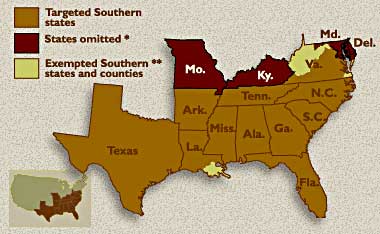
This was the area the EP covered:The Emancipation Proclamation was a presidential proclamation and executive order issued by President Abraham Lincoln on January 1, 1863. In a single stroke, it changed the federal legal status of more than 3 million enslaved persons in the designated areas of the South from "slave" to "free".
He sure didn't seem to care about black people in Maryland, Kentucky and Missouri being free. They were only allowed out of bondage after the 13th Amendment was ratified at the end of 1865. In fairness to Lincoln, it was passed by Congress in January of that year. But even then that was more than two years after the EP.
So what else do you disagree with? That Lincoln did not run on an abolitionist platform? That Lee didn't request for slaves to be emancipated to join the CSA army?
Obviously, it's not simple. Your repeated attempts to remove all nuance from situations do no favors to anyone. It just leads to misunderstand and inequality. Very few people truly represent the characters you create for them Alexander Stephens was one of them. Lee wasn't. That doesn't mean that I care about him. I wouldn't be advocating for a school to be named after him. But that doesn't mean that people can rewrite history.In the end, Lincoln freed the slaves.
Lee fought for the South that wanted to hold on to slavery.
It's as simple as that.

Renaming a school isn't rewriting history.
It's not. But retroactively and arbitrarily labeling some people as less worth remembering or honoring is. History is now VERY unkind to Jackson, when he's actually getting blamed for things Van Buren did. People want to single him out for being racist?
Popular opinions about historical figures change over time. That isn't rewriting history either.But retroactively and arbitrarily labeling some people as less worth remembering or honoring is.
Expecting professional historians to be fair is one thing; demanding it of popular opinion is laughable.
Yes it is. People are literally selecting which qualities to attribute to which figures. Lincoln and Lee where two pretty similar men on opposite sides of a conflict. That the general consideration is that one was a champion for racial equality while the other was a champion for oppression is wrong. That people are knocking down statues and changing names due to this misunderstanding is VERY wrong.
I am fine with the idea that Lee wasn't a moral paragon. I am not fine with people thinking his name should be cursed, especially since they seem more interested in changing the name of a good school rather than fixing the poor schools in the same city.
With the world becoming more interconnected than it ever has been, it won't be laughable forever.
Changing the name is easier.
Also, treating Lincoln and Lee as historically equivalent is dishonest. Emancipation no doubt happened for opportunistic reasons, but the results were no less momentous for those liberated, for their brothers and sisters in bondage and for this country.
Results matter. Lee fought for slavery; Lincoln freed slaves. People aren't wrong to judge the two figures by the outcome of the war.
as for lost cause sentimentality masquerading as historical fairness and white-knighting for Robert E. Lee, good riddance to smelly garbage.
Decisions and sides taken matter more than moral intent, sometimes.
There are currently 1 users browsing this thread. (0 members and 1 guests)
 Posting Permissions