Page 2 of 2 FirstFirst 12
Results 26 to 42 of 42
  1. #26
    I don't really care... Yonivore's Avatar
    My Team
    San Antonio Spurs
    Join Date
    Oct 2001
    Post Count
    26,781
    Meanwhile back at Reality Ranch Algore has an op-ed in Sunday's New York Times:

    Consider this tale of two planets. Earth and Venus are almost exactly the same size, and have almost exactly the same amount of carbon. The difference is that most of the carbon on Earth is in the ground--having been deposited there by various forms of life over the last 600 million years--and most of the carbon on Venus is in the atmosphere.

    As a result, while the average temperature on Earth is a pleasant 59 degrees, the average temperature on Venus is 867 degrees. True, Venus is closer to the Sun than we are, but the fault is not in our star; Venus is three times hotter on average than Mercury, which is right next to the Sun. It's the carbon dioxide.

    Well, the atmosphere on Mars is 95% carbon dioxide, just shy of Venus's 96%. (The Earth's atmosphere, by contrast, is less than 0.04% CO2.) Average temperature on Mars? Eighty-one below zero.

    Then, Agence France-Presse reports:

    Scientists who probed two kilometers (1.2 miles) through a Greenland glacier to recover the oldest plant DNA on record said Thursday the planet was far warmer hundreds of thousands of years ago than is generally believed.
    If scientists have such difficulty predicting past weather, surely we should be skeptical about politicians' predictions of future weather.

  2. #27
    Veteran
    My Team
    San Antonio Spurs
    Join Date
    Apr 2006
    Post Count
    2,592
    Okay... Al comparing temperatures on Venus and Mercury is just asinine. The difference there is atmospheric thickness more than anything. Venus has an ground level atmospheric pressure of around 9000kpa, Mercury effectively zero. Even without Venus's atmosphere being mostly CO2, that thick of an atmosphere is going to trap a lot of heat, while the surface of mercury is directly exposed temperature of space (aka it can radiate the heat off faster).

    Just in case anyone's curious, Mars has an atmospheric pressure of .03kpa, and Terra about 101kpa.

  3. #28
    I don't really care... Yonivore's Avatar
    My Team
    San Antonio Spurs
    Join Date
    Oct 2001
    Post Count
    26,781
    Once again, I think it's time.

    Me? 42%

  4. #29
    Believe. BradLohaus's Avatar
    My Team
    San Antonio Spurs
    Join Date
    Dec 2006
    Post Count
    1,343
    I'm no scientist, but why can't the causes of the last Ice Age, and of all the Ice Ages, be the same causes of the current change in global average temperature?

    http://en.wikipedia.org/wiki/Ice_age#Causes_of_ice_ages

    One of the causes is "Variation in the sun's energy output". I read an article in a newspaper the other day that said that the sun is producing more energy and heat than ever before in recorded history, although that's probably not a very long time. Because of this, temperatures are rising on all planets in the solar system, all the way to Neptune. Could that be a sufficient explanation for the increase in temperatures on Earth?

  5. #30
    I don't really care... Yonivore's Avatar
    My Team
    San Antonio Spurs
    Join Date
    Oct 2001
    Post Count
    26,781
    I'm no scientist, but why can't the causes of the last Ice Age, and of all the Ice Ages, be the same causes of the current change in global average temperature?
    Because, there's no money, babes, or Oscars in it.

    One of the causes is "Variation in the sun's energy output". I read an article in a newspaper the other day that said that the sun is producing more energy and heat than ever before in recorded history, although that's probably not a very long time. Because of this, temperatures are rising on all planets in the solar system, all the way to Neptune. Could that be a sufficient explanation for the increase in temperatures on Earth?
    Yes.

  6. #31
    Veteran Wild Cobra's Avatar
    My Team
    Portland Trailblazers
    Join Date
    May 2007
    Post Count
    43,117
    Once again, I think it's time.

    Me? 42%
    Beat you....

    I got a whopping 50%!

    It really bothers me how much the two think alike....

  7. #32
    Believe. gtownspur's Avatar
    My Team
    San Antonio Spurs
    Join Date
    Aug 2005
    Post Count
    3,906
    I got 58%

  8. #33
    Believe. BradLohaus's Avatar
    My Team
    San Antonio Spurs
    Join Date
    Dec 2006
    Post Count
    1,343
    I got 42%. Not only were the ideas all the same, but so was the writing style. Creepy.

  9. #34
    Steele Curtain cherylsteele's Avatar
    My Team
    San Antonio Spurs
    Join Date
    Feb 2005
    Post Count
    3,315

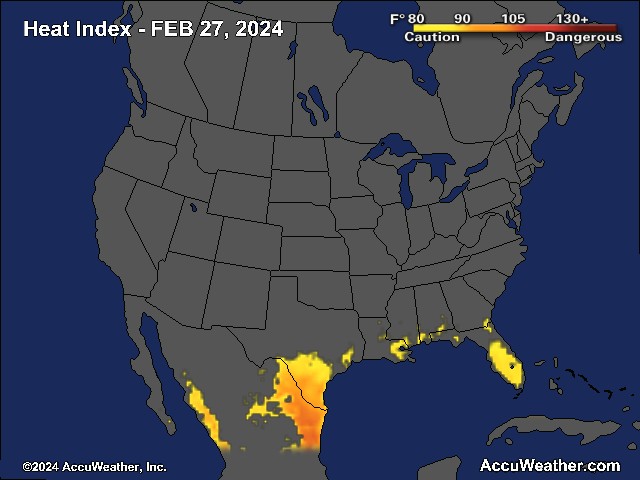
    The ocean is having a hard time cooling costal regions contributing to high temps all the way to Canada, but global warming isn't real, so

    PARTY ON!
    This chart says heat index.....to me that means it is taking into account the humidity as well....so it really isn't a true reading....it just feels hot to the skin.....just like wind chill in the winter.

    If someone believes in global warming, fine......if it leads to less pollution in some way.....then go for it.

  10. #35
    Veteran Wild Cobra's Avatar
    My Team
    Portland Trailblazers
    Join Date
    May 2007
    Post Count
    43,117
    Actually, the suns contribution to the temperature pales in comparison to the earth's molten core,
    I lost those numbers. Can you source, or recall what the earths temperature would be with no solar radiation?
    and most periods of global warming and cooling are most likely primarily caused by shifts in the magnetic fields and the earth's changing axial tilt.
    That's an interesting theory, and one I haven't seen. I'm not disputing it, just haven't seen the theory. Can you direct me somewhere?
    But I love that this map is supposed to convince us of global warming, when man-made global warming has been attributed something like a 1.2 degree celsius increase. Like 4 degrees F at most. Wouldn't make a very big difference on that map.
    I think that is a real stretch myself. Since I learned even more about the effects of CO2, I cannot see man-made warming any more than maybe 0.2 Celsius.

  11. #36
    Veteran Wild Cobra's Avatar
    My Team
    Portland Trailblazers
    Join Date
    May 2007
    Post Count
    43,117
    I got 42%. Not only were the ideas all the same, but so was the writing style. Creepy.
    Agreed. I thought I would be smart and pick them by the writing style...

    That sure didn't work...

  12. #37
    Veteran Wild Cobra's Avatar
    My Team
    Portland Trailblazers
    Join Date
    May 2007
    Post Count
    43,117
    I found an excellent piece of work compiled with source after source by a guy calling himself “The Internet Skeptic.” Links:

    Website

    Global Warming on Powerpoint

    Don’t rush to judgment spouting propaganda until you do some research please. Study the power point presentation, check some of the sources, and use your brain…

  13. #38
    Veteran
    My Team
    San Antonio Spurs
    Join Date
    Apr 2006
    Post Count
    2,592
    I lost those numbers. Can you source, or recall what the earths temperature would be with no solar radiation?

    That's an interesting theory, and one I haven't seen. I'm not disputing it, just haven't seen the theory. Can you direct me somewhere?

    I think that is a real stretch myself. Since I learned even more about the effects of CO2, I cannot see man-made warming any more than maybe 0.2 Celsius.
    I'll have to see if I can track it down (I don't keep track of sources and it's nothing something I've looked at recently). I do believe I've read somewhere (I believe recently, on wikipedia) that without the Sun's heat, Earth would be somewhere around -18 C, a temperature not condusive to life. I'll see if I can find sources.

    With the temperature change, I was going with total change, and a high estimate at that, not man-made change, since that cannot be determined since we don't even know what all the factors are. I think the number generally used is actually about 0.8 C in the last 75 years or so, but I'm not completely sure.

  14. #39
    Veteran Wild Cobra's Avatar
    My Team
    Portland Trailblazers
    Join Date
    May 2007
    Post Count
    43,117
    I do believe I've read somewhere (I believe recently, on wikipedia) that without the Sun's heat, Earth would be somewhere around -18 C, a temperature not condusive to life.
    It would be far colder than that. -18 might be the temperiture without any greenhouse gasses. Absolute zero is -273.15 C. The core is the only thing keeping the earth from cooling to that point with no incoming heat.

  15. #40
    W4A1 143 43CK? Nbadan's Avatar
    My Team
    San Antonio Spurs
    Join Date
    Nov 2001
    Post Count
    32,408
    Don't blame the Sun...

    A new scientific study concludes that changes in the Sun's output cannot be causing modern-day climate change.

    It shows that for the last 20 years, the Sun's output has declined, yet temperatures on Earth have risen.

    It also shows that modern temperatures are not determined by the Sun's effect on cosmic rays, as has been claimed.

    Writing in the Royal Society's journal Proceedings A, the researchers say cosmic rays may have affected climate in the past, but not the present.


    "This should settle the debate," said Mike Lockwood, from the UK's Rutherford-Appleton Laboratory, who carried out the new analysis together with Claus Froehlich from the World Radiation Center in Switzerland.
    BBC

  16. #41
    Veteran Wild Cobra's Avatar
    My Team
    Portland Trailblazers
    Join Date
    May 2007
    Post Count
    43,117
    Don't blame the Sun...

    BBC
    OK, we have more scientists covering up their poor position. So what.

    A new scientific study concludes that changes in the Sun's output cannot be causing modern-day climate change.
    Bull . They are either incompetent, liars, or misinterpreting the data.

    The average output of the sun has not changed hardly at all over approximately the last 50 years. The recorded history and proxy isotopes clearly show dramatic changes in the average before about 1950 and coincide with past historical warming and cooling trends.

    As for modern day warming, there is a lag time of several years between cause and effect. The more massive the component being warmed, the longer the time lag. Our modern day warming can easily, and likely is, the result of the last 50 years of higher solar activity than the activity before that timeframe.
    It shows that for the last 20 years, the Sun's output has declined, yet temperatures on Earth have risen.
    Declined? Not by anything worth mentioning. In 1981, the solar output peaked at about 1366.6 watts per meter. 1990 was about 1366.5 and 2001 was slightly lower by about 0.02 watts, maybe 1366.48. The minimums were 1365.5 in 1976, maybe 0.01 higher in 1986 at 1365.51, About 1365.48 in 1997, and about 1365.4 in 2006.

    What is this? A trend of about 0.1 watts lower over 30 years with about a 1366 average. Anyone think that a 0.0073% decrease is significant?

    Those of us claiming it's the sun are talking about more significant output changes. Look at the difference occurring about 1950 on this chart:


    Note the average increases by about .2 watts of forcing. Forcing is a different measurement than incoming radiation and it is not a 1:1 relationship. I approximate the change to be about 2 watts just by visual comparisons. Now 2 watts change from a 1366 is 0.15%. That may not seem significant either, but is a factor of 20 times that these scientists are trying to convince others doesn't exist. Also, 0.15% on our current global average temperature is a 0.43 C change (0.78 F.) Isn't that about how much global warming is estimated at?

    Now back to time lag. The solar radiation hitting the land causes nearly direct changes in temperature. Since so many other factors come to play, it is not directly observable. The majority of the earth is water. These temperature changes have a lag time of decades, maybe centuries. Even though we have seen a minute decline in solar output, the oceans are still influencing current change from the extra energy they started receiving about a hundred years ago, ending 50 years ago!
    It also shows that modern temperatures are not determined by the Sun's effect on cosmic rays, as has been claimed.
    Who claimed that they had an effect of temperature? I haven't seen any claims other than increased precipitation from increased cosmic rays.
    Writing in the Royal Society's journal Proceedings A, the researchers say cosmic rays may have affected climate in the past, but not the present.
    This point doesn't matter anyway.
    "This should settle the debate," said Mike Lockwood, from the UK's Rutherford-Appleton Laboratory, who carried out the new analysis together with Claus Froehlich from the World Radiation Center in Switzerland.
    I wonder if their grant money runs out when global warming is shown to be uncontrollable by man?

    ---- added note ----

    The 0.43 C is based on real science with the false assumption the earth would cool to absolute zero in a short time with no external heat/radiation. The core will keep the earth at some cold temperiture probably about -200 celcius. That gives a 215 degree range for 100% instead of a 288 degree range and is actually about a 0.32 C temperiture change for solar warming alone.
    Last edited by Wild Cobra; 07-11-2007 at 08:59 PM. Reason: added note

Thread Information

Users Browsing this Thread

There are currently 1 users browsing this thread. (0 members and 1 guests)

Posting Permissions

  • You may not post new threads
  • You may not post replies
  • You may not post attachments
  • You may not edit your posts
  •