Reply With Quote
so we escalate
what's the path to victory?

shortages, inflation, demand destruction and recession become more probable the longer this war drags on

so we escalate
what's the path to victory?
historically, punishment campaigns don't work
why will it work this time?
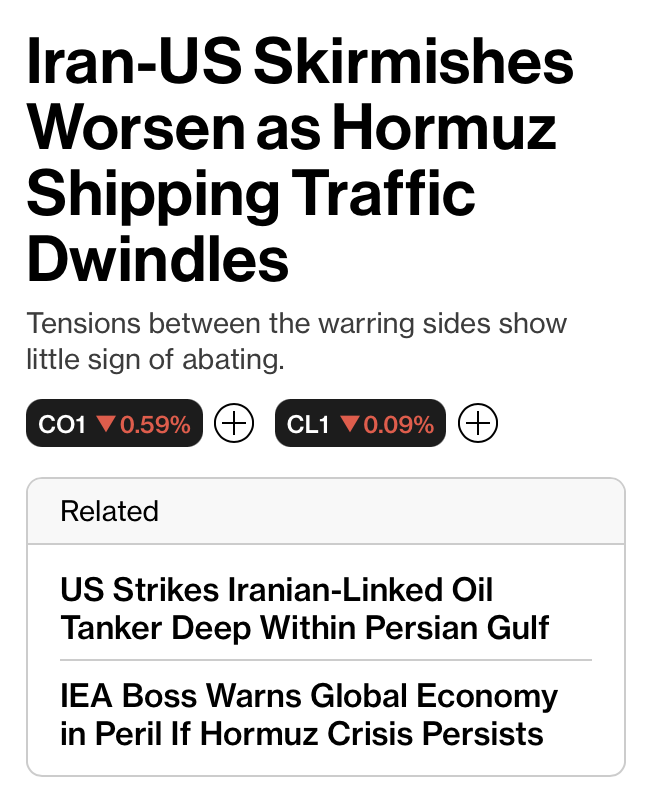
YEMEN'S HOUTHIS ARE REPORTEDLY PREPARING TO SHUT THE BAB EL-MANDEB STRAIT ON BEHALF OF IRAN. THE WATERWAY CARRIES ROUGHLY 10–12% OF GLOBAL MARITIME TRADE
Last edited by Winehole23; 07-16-2026 at 07:36 AM.
escalation trap
reportedly this took about 13% of Kuwait's water supply offline

losing the Daily Caller


This is already built in. Shutting in wells becomes harder to reverse as you go along. sooner or later you have to cap wells, and getting the oil field back up and running to where it was before is months to years.
Even if they stopped tomorrow, which seems remote to put it charitably, AND they had all the tankers ready to go in and resume shipment, which they are not, AND there no mines, it would still take months to get that oil to the places it used to go (Asia mostly). THEN you would have to fill up storage at refineries to spin them back up, THEN you would still have to refill all those strategic reserves that have been severly depleted. This process will take YEARS, at best.
Oil is going to be expensive for a while, and when the national reserves reach their bottom pretty soon, they will not be able to subsidize supply. Then you can expect north of 100 easy, potentially over 200.
Coupled with the disintegration of the russian empire, which will take that oil off the market likely for decades, due to the nature of their siberian production. Russia was already facing a slow spiral due to de-industrialization and rank corruption, and a collapsing demography, it seems likely that they will never recover from the damage being done by their pointless war.
s gonna get bleak, yo.
wife and I have played unofficial foster parents to a small number of young people through accidents of happenstance. One of those kids joined the military, and is now a diesel mechanic in an ADA unit in Quwait(?). He describes them as being "busy", and some of that is targeted at them specifically. So, I worry. Went to his tech training graduation, and those kids are so very young. I was a decade older than the most senior NCO I met.
Stupid war waged by a stupid, evil man.
The only way the US wins, is instatement of the draft, invasion and long term occupation of Iran.
Theoretically possible, in the way that a landslide could theoretically spontaneously assemble a functional 747.
Best case scenario for all involved, including the US would have been the US surrender, which was what the MOU was.
Now, that is out the window. We have conclusively shown to be not worth negotiating with.
One strong feature of persian culture is that they view struggle against injustice as worth giving ones life for, to what I have been told by someone who I kind of trust to know. This war is tailor made to appeal to that.
There is no path to US "victory" here. The best we can hope for would pre-war status quo, but Iran is going to use its grip on the SOH to extract rent on all ships, so we pretty much lost from the first shot, which is what every wargame we ever tested out said would happen, and why no president has been stupid enough to try. Netenyahu got exactly the war he wanted to prop himself up indefinitely. Trump the rube.
Saudis will scramble to build pipelines and charge fees to the quwaitis et al to get around this. Again, years before pre-war flows.

Easy answer
If Trump declares we need boots on the ground and activates a draft, the Republicans can kiss a whole lot of mid terms goodbye
it appears some people have made a lot of money off knowing what Trump was going to say beforehand
I wonder if Trump got a cut
https://abcnews.com/US/doj-probing-2...y?id=132738007
attacking waterworks is a das ly crime
https://www.aljazeera.com/news/liveb...secutive-nightKuwait’s civilian infrastructure is certainly being hit hard by the IRGC.
A power and desalination plant was hit for a second day. That is significant because that is critical infrastructure for Kuwait. The country doesn’t have permanent lakes or rivers. It has very little rain. So, 90 percent of its drinking water comes from seawater desalination.
Two plants have been attacked over the past few days, out of nine major desalination plants in the country, according to Kuwaiti figures.
This has been a significant attack and will have a significant impact.
Across the Persian Gulf coastline from Iran sit more than 400 desalination plants operated by Gulf Cooperation Council states.In Kuwait, approximately 90% of drinking water comes from desalination; in Oman the figure is 86%, in Saudi Arabia 70%, and in the UAE 42 %.
RAPIDAN: “.. How long will it take for a prolonged US blockade to bring the Iranian regime to its knees?
“.. While estimates in Tehran range from 1-3 years, our view falls in the middle of that range (18-24 months).”
THOUGHTS AND PRAYERS FOR THE BRAVE SOLDIERS WHO DIED DEFENDING US AGAINST...
Trump put a target on our backs by impulsively starting a war with Iran that he has no idea how to win
if Trump wanted to win the war with Iran he shouldn't have surrendered first -- Iran got $$$ and time to shore up its military
if his choices then were really -- as Trump said -- either continued war or Great Depression 2.0, it's hard to see how the math for the US and the world has improved since then


July 20 - Yemen's Iran-aligned Houthis will impose a maritime blockade on Saudi Arabia, they said on Monday, further throttling a global energy market already greatly restricted by Iran's closure of the Strait of Hormuz.
This is why it matters and what it means for the Iran war and the global energy crisis:
The Reuters Iran Briefing newsletter keeps you informed with the latest developments and analysis of the Iran war. Sign up here.
HOW BIG IS THE RISK TO GLOBAL ENERGY MARKETS?
It is not clear how the Houthis would carry out a maritime blockade of Saudi Arabia, its northern neighbour along the Red Sea coast, or whether it would include a return to attacks on shipping.
Yemen sits on the Bab el-Mandeb strait – the southern #gateway to the Red Sea – and closing that would open up a new front in the energy crisis and Iran's overarching conflict with the U.S.
With Hormuz already disrupted, the Red Sea has become a critical alternative outlet for Gulf oil and other products. A serious disruption would mean both of the Middle East's major oil export routes are shut simultaneously.
Iran's partial blockade of the Strait of Hormuz after Israel and the U.S. attacked it on February 28 disrupted most oil and other exports from the Gulf, raising prices and delivering a global energy shock.
Saudi Arabia responded by diverting more than 70% of its normal daily crude exports to the Red Sea port of Yanbu. Ships from Yanbu bound for Europe go north through the Suez Canal. Those heading to Asia go south through Bab el-Mandeb.
Shipments from Yanbu averaged 4 million barrels per day in recent weeks according to data from Kpler and Signal Ocean, up from around 973,000 bpd a year earlier.
Total petroleum volumes transiting Bab el-Mandeb amounted to 7.4 million bpd in June, or about 7% of global oil output, according to Kpler data, up from 4.2 million bpd last year.
That has provided a lifeline for the energy market, helping to keep down global oil prices. Saudi Arabia is considering an expansion of its crude oil pipeline to the Red Sea coast, Reuters reported last week.
When the Houthis launched attacks on Red Sea shipping in November 2023, Gulf oil exports were flowing freely.
WHO ARE THE HOUTHIS AND ARE THEY CLOSING RED SEA ENERGY ROUTES ON BEHALF OF IRAN?
The Houthis emerged as a military, political and religious movement in north Yemen in the 1990s, fighting guerrilla wars against the government in Sanaa.
They have been in a civil war against the Saudi-backed, internationally recognised, government for more than a decade and have attacked Gulf neighbours with missiles and drones.
However, a 2022 truce between the country's warring sides largely held until last week, when Yemen's internationally recognised government said it had struck Sanaa airport to stop an Iranian plane landing.
The Houthis said Saudi Arabia was responsible and in response fired missiles at Abha airport in the kingdom's mountainous southwest.
A senior Houthi official, politburo member Mohammad al-Farah, then warned in an interview on Iran's Press TV website that if the situation kept escalating, Bab el-Mandeb would be closed.
Iran champions the Houthis as part of its regional "Axis of Resistance", which includes Lebanon's Hezbollah and Iraqi Shi'ite militias, though its ties with the Yemeni movement are less clear than with #those other groups.
The Houthis do not recognise Iran's supreme leader as their ultimate religious authority in the same way Hezbollah and the Iraqi groups do. Their motivations are mainly domestic, though the group is ideologically aligned with Iran.
The U.S. says Iran has armed, funded and trained the Houthis with help from Hezbollah. The Houthis deny being an Iranian proxy and say they develop their own weapons. It is not clear how far the group's stance on Bab el-Mandeb and the Red Sea stems from its own strategic priorities or is being made on Iran's behalf.
WHAT HAPPENED WHEN THE HOUTHIS ATTACKED RED SEA SHIPS BEFORE?
After the October 7, 2023, Hamas attack on Israel, and Israel's devastating campaign in Gaza, the Houthis began firing at Israel and on shipping in the Red Sea, saying they were doing so in support of Palestinians.
The attacks severely disrupted global shipping, prompting Maersk, Hapag-Lloyd and other major companies to divert around Africa — a far longer, more expensive route.
Red Sea traffic has not recovered since, with traffic through the Suez Canal down 52% in 2025 versus 2023 levels and at its lowest in at least 50 years, Suez Canal Authority data shows.
A U.S.-led mission to restore free navigation in the Red Sea involved repeated strikes on Houthi targets and a defensive campaign that shot down hundreds of drones and missiles.
But some Houthi attacks continued until last summer, only ending completely with the Gaza ceasefire in October.
Last month the Houthis said they would ban ships linked to Israel from the Red Sea after Israel renewed military attacks on Iran.
However, that threat was never acted on and shipping groups Maersk and Hapag-Lloyd are resuming some Red Sea routes that they had abandoned during the Houthi attacks last year, Maersk said this month.
WHAT HAVE THEY DONE DURING THE LATEST IRAN WAR?
While Hezbollah and the Iraqi groups joined the war early with rocket and drone fire after the first U.S. and Israeli strikes on Iran, the Houthis had been comparatively quiet.
The group's leader Abdul Malik al-Houthi said on March 5: "Our fingers are on the trigger at any moment should developments warrant it".
Iranian commanders have repeatedly warned that the Houthis could join the war. The Houthis launched a few missile and drone attacks on Israel in late March and early April.
Revolutionary Guards Quds Force commander Esmaeil Qaani said on June 1 they could choke off the Red Sea.
That may now have changed with their announcement of the blockade on Monday against what they called the "criminal" Saudi Arabia in retaliation for what they called the kingdom's siege of its ports and airports, including with last week's strike.
There are currently 43 users browsing this thread. (0 members and 43 guests)
 Posting Permissions