Leontopodium alpinum
From Wikipedia, the free encyclopedia
Jump to:
navigation,
search
"Edelweiss" redirects here. For other uses, see
Edelweiss (disambiguation).
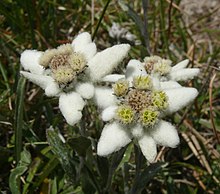
Edelweiss
 Scientific classification
 Kingdom:
Plantae (unranked):
Angiosperms (unranked):
Eudicots (unranked):
Asterids Order:
Asterales Family:
Asteraceae Tribe:
Gnaphalieae[1] Genus:
Leontopodium Species:
L. alpinum Binomial name Leontopodium alpinum
Cass., 1822


Established 1907 by the Austrian-Hungarian Army for their alpine troops, the sign was used in World War II by the Wehrmacht Gebirgsjäger—here as Edelweiss cap badge.

Illustration.
Edelweiss (
 i/ˈeɪdəlvaɪs/
;
Leontopodium alpinum) is a well-known
European mountain flower, belonging to the
sunflower family.
Contents
[
hide]
[edit] Names
The common name comes from
German edel, meaning "noble", and
weiß (also spelled
weiss) "white", thus signifying "noble whiteness" or "noble purity".
[2]
The scientific name
Leontopodium is a
Latin adaptation of
Greek leontopódion (λεοντοπόδιον) "
lion's paw", from
léōn "lion" and
pódion "foot" (diminutive of
poús, podós "foot").
[3]
The Romanian name,
floarea reginei,
[4] means "Queen's flower". Also, another common name is
floare de colţ which means "the corner's flower".
The Persian name is gol-e-yax, which translates as "ice flower"
[edit] Description
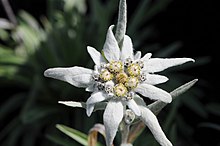
Leaves and flowers are covered with white hairs and appear woolly (
tomentose). Flowering stalks of Edelweiss can grow to a size of 3–20
cm (in cultivation, up to 40 cm). Each bloom consisting of five to six small yellow flower heads (5
mm) surrounded by
bracts in star formation. The flowers are in bloom between July and September.
[edit] Range
The plant is unequally distributed and prefers rocky limestone places at 2000–2900 m al ude. It is not toxic, and has been used traditionally in folk medicine as a remedy against abdominal and respiratory diseases. The dense hair appears to be an adaptation to high al udes, protecting the plant from cold, aridity and
ultraviolet radiation.
[5]
Since it usually grows in inaccessible places, it is associated in many countries of the alpine region with mountaineering.
[edit] Protection
Edelweiss is a protected plant in many countries, including
Mongolia,
Bulgaria,
Croatia,
Switzerland (since 1878),
France,
Norway,
Iran,
India (
Zanskar region),
Italy,
Serbia,
Malaysia (In Genting and Cameron Highlands),
Indonesia (In Semeru Mountain),
Germany,
Spain (Ordesa National Park),
Poland and
Slovakia (Tatra National Park),
Slovenia (in
Gorizia and Gradisca since 1896, in
Carniola since 1898),
Austria (since 1886) and
Romania (since 1933).
[edit] Cultivation
Leontopodium alpinum is grown in gardens for its interesting inflorescence and silver foliage.
[6] The plants are short lived and can be grown from seed.
[7]
[edit] Symbolic uses
- On the Austrian euro coins, a picture of Edelweiss is used on the two-euro-cent coins.
- It is the symbol of the Bulgarian Tourist Union
- It is also the symbol of the Swiss national tourism organisation
- On the Romanian 50 Lei banknote.
- Edelweiss Society
- In Austria, Edelweiß is also a brand of beer named after the flower.
- Edelweiss is the unofficial national flower of Switzerland.
- The Edelweiss is used in the logotypes of several alpine clubs such as the Deutscher Alpenverein (German Alpine Club) or the Österreichischer Alpenverein (Austrian Alpine Club).
- Edelweiss Air, an international airline based in Switzerland, is named after the flower, which also appears in its logo.
- The song "Edelweiss", which is about the flower, is from Rodgers and Hammerstein's 1959 musical The Sound of Music, which takes place in Salzburg, Austria during World War II.
- "Bring me Edelweiss" is the best-known song of the music group Edelweiss.
- The Edelweiss was established 1907 as the sign of the Austrian-Hungarian alpine troops by Emperor Franz Joseph I. These original 3 Regiments wore their edelweiss on the collar of their uniform. During World War I (1915) the Edelweiss was granted to the German alpine troops, for their bravery. Today it is still the insignia of the Austrian, Polish, and German alpine troops.
- Edelweiss was a badge of Edelweiss Pirates (Edelweisspiraten)—the anti-Nazi youth groups in Third Reich. It was worn on the clothes (e.g. a blouse or a suit).
- The Edelweiss flower was the symbol of Wehrmacht and Waffen-SS Gebirgsjäger, or mountain rangers, worn as a metal pin on the left side of the mountain cap, on the band of the service dress cap, and as a patch on the right sleeve. It is still the symbol of the Mountain division in the German army today.
- The World War II Luftwaffe unit, Kampfgeschwader 51 (51st Bomber Wing) was known as the Edelweiss Wing.
- The rank insignia of Swiss generals has Edelweiss signs instead of stars. A Korpskommandant for example (equivalent to a Lieutenant General in other countries) wears three Edelweiss signs on his collar instead of three stars.
- Polish professional ice hockey team MMKS Podhale Nowy Targ use an Edelweiss as their emblem.
[edit] See also
[edit] References
- ^ Randall J. Bayer, Christopher F. Puttock, and Scot A. Kelchner (2000). "Phylogeny of South African Gnaphalieae (Asteraceae) based on two noncoding chloroplast sequences". American Journal of Botany 87 (2): 259–272. doi:10.2307/2656914. JSTOR 2656914. PMID 10675314. http://www.amjbot.org/cgi/content/full/87/2/259.
- ^ William Shepard Walsh (1909). Handy-book of literary curiosities. J.B. Lippincott Co.. pp. 268–. http://books.google.com/books?id=hrJkAAAAMAAJ&pg=PA268. Retrieved 19 August 2010.
- ^ λέων, πόδιον, πούς. Liddell, Henry George; Scott, Robert; A Greek–English Lexicon at Perseus Project
- ^ Taner Murat. Dicţionar român — tătar crimean, Sózlík kazakşa — kîrîm tatarşa. Taner Murat. pp. 136–. ISBN 9789736922657.
- ^ Vigneron, Jean Pol; Marie Rassart, Zofia Vértesy, Krisztián Kertész, Michaël Sarrazin, László P. Biró, Damien Ertz, Virginie Lousse (January 2005). "Optical structure and function of the white filamentary hair covering the edelweiss bracts". Physical Review E (American Physical Society) 71. arXiv:0710.2695.
- ^ Mineo, Baldassare (1999). Rock garden plants: a color encyclopedia. Portland, Or.: Timber Press. pp. 150. ISBN 0-88192-432-6.
- ^ McVicar, Jekka. Seeds: The Ultimate Guide to Growing Successfully from Seed. The Lyons Press. pp. 22. ISBN 1-58574-874-9.



 read it and weep.....he says Kobe is still the future...
 Reply With Quote









 this .