

 Reply With Quote
Neat-o.

When I read this, the application to gasoline engines and hybrid cars seemed really obvious. Most of the energy from burning gasoline escapes as heat.
I also wonder if such a technology would be feasible to place on the condensor coils of A/C units.
Also the cooling towers from fuel burning power plants, to further suck energy out of that process.
Interesting applications, if so.
------------------------------------
http://www.ornl.gov/info/press_relea...=mr20110516-00
ORNL energy harvesters transform waste into electricity
OAK RIDGE, Tenn., May 16, 2011 — Billions of dollars lost each year as waste heat from industrial processes can be converted into electricity with a technology being developed at the Department of Energy's Oak Ridge National Laboratory.
The high-efficiency thermal waste heat energy converter actively cools electronic devices, photovoltaic cells, computers and large waste heat-producing systems while generating electricity, according to Scott Hunter, who leads the development team. The potential for energy savings is enormous.
"In the United States, more than 50 percent of the energy generated annually from all sources is lost as waste heat," Hunter said, "so this actually presents us with a great opportunity to save industry money through increased process efficiencies and reduced fuel costs while reducing greenhouse gas emissions."
Initially, Hunter envisions the technology being used for cooling high-performance computer chips, thereby helping to solve an enormous problem facing manufacturers of petaflop-scale computers. These mega machines generate massive amounts of heat that must be removed, and the more efficient the process the better. Turning some of that heat into electricity is an added bonus.
Hunter's technology uses cantilever structures that are about 1 millimeter square in size. About 1,000 of these energy converters can be attached to a 1-inch square surface such as a computer chip, concentrated photovoltaic cell or other devices that generate heat. Although the amount of electricity each device can generate is small - 1 to 10 milliwatts per device - many arrays of these devices can be used to generate sizable amounts of electricity that can power remote sensor systems or assist in the active cooling of the heat generating device, reducing cooling demands.
The underlying concept, pyroelectricity, is based on the use of pyroelectric materials, some of which have been known for centuries. First attempts to use this technology to generate electricity began several decades ago, but these studies have been plagued by low thermal to electricity conversion efficiencies - from about 1 to 5 percent.
This is also the case for techniques using thermoelectric, piezoelectric and conventional pyroelectric platforms. However, using arrays of cantilevered energy converters that feature fast response and cycle times, Hunter's team expects to achieve efficiencies of 10 to 30 percent - depending on the temperature of the waste heat generator - in an inexpensive platform that can be fabricated using standard semiconductor manufacturing technology.
"The fast rate of exchange in the temperature across the pyroelectric material is the key to the energy conversion efficiency and high electrical power generation," Hunter said, adding that ORNL's energy scavenger technology is able to generate electrical energy from thermal waste streams with temperature gradients of just a few degrees up to several hundred degrees.
The device is based on an energy harvesting system that features a micro-electro-mechanical, or MEMS, pyroelectric capacitor structure that when heated and cooled causes current to flow in alternate directions, which can be used to generate electricity. In this configuration, cantilevers are attached to an anchor that is affixed to a waste heat generator substrate. As this substrate becomes hot, the cantilever also heats and bends because of the bi-material effect, similar in principle to the bimetal switch used in room and oven thermostats.
"The tip of the hot cantilever comes into contact with a cold surface, the heat sink, where it rapidly loses its heat, causing the cantilever to move back and make contact with the hot surface," Hunter said. "The cantilever then cools and cycles back to the cold heat sink.
"The cantilever continues to oscillate between the heat source and heat sink as long as the temperature difference is maintained between the hot and cold surfaces."
Other developers of this technology, which is funded by the Laboratory Directed Research and Development program, are Nickolay Lavrik, Thirumalesh Bannuru, Salwa Mostafa, Slo Rajic and Panos Datskos. UT-Battelle manages ORNL for DOE's Office of Science.

Neat-o.

If they can make this device clear, then they can attach it to DarrinS' light bulbs and power another house!

Original
C'mon man, even you have to admit that was kinda funny.
Ok, got the jokes outta the way (but I agree, it was original AND funny). Since I have read this, I have just been coming up with more and more uses for this. What a technology! I mean, , throw this onto solar panels because PV operates more efficiently at lower temperatures, and you can increase the PV efficiency as well as adding another electricity stream.
This is awesome! This could change the world! Exciting stuff, I can't wait to tell my friends and family about it. Thanks for sharing!

Anyone know the cost/watt?

Probably pretty high ATM I get the impression that this is relatively new.
No, it is very old technology. Unless a very significant breakthrough has occurred, this will never be a useful technology for normal power production. Even collecting auto exhaust heat will produce some power, but likely be lost in the resistance of cooling and extra weight. Commercial applications at the cooling end of turbine power generation would work, but at what cost to power?
wiki: Thermoelectric effect; Thermopower
The Seebeck effect is the conversion of temperature differences directly into electricity and is named for German physicist Thomas Johann Seebeck, who, in 1821 discovered that a compass needle would be deflected by a closed loop formed by two metals joined in two places, with a temperature difference between the junctions. This was because the metals responded differently to the temperature difference, creating a current loop and a magnetic field. Seebeck did not recognize there was an electric current involved, so he called the phenomenon the thermomagnetic effect. Danish physicist Hans Christian Ørsted rectified the mistake and coined the term "thermoelectricity". The voltage created by this effect is on the order of several microvolts per kelvin difference. One such combination, copper-constantan, has a Seebeck coefficient of 41 microvolts per kelvin at room temperature.To be produce usable electricity, the temperature difference at the junctions have to be dramatically different:The thermoelectric effect is sometimes used to generate electrical power, starting from a source of a temperature gradient. For example, some spacecraft are powered by a radioisotope thermoelectric generator, exploiting the temperature difference between a radioactively-heated plate and the cold empty space surrounding the craft. Some researchers hope that, in the future, much wider use could be made of thermoelectric power generation, including using waste heat from automobiles (see Automotive Thermoelectric Generators) and power plants. (This is a form of energy recycling.)
wiki: Radioisotope thermoelectric generator
RTGs can be considered as a type of battery and have been used as power sources in satellites, space probes and unmanned remote facilities, such as a series of lighthouses built by the former Soviet Union inside the Arctic Circle. RTGs are usually the most desirable power source for robotic or unmaintained situations needing a few hundred watts (or less) of power for durations too long for fuel cells, batteries, or generators to provide economically, and in places where solar cells are not practical. Safe use of RTGs requires containment of the radioisotopes long after the productive life of the unit.
Taken to the moon on Apollo 14:
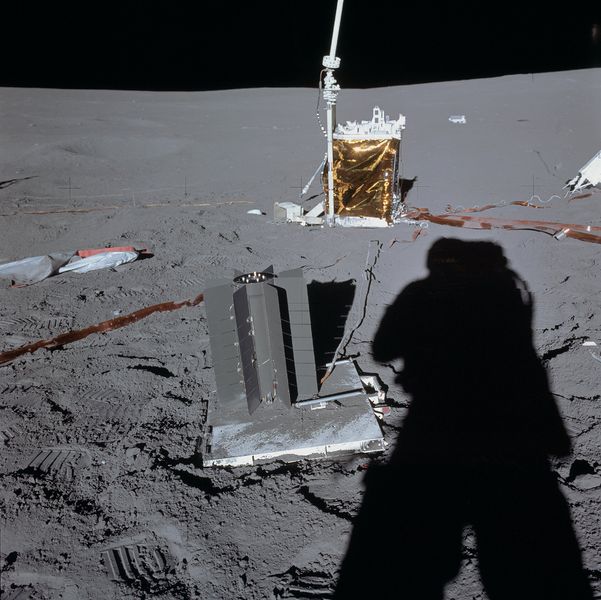
Well its nice to see that WC did not even bother to read the article.
They are doping semiconductors and coupling it with a very basic mechanical device to maintain the oscillation thus the use of the term cantilever. Nanotechnology is neat stuff. Your nonsense of pressure relief devices, tubes and coils is not.The device is based on an energy harvesting system that features a micro-electro-mechanical, or MEMS, pyroelectric capacitor structure that when heated and cooled causes current to flow in alternate directions, which can be used to generate electricity. In this configuration, cantilevers are attached to an anchor that is affixed to a waste heat generator substrate. As this substrate becomes hot, the cantilever also heats and bends because of the bi-material effect, similar in principle to the bimetal switch used in room and oven thermostats.
"The tip of the hot cantilever comes into contact with a cold surface, the heat sink, where it rapidly loses its heat, causing the cantilever to move back and make contact with the hot surface," Hunter said. "The cantilever then cools and cycles back to the cold heat sink.
"The cantilever continues to oscillate between the heat source and heat sink as long as the temperature difference is maintained between the hot and cold surfaces."
Yes, I missed part of it. Still, my question remains. What is the cost/milliwatt.
Probably more than coal at the moment, so we should probably stop pursuing it.
No, if it can potentially become a viable power, then pursue it. However, let the energy companies or wannabe energy companies develop it with their resources, and not tax payer dollars. If an investor sees a future for it, they will invest. If nobody is willing to gamble on the technology, why should tax dollars be used?

With thinking like this, we probably wouldn't have the internet. Don't you think that turned out to be a good use of taxpayer dollars?
You are asking this when they are still developing the prototype? This just goes to show how amateur you are. I guess you want to be able to compare it to the those wonderful efficient natural gas boilers you love to tell us about. The more important question is what materials are used.
Diodes are cheap. Very cheap. Heatsinks for temperatures around boiling are cheap. The question is what the nature of the material to stretch the silicon base is. All of the other parts are dirt ass cheap and we can dope very small gaps very cheaply nowadays too.
I am more curious about whether they use a silicon alloy, tubes, films etc to achieve the bend.
That you are trying to get at efficiency at this point just goes to show how you miss the point.
Once you know how its made then you can predict voltages generated by how much it expands the gap and how much it will cost to acquire materials and manufacture. Then they can print a label so you can read the specs on the part.
You are right all tax payer dollars should only go to proven technologies like coal and natural gas.
LOL...
That's right, Take me out of context whenever you can. Just shows your moral character, or should I say lack of.
I am on record for being against subsidies.
The internet is a spinoff from developing other technologies. Technology I used in the 80's. The internet was not financed to be created, at least not as I think you are implying.
Before I just jump into "WC is a moron" mode please clarify "not financed to be created". Was all of that money spent on a thought experiment?
The internet was a spinoff of digital communications financed by AT&T and the military. I worked on digital packet switching frames that would strip any packet from a DS1 signal and place it on one of the other 119 DS1 channels prepacked, as an electronic technician before it was seen the technology could be used as what is now the internet. A DS1 is a 2.048 megabit circuit and we used it for T1 (1.544 mb) circuits. We also had equipment that handled T3 circuits.
I don't know who spent how much on developing the internet concept, but the backbone was already in place.
I am going to highlight the important parts of your post.
BTW, if I remember correctly, it started out using radio communication tech in hawaii for military comm (I will confirm when I can). It didn't go wired until later.
Last edited by Drachen; 11-04-2011 at 09:22 PM.

not putting money into innovation
ishyddt
The military simply used the same technology Ma Bell did, except they also encrypted the signals. AT&T was really who financed most the tech. The financing the military did do was for their use. Not to supplement a future concept for civilian applications.
There are currently 1 users browsing this thread. (0 members and 1 guests)
 Posting Permissions


