Reply With Quote
LOL Italy


LOL Italy
Keep laughing. Sovereign default is contagious.
On a somewhat related note, we're just days away from the U.S. debt topping the $15 trillion mark.
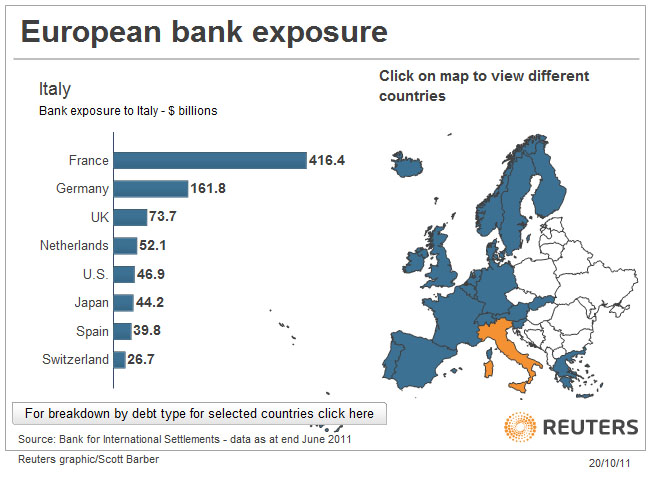
France's banks are fatally exposed to Italian debt. And then who is exposed to France's banks?
A large economy like Italy defaulting would be a disaster to the international mesh of interlinked bond holders.
( CG still pushing the VRWC bull about US debt, and undoubtedly that the debt is much more important (as a pretext to pro-cyclical spending cuts, one estimate saying Repug spending cuts would cause 15M more unemployed) than jobs and mortgage crisis. )
Last edited by boutons_deux; 11-10-2011 at 11:06 AM.
You're right dip . Sovereign debt is only something europeans need to worry about. Spend away!
yes, anti-cyclical "spending away", like about $2T+, is what the US economy needs to get the income, property, sales, etc taxes flowing in to pay down the debt. iow, grow the economy out of debt, as was done in the 1990s.
Repugs, who say govt spending can't create jobs, are whining loudly about cutting DoD spending because it would ... kill jobs!
Spend til you grow, debt be damned!
How'd that approach work out for Italy?

Well, when a power-hungry guy like Berlusconi decides to step down no strings attached, you figure some really serious is going on.

lolitaly

I have begun to think that the EU is swirling the toilet as we speak.
That scares me. A lot.
http://www.economist.com/node/21538161
If the European leaders can't get their collective together, and there is no indication that they can, the global economy is ed.

lol goat ers, lol italy, lol france, lol EU, lol america should just default..so we can lol china holding dead bonds...then watch the trickle affect around the world who relies on chinas demand for natural resources.....when they have no passive income to fund its own economy
pretty good b/g on how banks pushed sovereign bonds as no-risk and pocketed the fees, much like US banks/rating agencies fraudulently rating/selling MBS full of toxic .
Europe’s Banks Found Safety of Bonds a Costly Illusion
PARIS — As the bets that European banks made on United States mortgage investments went bust a few years ago, bankers piled into what they saw as a safe refuge: bonds issued by countries in Europe’s seemingly ironclad monetary union.
“When people started buying more European sovereign debt, there was not a cloud in the sky,”
European banks face tens and possibly hundreds of billions of dollars in losses on loans to nations that use the euro.
How European sovereign debt became the new subprime is a story with many culprits, including governments that borrowed beyond their means, regulators who permitted banks to treat the bonds as risk-free and investors who for too long did not make much of a distinction between the bonds of troubled economies like Greece and Italy and those issued by the rock-solid Germany.
Banks had further incentive to overlook the perils of individual euro zone countries because of the fees they earned for underwriting sovereign debt sold to other investors. Since 2005, several dozen banks in Europe and the United States have earned $1.1 billion in fees from selling bonds for European governments,
http://www.nytimes.com/2011/11/11/bu...e.html?_r=1&hp
John Maynard Keynes Knew What Occupy Wall Street Tells Us Today: "Banks and bankers are by nature blind."
Keynes in 1930 knew what Occupy Wall Street tells us today: the Great Depression was produced by banks. He wrote “Banks and bankers are by nature blind. They have not seen what was coming...” Even when faced with their own destruction they get it wrong: “In the United States,” he wrote “some of them employ so-called ‘economists’ who tell us even today that our troubles are due to the fact that prices have not fallen enough...” [Shades of Inside Job.] “A sound banker, alas! is not one who foresees danger and avoids it, but one who when he is ruined, is ruined in a conventional and orthodox way along with his fellows, so that no one can really blame him.” Sic Transit Gloria Charles Prince and Richard Fuld.
But Keynes’s greatest policy polemic was his first, The immortal Economic Consequences of the Peace. His message was that debts that cannot be paid will not be paid, and the attempt to squeeze blood from stones brings disaster. As Nicholas Wapshott tells, Keynes was a hero to Hayek and his friends in 1919 Vienna for this. “Europe is solid with herself,” he wrote. “If the European Civil War is to end with France and Italy abusing their momentary victorious power to destroy Germany and Austria-Hungary now prostrate, they invite their own destruction also, being so deeply and inextricably intertwined with their victims by hidden psychic and economic bonds.” So it is today with Germany and France and Holland and Finland on one side and Greece, Portugal, Ireland, Spain and Italy on the other.
In each of these areas: jobs, banks, and international debt, we can read Keynes with direct relevance to our present miseries. Against this, today’s followers of Hayek tell us to accept those miseries and not to relieve them.
You need a lot of faith in the resilience of markets to buy that line, three years into the Great Financial Crisis, with nine million Americans unemployed, with twenty-five million who would work if there were jobs, with Europe hanging on the brink, and with no end in sight.
http://www.alternet.org/module/printversion/153034
lol IMF EU sayin asia aint immune to euro crisis, no sherlock...but asia can rely on its cheap labour and manufacturing industries to keep afloat...while those euro countries thats in debt offers all....
U.S. Bank Exposure To Europe Could Reach $4 Trillion
American banks have only “moderate” direct exposure to the European countries currently seeking bailout relief, but adding exposure to wounded economies in Italy and Spain, indirect exposure through European banks, and credit default swaps, the sum of American exposure rises to roughly $4 trillion. The U.S. is attempting to erect firewalls to protect its banks from a further deepening of the European fiscal crisis, with policymakers urging financial ins utions to scale back such exposure. Last week, Federal Reserve Chairman Ben Bernanke indicated that the U.S. couldn’t avoid ill effects from a widening of the European crisis. “It is not something that we would be insulated from,” he said. “I don’t think we would be able to escape the consequences of a blow-up in Europe.”
http://thinkprogress.org/economy/201...four-trillion/
http://www.project-syndicate.org/com...bini44/EnglishThe recent chaos in Greece and Italy may be the first step in this process. Clearly, the eurozone’s muddle-through approach no longer works. Unless the eurozone moves toward greater economic, fiscal, and political integration (on a path consistent with short-term restoration of growth, compe iveness, and debt sustainability, which are needed to resolve unsustainable debt and reduce chronic fiscal and external deficits), recessionary deflation will certainly lead to a disorderly break-up.
With Italy too big to fail, too big to save, and now at the point of no return, the endgame for the eurozone has begun. Sequential, coercive restructurings of debt will come first, and then exits from the monetary union that will eventually lead to the eurozone’s disintegration.

lol france posters shouldnt be giving italy
416b lended to italy...lol france what are they thinkn?
Barclays is to England what JP Morgan is to the US but with less compe ion. They are one of the creators of the bond industry as we know it. I use the term industry very loosely.

Good, I hope the system crashes everywhere, including here. It can't be repaired and the only way anything changes is if it's forced to.
Yep. Reality can't be mocked forever and eventually will overtake us.
Euro Zone Weighs Plan to Speed Fiscal Integration
BERLIN—Euro-zone countries are weighing a new plan to accelerate the integration of their fiscal policies, people familiar with the matter said, as Europe's leaders race to convince investors they can resolve the region's debt crisis and keep the currency area from fracturing.
http://online.wsj.com/article/SB1000...535969680.html
Under the proposed plan, national governments would seal bilateral agreements that wouldn't take as long as a bersome change to European Union treaties, according to people familiar with the matter. Some German and French officials fear that an EU treaty change could take far too long. That has prompted the search for a faster option.
There are currently 1 users browsing this thread. (0 members and 1 guests)
 Posting Permissions