

 Reply With Quote
Its too bad that none of this technology can be used in anything else. Sad Day.

http://www.michigancapitolconfidential.com/16192
Chevy Volt Costing Taxpayers Up to $250K Per Vehicle
Analyst: 'This might be the most government-supported car since the Trabant'
By TOM GANTERT | Dec. 21, 2011 Follow Tom Gantert on Twitter
Each Chevy Volt sold thus far may have as much as $250,000 in state and federal dollars in incentives behind it – a total of $3 billion altogether, according to an analysis by James Hohman, assistant director of fiscal policy at the Mackinac Center for Public Policy.
Hohman looked at total state and federal assistance offered for the development and production of the Chevy Volt, General Motors’ plug-in hybrid electric vehicle. His analysis included 18 government deals that included loans, rebates, grants and tax credits. The amount of government assistance does not include the fact that General Motors is currently 26 percent owned by the federal government.
The Volt subsidies flow through multiple companies involved in production. The analysis includes adding up the amount of government subsidies via tax credits and direct funding for not only General Motors, but other companies supplying parts for the vehicle. For example, the Department of Energy awarded a $105.9 million grant to the GM Brownstown plant that assembles the batteries. The company was also awarded approximately $106 million for its Hamtramck assembly plant in state credits to retain jobs. The company that supplies the Volt’s batteries, Compact Power, was awarded up to $100 million in refundable battery credits (combination tax breaks and cash subsidies). These are among many of the subsidies and tax credits for the vehicle.
It’s unlikely that all the companies involved in Volt production will ever receive all the $3 billion in incentives, Hohman said, because many of them are linked to meeting various employment and other milestones. But the analysis looks at the total value that has been offered to the Volt in different aspects of production – from the assembly line to the dealerships to the battery manufacturers. Some tax credits and subsidies are offered for periods up to 20 years, though most have a much shorter time frame.
GM has estimated they’ve sold 6,000 Volts so far. That would mean each of the 6,000 Volts sold would be subsidized between $50,000 and $250,000, depending on how many government subsidy milestones are realized.
If battery manufacturers awarded incentives to produce batteries the Volt may use are included in the analysis, the potential government subsidy per Volt increases to $256,824. For example, A123 Systems has received extensive state and federal support, and bid to be a supplier to the Volt, but the deal instead went to Compact Power. The $256,824 figure includes adding up the subsidies to both companies.
The $3 billion total subsidy figure includes $690.4 million offered by the state of Michigan and $2.3 billion in federal money. That’s enough to purchase 75,222 Volts with a sticker price of $39,828.
Additional state and local support provided to Volt suppliers was not included in the analysis, Hohman said, and could increase the level of government aid. For instance, the Volt is being assembled at the Poletown plant in Detroit/Hamtramck, which was built on land acquired by General Motors through eminent domain.
“It just goes to show there are certain folks that will spend anything to get their vision of what people should do,” said State Representative Tom McMillin, R-Rochester Hills. “It’s a glaring example of the failure of central planning trying to force citizens to purchase something they may not want. … They should let the free market make those decisions.”
“This might be the most government-supported car since the Trabant,” said Hohman, referring to the car produced by the former Communist state of East Germany.
According to GM CEO Dan Akerson, the average Volt owner makes $170,000 per year.

Its too bad that none of this technology can be used in anything else. Sad Day.

No vision - improving fuel cells isn't 'anything else that can be used in the future'
The Chevy Volt has been a disaster in the same way that the model A was a disaster for Ford

How needs a car that can't even keep up with horses?

So it's not a debacle.
Fuel Cell Vehicles Speeding Towards Commercialization
With a new funding announcement from the U.S. Department of Energy (DOE) and several automakers showcasing new vehicles and major technical developments, fuel cell electric vehicles (FCEVs) are driving back into the advanced vehicle technology conversation.
DOE awarded more than $7 million in funding for four projects in California, Oregon, and Washington to advance hydrogen storage systems for use in FCEVs. These projects aim to cut costs and increase the performance by developing innovative materials and advanced tanks. The selected organizations are providing close to $2 million in cost share. With this announcement, Secretary of Energy Steven Chu spoke positively about fuel cells and hydrogen, as he has several times this year.
"Targeted investments in cutting-edge hydrogen storage technologies will spur American ingenuity, accelerate breakthroughs, and increase our compe iveness in the global clean energy economy," said Chu. "As we focus on energy security, strengthening our portfolio to include domestically-produced hydrogen and American-made fuel cells for transportation and energy storage applications will create new jobs and reduce carbon pollution."
Reinforcing the value of government support and investment, two recent studies– one from the Low Carbon Vehicle Partnership and Element Energy, and another from the DOE's Argonne National Laboratory – highlight the progress of FCEVs toward achieving major cost reduction and underscore that FCEVs are an essential component of the advanced energy portfolio. Both studies stress that the investment is necessary to help move the vehicles towards commercialization, since technical improvements will continue to bring the cost down.
There have been exciting advancements from automakers as well:
Nissan unveiled its next-generation fuel cell stack, which it claims is the world's best as far as power density. The new fuel cell also boasts a significantly reduced weight and cost. Nissan, best known as a leading proponent of battery electric vehicles, aims to launch its FCEV by 2016 as part of its goal of selling 1.5 million zero-emission vehicles.
http://www.altenergymag.com/news/201...lization/22579
=========
$7M? $2M? one time? but $700B every damn year for the MIC?

Soooo how much does any other car recieve per car on incentives?
Does the total per unit go down if they sell more units?
How is this comparable to any other new line of car?
Seems like an awful lot of things left out. Given the tone of the article, one has to wonder at the methodology used to arrive at the figure as well.
Meh. I'm sure it is subsidized, but a "debalacle" seems to be a conclusion in search of data, instead of the other way around.

Agreed. Amortorizing total costs across only one years production is flawed at best.
There's some promising development in solid state li-ion batteries on the horizon that could double or triple current capacity while halving the cost.
In fact, let's add a couple of rather recent developments together.
One of several intriguing technologies with the potential of increasing the power out put of solar panels, or vastly reducing their per watt costs:
http://www.nrel.gov/news/press/2011/1667.html
Plus
http://newenergyandfuel.com/http:/ne...-salt-battery/
And many other advances in battery technology, will allow battery cost and ability to store power to go up.
Both of which are solid historical trends that will favor the economics of such vehicles.
If the US took a page from Germany in structuring PV incentives to where people actually invested in it, we could easily see ourselves sharply reduce or even eliminate oil-based energy for our transportation needs in my lifetime.
Yeah, it's wiki.Electricity storage for grid supportAs noted above, NaS batteries can be deployed to support the electric grid. In 2010, Presidio, Texas built the world's largest sodium–sulfur battery to provide power when the city's lone line to the United States power grid goes down.[12] Under some market conditions, NaS batteries provide value via energy arbitrage (charging battery when electricity is abundant/cheap, and discharging into the grid when electricity is more valuable) and voltage regulation.[13] NaS batteries are a possible energy storage technology to support renewable energy generation, specifically wind farms and solar generation plants. In the case of a wind farm, the battery would store energy during times of high wind but low power demand. This stored energy could then be discharged from the batteries during peak load periods. In addition to this power shifting, it is likely that sodium sulfur batteries could be used throughout the day to assist in stabilizing the power output of the wind farm during wind fluctuations. These types of batteries present an option for energy storage in locations where other storage options are not feasible due to location or terrain constraints. For example, pumped-storage hydroelectricity facilities require a lot of space and a significant water resource, and compressed air energy storage (CAES) requires some type of geologic feature for storage.[14]
NGK Insulators Ltd. develops sodium-sulfur batteries as grid storage in Japan, France (Île de la Réunion) and the United States.
[edit] Space applicationsBecause of its high energy density, the NaS battery has been proposed for space applications.[15][16] Sodium sulfur cells can be made space-qualified; in fact a test sodium sulfur cell was flown on the Space Shuttle to demonstrate operation in space. The sodium sulfur flight experiment demonstrated a battery with a specific energy of 150 W·h/kg (3 x nickel–hydrogen battery energy density), operating at 350 °C. It was launched on the STS-87 mission in November 1997, and demonstrated 10 days of experiment operation in orbit.[17]
Renewable power producers are actively hunting for the best storage scheme, and this battery looks to be it.
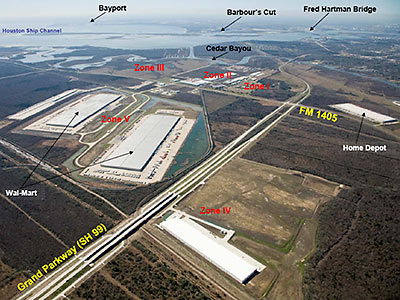
I always think of buildings like this when I think of PV:
That is a lot of surface area for both PV and water capture.
You can see what Walmart sees when it looks around at the massive stores and warehouses they use.
There are currently 1 users browsing this thread. (0 members and 1 guests)
 Posting Permissions

