Reply With Quote
Pretty interesting. I should see if the USGS has historical earthquake records in GIS format. Would be interesting to see where the new earthquake are happening compared to other geological factors.
http://www.ewg.org/analysis/usgs-rec...tainly-manmadeUSGS: Recent Earthquakes “Almost Certainly Manmade”
Report Implicates Oil and Natural Gas Drilling
By Dusty Horwitt and Alex Formuzis, April 2012
Washington, D.C. – A U.S. Geological Survey research team has linked oil and natural gas drilling operations to a series of recent earthquakes from Alabama to the Northern Rockies.
According to the study led by USGS geophysicist William Ellsworth, the e in earthquakes since 2001 near oil and gas extraction operations is “almost certainly man-made.” The research team cites underground injection of drilling wastewater as a possible cause.
“With gasoline prices at $4 a gallon, there’s pressure to rush ahead with drilling, but the USGS report is another piece of evidence that shows we have to proceed carefully,” said Dusty Horwitt, Senior Counsel and chief natural resources analyst at Environmental Working Group. “We can’t afford multi-million-dollar water pollution cleanups or earthquakes that could pose risks to homes and health.”
The USGS study, published by the Seismological Society of America, will be presented at the group’s meeting April 17-19 in San Diego.
The authors shared their findings with EnergyWire’s Mike Soraghan in an article published March 29. Soraghan wrote:
“The study found that the frequency of earthquakes started rising in 2001 across a broad swath of the country between Alabama and Montana. In 2009, there were 50 earthquakes greater than magnitude-3.0, the abstract states, then 87 quakes in 2010. The 134 earthquakes in the zone last year is a sixfold increase over 20th century levels.
The USGS authors said they do not know why oil and gas activity might cause an increase in earthquakes but a possible explanation is the increase in the number of wells drilled over the past decade and the increase in fluid used in the hydraulic fracturing of each well. The combination of factors is likely creating far larger amounts of wastewater that companies often inject into underground disposal wells. Scientists have linked these disposal wells to earthquakes since as early as the 1960s. The injections can induce seismicity by changing pressure and adding lubrication along faults.
The U.S. Energy Information Administration reports that between 1991 and 2000, oil and gas companies drilled 245,000 wells in the U.S. compared to 405,000 wells between 2001 and 2010 – a 65 percent increase.1 As an example of how much more fracking fluid is used, New York state’s review of oil and natural gas drilling regulations in 1988 assumed that companies would use between 20,000 and 80,000 gallons of fluid for hydraulic fracturing per well.2 The state’s 2011 review of regulations for natural gas drilling in shale formations assumed that companies would use 2.4 million to 7.8 million gallons of fluid per well – a 100-fold increase.3
According to Anthony Ingraffea, a professor of engineering at Cornell University who has conducted research on hydraulic fracturing, the increase in both the number of wells drilled and the amount of hydraulic fracturing fluid used per well has been driven by a shift of drilling into so-called unconventional formations such as shale in which gas and oil are distributed over very large volumes of rock, which need stimulation by fracking. Companies have increasingly tapped these formations because they have depleted most of the conventional formations in which gas and oil are contained in a relatively concentrated pool. In these conventional formations, companies can simply perforate the pool with their drill bit and drain a significant quan y of oil or gas. In unconventional formations, however, energy companies must drill more wells because the energy deposits are widely dispersed. Drillers must also use significantly more fracturing fluid to create larger fractures that can access a broader area of oil or gas.
“The rate of drilling and the volume of fluid used have increased tremendously,” said Ingraffea.
The Environmental Protection Agency regulates underground waste disposal wells under its underground injection control program. The agency often delegates primary enforcement authority to the states. According to an article written by Soraghan and published in the March 15, 2012 edition of EnergyWire, an EPA task force is preparing recommendations for “managing or minimizing” earthquakes caused by underground injection wells. “The group appears to have receded from its initial goal of finding ways to ‘avoid’ earthquakes caused by injection,” Soraghan reported. An EPA presentation included in the article showed that the EPA sets specific standards for avoiding earthquakes for some types of injection wells but in the case of oil and gas wastewater injection wells, such measures are up to the agency’s discretion.4
The USGS report is likely to be of particular interest in California where earthquakes are a part of life largely as a result of the 810-mile long San Andreas Fault. An EWG investigation recently discovered that companies are engaged in hydraulic fracturing, mostly for oil, in a number of counties throughout California, including several directly above the fault line. It is unclear how the companies are disposing of their wastewater.
1 U.S. Dept. of Energy, Energy Information Administration, U.S. Crude Oil, Natural Gas and Dry Exploratory and Development Wells Drilled, Annual. Accessed online Mar. 30, 2010 at http://www.eia.gov/dnav/pet/hist/Lea...XWC0_NUS_C&f=A.
2 New York State Department of Environmental Conservation, Draft Generic Environmental Impact Statement on the Oil, Gas and Solution Mining Regulatory Program, Volume 1, Jan. 1988, at 9-26.
3 New York State Department of Environmental Conservation, Revised Draft, Supplemental Generic Environmental Impact Statement on the Oil, Gas and Solution Mining Regulatory Program Well Permit Issuance for Horizontal Drilling and High-Volume Hydraulic Fracturing to Develop the Marcellus Shale and other Low-Permeability Reservoirs, Sept. 7, 2011, at ES-8. Accessed online Mar. 30, 2012 at http://www.dec.ny.gov/energy/75370.html.
4 Mike Soraghan, EPA Looking for Ways to 'Manage or Minimize' Injection Earthquakes,” Energy Wire Mar. 15, 2012. Accessed online Mar. 30, 2012 at http://www.eenews.net/public/energywire/2012/03/15/2.

Pretty interesting. I should see if the USGS has historical earthquake records in GIS format. Would be interesting to see where the new earthquake are happening compared to other geological factors.

If this is true then San Antonio must be gonna fall into the aquifer when one hits here...lots and lots and lots of fracking going on.

Not over the Edwards.
And also note the distinction that it's not the fracking per se but some injection wells getting rid of the used frac fluid. The theory is that the injected water is lubricating the existing tectonic plate fault allowing it to slide easier.

According to the story on NPR I heard this morning the majority of them happened near waste disposal wells that had water injected into them recently.
When they stopped injecting water, the earthquakes stopped.
Wastewater injection wells tend to be at levels far below aquifers.
There might be a problem if there was some magma vent that would cause the water to go UP, but that is considered to be unlikely to my understanding.
Frankly, if no one is hurt in these quakes, and nothing is really damaged, I don't see a problem.
Take some solid precautions and surveys before you inject water, and stop if there is a problem, but overall, it doesn't seem to be harmful.

.
Last edited by DarrinS; 04-12-2012 at 09:19 AM.
I'm really sorry. I should have put my comments in blue. I forgot. I was just being facetious.
See my note to CC. I was not being serious and I apologize for not making it clear that I was not being serious. Sorrrreeee.


I was really hoping to open this up and hear about some das ly supervillain.
Nah, not close enough to fault lines:
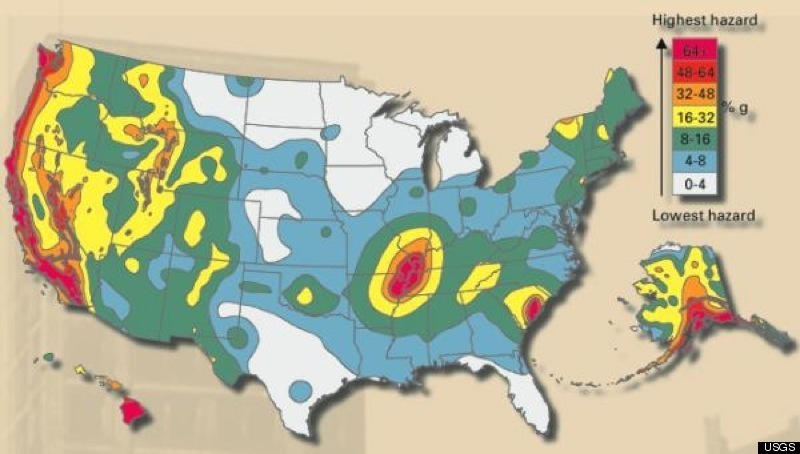
S'all good, no apology needed. I kinda guessed that. My post was in no way a comment on yours specifically.
Just me regurgitating, mostly.

http://news.yahoo.com/wastewater-inj...192855495.htmlOne of Oklahoma's biggest man-made earthquakes, caused by fracking-linked wastewater injection, triggered an earthquake cascade that led to the damaging magnitude-5.7 Prague quake that struck on Nov. 6, 2011, a new study confirms.
The findings suggest that even small man-made earthquakes, such as those of just a magnitude 1 or magnitude 2, can trigger damaging quakes, said study co-author Elizabeth Cochran, a seismologist with the U.S. Geological Survey.
"Even if wastewater injection only directly affects a low-hazard fault, those smaller events could trigger an event on a larger fault nearby," she told Live Science.

murica's fault


Didn't the USGA look into ways to cause earthquakes in areas they thought to much potential energy was building?
Kind of like setting off a mousetrap or spring before it's dangerously engaged...?
fracking adds to underground pressures, and the liquids "lubricate" the slippages
And there are thoughts among some geologists is that slippage is good if it causes small earthquakes that would otherwise be huge. Again, relief in the buildup of potential energy. Release it incrementally. Now of course this is not why we frack, but it is interesting.
The added pressure is the match to burn a smaller fire... An analogy.

This is my viewpoint.
lol USGA
lol agreeing with WC that fracking makes us safer
In a lot of places, like around DFW area, there is NO history of geological instability, until fracking started. Same in other stable but fracked-up regions.
Who is saying fracking makes us safer?
I said that some geologists had presented ideas on causing smaller earthquakes to relieve stress buildup in fractures.
It is interesting.
Read again.
http://www.texasalmanac.com/topics/e...texas-occasion
Texas has experienced more than 100 earthquakes of magnitude 3 or greater since 1847. However, because the density of both seismographs and people has been very low in Texas, knowledge of the state’s seismicity is undoubtedly incomplete.
The largest known earthquake in Texas occurred on Aug. 16, 1931, near the town of Valentine in Jeff Davis County. The total felt area exceeded one million square kilometers (about 400,000 square miles).
Ten earthquakes had epicenters near El Paso. Several of these shocks have produced minor damage. One earthquake on March 7, 1923, caused an adobe house to collapse and led to the suffocation of a man in Juarez, Mex. This is the only known death caused by a Texas earthquake. Seismic activity in this area of Texas may be related to known faults that have been interpreted as part of the Rio Grande rift zone, a zone of crustal extension.
Notable earthquakes in the Texas Panhandle are probably associated with an ancient zone of crustal weakness that has been reactivated in recent times. Although the largest known earthquakes in the Panhandle have not exceeded magnitude 5.4, the potential for very large earthquakes remains uncertain.
Historic earthquakes in East and Central Texas include the 1847 Seguin, 1873 Manor, 1887 Paige, 1902 Creedmoor, 1932 Mexia-Wortham and the 1934 quake near Paris. These earthquakes were all fairly small and probably occurred as a result of sediment loading and resulting flexure in the Gulf of Mexico.
Earthquakes also have been located in Southeast Texas. The 1887 Wellborn, 1910 Hempstead and 1914 Anderson shocks may have been related to salt dome growth or minor adjustments from sediment loading in the Gulf. The 1891 Rusk and the 1981 Center and Jacksonville earthquakes in Northeast Texas were all located on or near an 80-kilometer segment of the Mount Enterprise fault system.
Fluid withdrawal is usually associated with aseismic subsidence and faulting such as occurs in the Houston area. However, small earthquakes are sometimes reported. In 1925, small shocks were associated with subsidence produced from oil production at the Goose Creek old field near Houston.
Larger earthquakes in East Texas also may have resulted from fluid withdrawal. Tentative relations between withdrawal and seismicity have been proposed for the 1932 Mexia-Wortham and the 1957 Gladewater earthquakes. More convincing evidence exists for the earthquakes in some oil and gas fields in South Texas.
The injection of fluids into the earth’s crust for disposal or for secondary recovery of oil also has been known to produce earthquakes in other states. Some earthquakes, none very damaging, may be associated with fluid injection in the Permian Basin of West Texas.
An account of Texas’ seismicity would not be complete without considering the effects of earthquakes from neighboring regions. Popular legend holds that the New Madrid, Mo., earthquakes of 1811-1812 were responsible for the formation of Caddo Lake. However, there exist accounts of the lake’s existence as a swampy area as early as 1722. Whether the shocks deepened the lake is not known. In any case, it is likely that moderately high intensities of shock waves were experienced in Northeast Texas.
The Sonora, Mexico, earthquake of 1887 cracked several buildings in El Paso and caused a general panic in the population of that city. Seismic surface waves from the Alaskan earthquake of 1964 damaged a water well in the Texas Panhandle and produced waves, which damaged several boats in channels along the Gulf Coast
This adapted article was prepared for the Texas Almanac 1986-1987 by Dr. Wayne D. Pennington and Scott D. Davis, both of the Ins ute of Geophysics of the University of Texas at Austin.
Earthquake map
As the map shows, except for the Trans-Pecos, most of the state has a relatively small probability of experiencing an earthquake. Click to enlarge.
Significant Earthquakes in Texas
Listed chronologically are the significant earthquakes in Texas (above 3.0), followed by the magnitude (commonly called the Richter scale) and known details about each earthquake.
1811 (8.1) — The first of this series of earthquakes at New Madrid, Mo., occurred on Dec. 16, 1811, magnitude 8.1. The second occurred on Jan. 12, 1812, with a magnitude of 7.8, and the third occurred on Feb. 7, 1812, with a magnitude of 8.0. All three were felt over an area of 5,000,000 square kilometers and were probably felt in Texas, but no verifiable accounts are known.
1847 (3.6) — The Feb. 14, 1847, earthquake was centered near Seguin. Newspapers reported cracked timber in houses at Seguin and New Braunfels.
1873 (3.1) — The May 1, 1873, earthquake was at Manor near Austin.
1882 (5.6) — The Oct. 22, 1882, earthquake felt in Texas, was probably centered in Oklahoma or Arkansas; the total felt area covered about 375,000 square kilometers. At Sherman heavy machinery vibrated, bricks were thrown from chimneys, and movable objects overturned.
1887 (4.1) — The Jan. 5, 1887, earthquake was at Paige in Bastrop County. The felt area was 4,600 square kilometers.
1887 (3.3) — The Jan. 31, 1887, earthquake was at Wellborn near College Station.
1887 (7.4) — A May 3, 1887, earthquake in Sonora, Mex., was felt strongly in West Texas, including El Paso and Fort Davis.
1891 (4.0) — On Jan. 8, 1891, violent shaking of buildings and a few toppled chimneys were reported from Rusk. These effects were evaluated as intensity VI, although other towns in East Texas along a northeast-southwest line through Rusk experienced tornadoes and sudden, violent wind storms producing effects similar to, and in some cases more damaging than, those in Rusk.
1902 (3.9) — The Oct. 9, 1902, earthquake was near Creedmoor, south of Austin. The felt area was 5,600 square kilometers.
1907 (3.6) — In April 1907, an earthquake near Amarillo occurred. Newspapers reported a window broken.
1910 (3.8) — The May 8, 1910, earthquake was at Hempstead. The felt area was 2,900 square kilometers.
1914 (3.3) — The Dec. 30, 1914, earthquake was at Anderson.
1917 (3.9) — A locally damaging earthquake occurred at Panhandle on March 28, 1917. Some cracked plaster was reported and children were evacuated from a school building.
1923 (4.7) — An earthquake on March 7, 1923, caused an adobe house to collapse and led to the suffocation of a man in Juarez, Mex., a few miles from the Texas border. This is the only known death caused by a Texas earthquake.
1925 (5.4) — Another disturbance occurred at Panhandle on July 30, 1925. There were three distinct shocks over a period of 15 seconds. Major problems were the shaking of dishes on shelves and rattling and creaking of furniture. The shocks were felt over an area of approximately 518,000 square kilometers including Roswell, N.M., Tulsa, Okla., and Leavenworth, Kan.
1931 (6.0) — This West Texas earthquake heavily damaged buildings in Valentine. The first shock occurred at 5:40 a.m. on Aug. 16. Although people were panic stricken, there were no fatalities and only a few minor injuries from falling adobe. Even though Valentine bore the brunt of the shock, damage was reported from widely scattered points in Brewster, Culberson, Jeff Davis and Presidio counties. Cracked walls and damaged chimneys were reported from several towns. The total felt area covered about 1,000,000 square kilometers in Texas, New Mexico and Mexico. The earthquake was accompanied by rumbling subterranean sounds heard over practically the entire affected area. The shock was strongly recorded on all seismographs in North America and at stations all over the world. Numerous aftershocks were felt in the epicentral region; the strongest, on Aug. 18, was magnitude 4.2 at Alpine, Lobo, Pecos and Valentine. A minor aftershock was felt at Valentine on Nov. 3.
1932 (4.0) — Slight damage resulted from an earthquake in the Mexia-Wortham area on April 9, 1932. Loose bricks were thrown down and some plaster cracked. The shock was also felt in Coolidge, Currie, Groesbeck, Hillsboro, Teague and Richland.
1934 (4.2) — A moderate earthquake affected an area of about 7,700 square kilometers in northeastern Texas near Paris and an adjoining portion of Oklahoma on April 11, 1934. The tremor was most distinctly felt at Arthur City, Chicota and Powderly. Many persons who felt the shock reported having heard a roaring or rumbling noise. Two shocks were recognized by many observers.
1936 (5.0) — Widely felt earthquake shocks with an epicenter in the Panhandle near Borger occurred June 19, 1936. Effects were noted at Gruver, White Deer and outside Borger.
1948 (5.2) — On March 11, 1948, a shock in the northern Panhandle near Dalhart caused minor damage, consisting mainly of cracked plaster. The effects were reported from Amarillo, Channing, Dalhart, Panhandle and Perryton.
1951 (4.2) — The Panhandle area was the center for another moderate shock on June 20, 1951. Damage to plaster occurred at Amarillo and Hereford. The felt region extended from Lubbock to Borger.
1952 (5.5) — This earthquake in central Oklahoma near El Reno on April 9, 1952, caused furniture to sway in North Texas and was felt as far south as Austin.
1957 (4.7) — Four shocks over six hours affected an area of about 26,000 square kilometers in bordering portions of Arkansas and Louisiana on March 19, 1957. Press reports noted that a few objects were upset and at least one or two windows were broken. Newspaper office and police station switchboards were swamped with called from alarmed residents. Effects were felt in Gladewater, Diana, Elkhart, Marshall, Nacogdoches and Troup.
1964 (4.4) — A series of moderate earthquakes in the Texas-Louisiana border region near Hemphill started on April 23, 1964. Epicenters were determined on April 23, 24, 27 and 28. There were numerous additional shocks reported felt at Pineland, Hemphill and Milam. The only damage reported was from the magnitude 4.4 earthquake on April 28 — wall paper and plaster cracked at Hemphill. The magnitude of the other epicenters changed from 3.2 to 3.7. Shocks were also felt at Pineland on April 30 and May 7. On June 2, three more shocks were reported in the same area. The strongest was measured at magnitude 4.2. Another moderate earthquake on Aug. 16 awakened several people at Hemphill and there were some reports of cracked plaster. The shock was also felt at Bronson, Geneva, Milam and Pineland.
1966 (4.1) — The Texas Panhandle region experienced another tremor on July 20, 1966. The earthquake knocked books from a shelf in one home and was felt by nearly all in Borger. Effects were felt Amarillo.
1966 (3.4) — Several street signs were knocked down and windows were broken at Kermit on Aug. 14, 1966. The shock was also felt at Wink.
1969 (3.9) — Four small earthquakes occurred near El Paso on May 12, 1969. One house in El Paso had hairline cracks in the ceiling and cracks in the cement driveway.
1974 (4.5) — On Feb. 15, 1974, an earthquake in the Texas Panhandle caused plaster cracks at Perryton, Booker, Darrouzett and Texhoma.
1978 (4.6) — An earthquake occurred on June 16, 1978 centered near Synder. Windows broke at Snyder, Fluvanna and Pea , and cracked plaster was reported at Justiceburg.
1981 (3.2) — On June 9, 1981, an earthquake at Center, near the border with Louisiana.
1981 (3.3) — On Nov. 6, 1981, an earthqake at Jacksonville. The felt area of 800 square kilometers.
1992 (4.6) — An earthquake centered in Andrews County occurred on Jan. 2, 1992. Although felt over a wide area, 440,000 square kilometers, only minor damage was reported.
1993 (4.3) — An earthquake centered in Atascosa County occurred on April 9, shaking a home from its foundation in Campellton and forcing a natural-gas processing plant to shut down.
1995 (5.7) — An earthquake occurred on April 14, 1995, in Brewster County near Marathon. There were broken water mains, cracked walls and windows and broken dishes. Broken gas mains resulted in several small fires. Landslides were reported, most notably from the peak of Cathedral Mountain.
1997 (3.8) — In March, in Jim Wells County.
2008 (3.7) — On April 7, near Falls City.
2008-2009 (3.3) — A series of small earthquakes occurred in Tarrant and Dallas counties near DFW Airport, the largest of which was 3.3.
2010 (4.0) — On April 24 an earthquake occurred 13 miles east of Alice near Agua Dulce.
2010 (4.3) — On October 13 an earthquake centered about six miles east of Norman, Okla., shook at 9:06 a.m. The temblor was felt all across Oklahoma, north into Kansas, and into North Texas.
2011 (4.4) — Sept. 11, a short-lived quake hit 11 miles north-northeast of Snyder at 7:27 a.m., rattling shutters and items on tables.
2011 (4.8) — On Oct. 20, a quake centered at Fashing in Atascosa County struck at 7:24 a.m., rattling windows and sending tremors that could be felt throughout Central and South Texas.
2011 (5.6) — On Nov. 5 an earthquake between Oklahoma City and Tulsa shook at 10:53 p.m. Tremors were felt into North Texas.
2011 (3.2) — Dec. 17, an earthquake centered about 5 miles north-northeast of Snyder occurred at 8:47 a.m. Scores of people said they felt the quake, but no damage was reported. It was the third quake in the area in less than a month. On Nov. 24, a 3.0 magnitude quake was centered 17 miles north-northeast of Synder, and on Dec. 9 a 3.4 magnitude quake was centered 15 miles north of Snyder.
2012 (3.2) — Jan. 18, an earthquake near Godley in Johnson County occurred at 4:30 p.m., causing no damage or injuries.
2012 (3.6) — Jan. 24, at 12:21 p.m., 17 miles southeast of Alpine near Big Bend National Park. No damage was reported.
2012–2013 (4.8) — Shelby County. On May 17, at 3:12 a.m. an earthquake near Timpson in East Texas injured one person and broke some windows. It was the second and largest quake in the area within several weeks, and was felt as far away as Longview and Shreveport. On May 10, at 10:15 a.m., a 3.9 magnitude quake occurred. No significant damage was reported. A third 2.7 tremor followed on May 20, a fourth 2.5 tremor occurred in the same area at 1:30 a.m. on May 26, and a fifth 2.1 tremor occurred on June 16. Again, on Dec. 7 a 2.8 magnitude quake occurred in the same area. On Jan. 25, at 1:01 a.m., a 4.1 magnitude quake occurred in the area. On Jan. 29, at 6:30 a.m. a 2.8 magnitude earthquake occurred just south of Timpson. No damages were reported. On Sept. 1 at 4:52 p.m., a 4.1 magnitude earthquake occurred 2 miles west-northwest of Timpson. Two hours later, a second 4.3 magnitude quake struck nearby. Little damaged was reported.
2012–2013 (3.6) — Johnson County. On June 24 at 12:46 p.m. a 3.6 magnitude earthquake occurred near Keene in North Texas. The quake caused some household items to be knocked over and a few windows to break. It was the largest in a series of quakes within several weeks in the county. On June 4 there was a 2.3 tremor near Cleburne, on June 15 at 2 a.m. there was a 3.2 magnitude earthquake near Burleson, on June 26 there was a 2.6 magnitude quake at Alvarado, on July 6 there was a 2.7 magnitude quake near Keene, on July 10 there was a 2.4 magnitude quake southwest of Keene, and on July 13 there was a 2.7 magnitude quake near Godley. No damage or injures were reported. On Dec. 12, a 2.6 magnitude tremor occurred 2 miles east of Burleson and was felt in Tarrant and Johnson counties. On Feb. 25, 2013. a 2.7 magnitude earthquake was reported at 3:07 p.m. near Midlothian. On March 10, another 2.7 magnitude earthquake occurred at 8:47 a.m. near Godley. No damage was reported.
2012 (3.4) — McMullen County. On June 24, a 3.4 magnitude earthquake occurred at 3:55 a.m. near Tilden in South Texas. No damage was reported.
2012–2013 (3.4) — Dallas County. Sept. 29, a 3.4 magnitude earthquake occurred at 11:05 p.m. 2 miles north of Irving. It was followed within minutes by a second quake of 3.1 magnitude, in the same area. The quakes caused some cracks in walls and ceilings, but there was no major damage reported. Another of 2.1 magnitude followed one day later. In the same area, a 3.0 magnitude earthquake occurred the following Jan. 22. On Feb. 25, a 2.5 magnitude earthquake occurred at 6:56 a.m. south of DeSoto. In the same area, just south of there in Ellis County, a 2.4 magnitude earthquake occurred on that same date at 4:35 a.m. No damage was reported. Another 2.4 magnitude quake occurred in that part of northern Ellis County on Oct. 15. No damage was reported.
2013–2014 (3.7) — Parker County. More than two dozen earthquakes occurred in northeast Parker County and across the county line in Wise County and Tarrant County in November through February, the strongest being on Dec. 9 northeast of Mineral Wells, registering 3.7 magnitude. Another, on Nov. 19 near Azle, registered 3.6. It occurred at 6:35 p.m. and followed two tremors earlier that day around noon, the first was a magnitude 2.5 south-southwest of Reno. Six minutes later, a 2.8 magnitude earthquake was recorded two miles west of Azle. The first of the November quakes occurred Nov. 1 near Richland Hills in Tarrant County, registering 2.1 magnitude. On Nov. 5, a 2.6 magnitude earthquake occurred at 8:30 p.m. near Reno in the northeast corner of Parker County, followed by an aftershock. Minutes later a 2.3 magnitude quake happened within 20 miles near Newark in the southeast corner of Wise County. Then, on Nov. 6, a 2.7 magnitude earthquake occurred in the morning southeast of Springtown, followed the next day by a 2.9 magnitude earthquake in the same area at 10:32 p.m. On Nov. 8, a 2.4 magnitude earthquake a mile northwest of Azle occurred. Again on Nov. 9, a 3.0 magnitude earthquake occurred near Springtown. Nov. 11, a 2.8 tremor occurred west of Briar. Nov. 23, a 2.9 magnitude earthquake occurred two miles southwest of Reno at 3:43 a.m. On Nov. 25, a 3.3 magnitude earthquake occurred near Azle at 1:53 a.m. On Dec. 3, a 2.7 magnitude earthquake occurred at 9:44 a.m a mile east-southeast of Reno. On Dec. 8, a 3.6 magnitude earthquake occurred north of Azle. On Dec. 10, a 2.7 magnitude earthquake occurred east of Azle. On Dec. 14, a 2.8 magnitude earthquake occurred southwest of Springtown. On Jan. 13, a 3.1 magnitude earthquake occurred at Reno. On Jan. 28, a 3.0 magnitude earthquake occurred three miles northwest of Azle. On Feb. 2, a 2.3 magnitude earthquake occurred between Benbrook and Crowley. No major damage was reported in any of the earthquakes.
2013 (2.6) — Grayson County. A 2.6 magnitude earthquake occurred northeast of Whitesboro on Dec. 13, one day after another 2.6 magnitude earthquake occurred southeast of Pottsboro. A 2.5 magnitude earthquake occurred southwest of Pottsboro on Dec. 11. No major damage was reported in any of the earthquakes.
2014 (3.5) — Oldham County. A 3.5 magnitude earthquake occurred 14 miles west of Vega on Jan. 6. about 2:41 a.m. No major damage was reported
There are currently 1 users browsing this thread. (0 members and 1 guests)
 Posting Permissions