

 Reply With Quote
"Exports on the scale that we project would not play a large role in domestic price setting."
$3 in US vs $12 in Europe, elsewhere?

LONDON (CNNMoney)
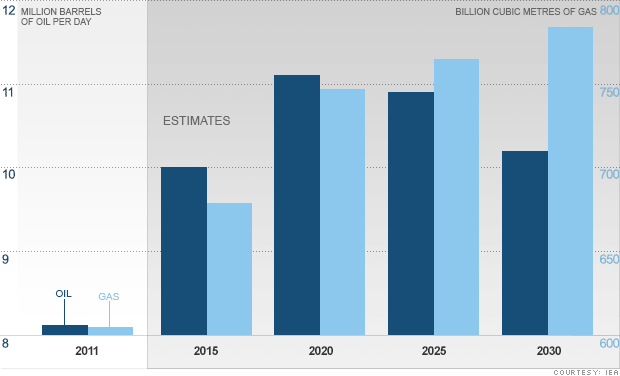
The United States will overtake Saudi Arabia to become the world's biggest oil producer before 2020, and will be energy independent 10 years later, according to a new forecast by the International Energy Agency.
The recent resurgence in oil and gas production, and efforts to make the transport sector more efficient, are radically reshaping the nation's energy market, reported Paris-based IEA in its World Energy Outlook.
North America would become a net exporter of oil around 2030, the global organization said Monday.
"The United States, which currently imports around 20% of its total energy needs, becomes all but self sufficient in net terms -- a dramatic reversal of the trend seen in most other energy importing countries," the IEA stated.
The U.S. is experiencing an oil boom, in large part thanks to high world prices and new technologies, including hydraulic fracking, that have made the extraction of oil and gas from shale rock commercially viable.
From 2008 to 2011, U.S. crude oil production jumped 14%, according to the U.S. Energy Information Administration. Natural gas production is up by about 10% over the same period.
According to the IEA, U.S. natural gas prices will rise to $5.5 per million British thermal units (MBtu) in 2020, from around $3.5 per MBtu this year, driven by rising domestic demand rather than a forecast increase in exports to Asia and other markets.
"In our projections, 93% of the natural gas produced in the United States remains available to meet domestic demand," it said. "Exports on the scale that we project would not play a large role in domestic price setting."
North America's new role in the world energy markets will accelerate a change in the direction of international oil trade toward Asia, and underscore the importance of securing supply routes from the Middle East to China and India.
The IEA said it expects global energy demand to increase by more than a third by 2035, with China, India and the Middle East accounting for 60% of the growth, and more than outweighing reduced demand in developed economies.
That will push world average oil import prices up to $125 per barrel (in 2011 dollars) by 2035, from around $100 per barrel at present, but they could be much higher if Iraq fails to deliver on its production potential.
Iraq is set to become the second largest oil exporter by the 2030s, as it expands output to take advantage of demand from fast growing Asian economies.
Related: Iraq oil output to double by 2020 [left this bit in too, worth reading as well-RG]
New fuel economy standards in the U.S. and efforts by China, Japan and the European Union to reduce demand would help to make up for a disappointing decade for global energy efficiency.
"But even with these and other new policies in place, a significant share of the potential to improve energy efficiency -- four-fifths of the potential in the buildings sector and more than half in industry -- still remains untapped," the IEA stated.
Policymakers are still missing out on potential benefits for energy security, economic growth and the environment.
Growth in demand over the years to 2035 would be halved and oil demand would peak just before 2020, if governments took action to remove barriers preventing the implementation of energy efficiency measures that are already economically viable, the global organization said.
-------------------------------------------------
FWIW.
"Exports on the scale that we project would not play a large role in domestic price setting."
$3 in US vs $12 in Europe, elsewhere?

And people mocked "Drill baby, drill"
There will be NO BENEFIT to US consumers for domestic oil (it and its products already exported at world prices), and same with NG when the LNG terminals are built.

Royalties.
Taxes.
Jobs.
When LNG prices are finally allowed to normalize, non profitable wells will be uncapped and producing nat gas.
More royalties.
More taxes.
More jobs.
So yeah. There will be benefits to US consumers.

...but there are also costs which we haven't really ever considered before...for instance, we are poisoning millions of acres of land which will make them virtually usable for thousands of years...we have proposed pipelines carrying millions of barrels of highly corrosive chemicals through aquifers collection land threatening millions of people's habitat...we have a warming planet, affecting the rain cycle and already flooding low lying areas like Manhattan and other parts of the world...We see no cost benefit to US consumers because companies can make more selling our oil to Europe or Indonesia...
So yeah. There will be hidden costs to US consumers.
I see you ignored my previous posts.
cost:benefit says "hi".
millions of acres that will be virtually unusable for thousands of years.
Oooook.
That isn't quite the way the oil market works.
The benefit will be that we don't pay quite as high a price for gasoline/oil as we might have otherwise.
We are still very vulnerable to any supply shocks that might be cause by instability in other world regions that produce a lot of oil for export, though. You can't get rid of that without reducing dependence on oil.
It deserved to be mocked, and still does for reasons that seem to escape you, still.
Oilcos sell to whichever market pays best. Their allegiance is only to max profits, not to USA. (but they do love US taxpayers footing the bill for protecting oilcos' foreign sources)
When NG producers get LNG terminals, the same profit maximization will apply.
None of these ing oilco/gasco are paying the external costs of environmental pollution/destruction, of roads and rail maintenance/destruction. All that's on taxpayers, a hidden couple $ on the price of oil/gas.
And what happened to the questions of eROI and flow rate?
Except, of course, for the examples I've already provided and you continue to ignore.
But, here's another one for you to completely ignore.
http://www.denverpost.com/news/ci_22...-work-colorado
Paying some, but not all, the costs makes boutons' point valid.
The full negative externalities of oil are simply not reflected in the market cost of that oil.
Nor are the benefits.
boutons point is invalid, as usual, because he is unable to stray away from absolutes. Again, as usual, I invalidated it with a quick search.
Exxon Spills Tar Sands Oil Again In Missouri, Can’t Find 126,000 Gallons Spilled In Arkansas
Despite a massive cleanup effort in the Mayflower, Arkansas, neighborhood, the federal pipeline safety agency reports that ExxonMobil has recovered only 2,000 of the total 5,000 barrels of spilled tar sands crude. The accident incident report, which the agency shared with the Sierra Club after a Freedom of Information Act request, gives new insight into the size of the spill and the ineffectiveness of the cleanup effort. The report reveals that in total 83 people were evacuated from their homes, emergency response took 40 minutes, the pipeline was operating at 708 pounds of pressure when it burst, and 2,000 barrels reached local waterways.
The Pegasus pipeline was built to carry diesel fuel in 1947, Exxon converted the pipeline to carry tar sands crude and reversed its flow in 2006. In 2011, the federal pipeline safety agency fined Exxon $26,500 for failure to properly inspect a section of the line.
While Exxon’s Valdez spill more than 20 years ago was much larger that the Mayflower spill, the company was rebuffing claims of liability for future losses as recently as 2011.
Exxon pulled in $9.5 billion in pure profits in the first quarter of this year.
http://thinkprogress.org/climate/201...d-in-arkansas/
There are lots of medical problems from the Exxon pipeline spill, aka, externalities, that Exxon is not paying, just as they aren't paying for all of the cleanup and ongoing damages.
Cross posted from WH23
http://qz.com/84418/a-new-forecast-p...soline-prices/
BP and S Raided in European Commission Price-Rigging Inquiryhe London offices of BP and S have been raided by European regulators investigating allegations they have "colluded" to rig oil prices for more than a decade.
The European commission said its officers carried out "unannounced inspections" at several oil companies in London, the Netherlands and Norway to investigate claims they may have "colluded in reporting distorted prices to a price reporting agency [PRA] to manipulate the published prices for a number of oil and biofuel products".
The commission said the alleged price collusion, which may have been going on since 2002, could have had a "huge impact" on the price of petrol at the pumps "potentially harming final consumers".
Lord Oakeshott, former Liberal Democrat Treasury spokesman, said the alleged rigging of oil prices was "as serious as rigging Libor" – which led to banks being fined hundreds of millions of pounds.
http://readersupportednews.org/news-...igging-inquiry
The safe bet is to assume MegaCorps are guilty until proven innocent, although as motivated ($$$) and intelligent (pay top $$$ for best and brightest) as they are, finding the truth will be difficult.
LIBOR was a huge crime, but barely punished.
That is a possibilty, indeed. It makes me giddy with the prospect that it will take the price of gold with it.

A United States with an improved budget outlook, and projected to be energy-independent by 2030, is going to see a strengthening of the dollar against gold.
There are currently 1 users browsing this thread. (0 members and 1 guests)
 Posting Permissions

