
 Reply With Quote
Career Arc: Tim Duncan, Part 1
The Duncan Show has been many things over the past 16 years, but it has rarely, if ever, been boring
by Bill Simmons on June 11, 2013
The San Antonio Spurs picked Tim Duncan on June 25, 1997, about seven weeks before Matt Stone and Trey Parker launched their new animated series on Comedy Central. Sixteen years later, the Spurs and South Park are still chugging along like kindred spirits; in a goofy twist, Duncan’s only fun nickname (“Timmaaaaaaaay”) comes from that show. Both the Spurs and South Park generated so many classic moments over the years, they practically blend into each other now. They were lavished with critical acclaim while being overshadowed by more popular network shows (the Lakers and The Simpsons, respectively). Parker and Stone should have burned out years ago; Duncan should be washed up by now. Nope and nope. Every time they seemed ready to lose their relevance, they rallied back. You know, like right now.
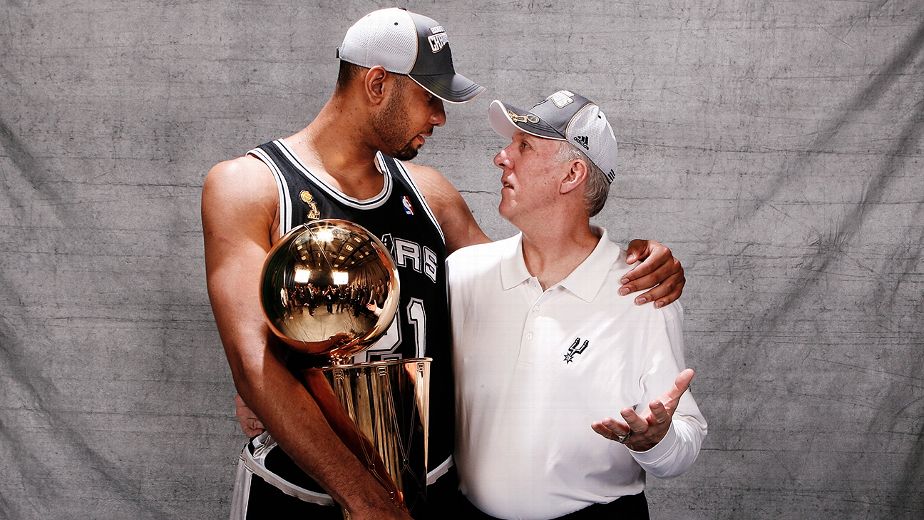
It’s easier to put San Antonio’s unprecedented run in perspective. The Spurs won four les in nine years. They made two different Finals 14 years apart. They won 70 percent of their games without ever missing a postseason. They never won fewer than 50 games except for the ’99 lockout season (when they finished 37-13). Their three signature players (Duncan, Manu Ginobili and Tony Parker) have played together 11 years, one away from passing the original Big Three (Larry Bird, Kevin McHale and Robert Parish) as the longest-running three-star alliance. If Duncan and Gregg Popovich capture les 14 years apart, they will make history; only Bill Russell and Red Auerbach won rings even nine years apart (1956 and 1966).1 If Duncan wins the Finals MVP, he’ll match Kareem as the only player to repeat that 14 years apart.
There’s been a misconception over these past 16 years that Duncan’s Spurs were boring, that America repeatedly rejected them. Uh-oh, here come the small-market Spurs again. Get ready for lousy ratings! It didn’t help that their signature stars never fit into a culture that rewarded cool commercials, YouTube clips and self-created nicknames. Despite unrivaled success, unprecedented continuity, enviable chemistry and innovative thinking, the Spurs never received the same mainstream recognition that, say, the Patriots always did. Gregg Popovich never developed Bill Belichick’s polarizing mystique (nor did he care to). Tim Duncan never became a mainstream celebrity like Tom Brady (nor did he care to). We never argued about the Spurs, and when we did, it always centered on some lame thesis like “Why don’t more people appreciate Tim Duncan?”
Their biggest issue wasn’t their fault: Until this month, they never found the right Finals opponent, someone who brought out the best in them and produced riveting basketball. Remember, the Patriots played five unforgettable Super Bowls against the Rams, Panthers, Eagles and the Giants (twice). Until this month, the Spurs never drew a Finals opponent that made you say, “I can’t wait for this one!” That’s just bad luck, even if that same luck helped them win all four of those series.
Are the Spurs a dynasty? Of course not. More like a compelling television series that churned out an inordinate number of high-level seasons — like South Park, actually. Think of them as The Duncan Show and it makes more sense. The Duncan Show is a lot of things, but it has been rarely, if ever, boring.
THE CREATION: 1996-97
What Happened: The ’96 Spurs won 59 games before collapsing in the playoffs for the umpteenth time, losing a deciding Game 6 in Utah by 27 points. That triggered a summer of “David Robinson is too nice; you need to be a killer to win les and he’s not a killer” stories. Which wasn’t untrue.2
When Robinson missed the first six weeks of the ’97 season with a back injury, the Spurs staggered to a 3-15 start. He returned and immediately broke his left foot, inadvertently murdering their season and thousands of Robinson’s fantasy owners. (Note: I was one of them. You know how many total games Robinson played? Six! I’m still bitter.) After then-GM Popovich fired Bob Hill and took over coaching duties, some mistakenly remember the Spurs tanking for a Duncan lottery ticket. Not entirely true! Injuries decimated them: Robinson, Chuck Person, Charles Smith and Sean Elliott missed a combined 264 games. They finished 20-62; only Boston and Vancouver did worse. Since the expansion Grizzlies were ineligible for the no. 1 pick, the Celtics had a 36.3 percent chance at getting Duncan. San Antonio? 21.4 percent.
You know what happened next.
Hold on, I have to throw scalding acid in my eyes. Just give me one second.
THE DUNCAN SHOW, SEASON 1: 1997-98
Record: 56-26
Playoffs: Round 2, lost to Utah in five
Returning core: David Robinson, Vinny Del Negro,4 Avery Johnson, Will Perdue, Monty Williams, Sean Elliott
New additions: Tim Duncan, Jaren Jackson, Chuck Person, Malik Rose
The Big-Picture Story Line: “Here Come the Twin Towers!!!” As crazy as this seems now, some experts wondered if Duncan and Robinson could coexist. Before the ’97 draft, some Spurs fans argued for Keith Van Horn over Duncan because they already had a center.5 A brief history of NBA Twin Tower duos: Wilt Chamberlain and Nate Thurmond (one Finals trip); Walt Bellamy and Willis Reed (no Finals trips); Kevin McHale and Robert Parish (five Finals trips, three les); Bill Cartwright and Patrick Ewing (no Finals trips); Ralph Sampson and Hakeem Olajuwon (one Finals trip). Only the McHale-Parish tandem generated rings, but Larry Bird was Boston’s best player for all three les. Could you actually build around the Twin Towers gimmick?
What Went Right: Not only did Duncan win Rookie of the Year, he became the first rookie since Larry Bird to make first-team All-NBA.6 Meanwhile, the Celtics traded their top lottery pick (Chauncey Billups) after 51 games. Oh, and they passed up T-Mac for Ron Mercer with their other lottery pick. I need a drink.
Read more http://grantland.com/features/tim-duncan-part-1/