Reply With Quote
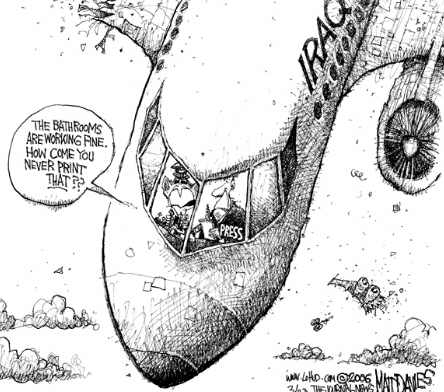
Condi is my friend, and Rummy is my friend.
The only way to settle this, is a 3-some.
I'm George W Bush and I approve this message
Rumsfeld Challenges Rice on 'Tactical Errors' in Iraq
By Josh White
Washington Post Staff Writer
Thursday, April 6, 2006; A21
Defense Secretary Donald H. Rumsfeld said he did not know what Secretary of State Condoleezza Rice was talking about when she said last week that the United States had made thousands of "tactical errors" in handling the war in Iraq, a statement she later said was meant figuratively.
Speaking during a radio interview on WDAY in Fargo, N.D., on Tuesday, Rumsfeld said calling changes in military tactics during the war "errors" reflects a lack of understanding of warfare. Rumsfeld defended his war plan for Iraq but added that such plans inevitably do not survive first contact with the enemy.
( ... conveniently ignoring the fact the Rummy and friends did not assume a n insurgency was possible and had no plans to handle. The rummy ups are mind-boggling, even the context of the totally ed up decison to even start the Repug re-election war. "You're doing a heckuva job, rummy" )
"Why? Because the enemy's got a brain; the enemy watches what you do and then adjusts to that, so you have to constantly adjust and change your tactics, your techniques and your procedures," Rumsfeld told interviewer Scott Hennen, according to a Defense Department transcript. "If someone says, well, that's a tactical mistake, then I guess it's a lack of understanding, at least my understanding, of what warfare is about."
Rumsfeld's questioning of Rice's comment came amid long-standing tensions between their departments over the war in Iraq and other issues. Rumsfeld and the Pentagon have been criticized by members of Congress and even some retired generals for missteps in Iraq, such as failing to anticipate the insurgency.
On a trip to Britain, Rice told reporters Friday that "I know we've made tactical errors, thousands of them I'm sure," but that the strategic decisions will be the ones historians judge.
When asked about the comment the next day, Rice said she "wasn't sitting around counting" U.S. tactical errors and instead meant her remark figuratively. "The point I was making . . . is that, of course, if you've ever made decisions, you've undoubtedly made mistakes in the decisions that you've made, but that the important thing is to get the big strategic decisions right and that I am confident that the decision to overthrow Saddam Hussein and give the Iraqi people an opportunity for peace and democracy is the right decision."
In the radio interview, Hennen said Rice had "figuratively suggested recently we've made thousands of tactical errors" and "also suggested that the important test was making the right strategic decisions and that would be the test of history."
Hennen asked Rumsfeld: "Do you agree with that? Have we made thousands of tactical errors? And does that concern you?"
Rumsfeld replied: "I don't know what she was talking about, to be perfectly honest."
Rumsfeld pointed to the nature of the Iraq war -- unpredictable from the start -- as the reason the United States has had to change tactics over the past three years.
"If you had a static situation and you made a mistake in how you addressed the static situation, that would be one thing," he said. "What you have here is not a static situation, you have a dynamic situation with an enemy that thinks, uses their brain, constantly adjusts, and therefore our commanders have to constantly make tactical adjustments."
© 2006 The Washington Post Company
===================
April 6, 2006
Bush Defends Iraq Strategy but Admits Mistakes
By JOHN O'NEIL
President Bush told a town-hall meeting in Charlotte, N.C., today that he was "constantly looking back to see if things could have been done differently or better" in Iraq.
Mr. Bush gave a forthright defense of what he called "the strategic objective" in Iraq and his decision to order an invasion, saying "knowing what I know today, I'd have made the same decision."
But he acknowledged that there had been problems with the "tactics" used in Iraq, citing flaws in the initial approach to reconstruction and the training of the Iraqi army and police force.
"Obviously, one classic case that hurts us that I wish was done differently was Abu Ghraib," Mr. Bush said, referring to the abuse of Iraqi detainees by American personnel at a prison built by Saddam Hussein.
Mr. Bush has made similar remarks in the string of speeches he has given on Iraq in recent weeks. But his statements today were somewhat more detailed, both in his opening speech and in response to a questioner who asked whether he ever reflected on what he could have done differently.
Administration officials are well aware of polls showing a steady erosion of public support for the war in Iraq, and have begun to speak more openly about the difficulty of the task ahead, while stressing the need for Americans to maintain their resolve.
"I'm confident people are saying, 'I wonder if these people can ever get their act together and self-govern?' " Mr. Bush said of the Iraqi leadership. "The answer is, I'm confident they can, if we don't lose our nerve."
Referring to the need to restrain sectarian violence in Iraq, Mr. Bush said, "It's tough work, but I want you to know we understand the problem."
Last week, Secretary of State Condoleezza Rice told an audience in Britain that the administration had made "tactical errors, thousands of them I'm sure," while arguing as Mr. Bush did today that the right strategic decisions had been made.
On Tuesday, Defense Secretary Donald H. Rumsfeld appeared to take issue with that assessment. In a radio interview, Mr. Rumsfeld said that tactics changed in accordance with the enemy's activities. "If someone says, well, that's a tactical mistake, then I guess it's a lack of understanding, at least my understanding, of what warfare is about," Mr. Rumsfeld said, according to an article today in The Washington Post.
Mr. Bush described the changes in tactics as both a result of adjustments to changes by insurgents and of a realization that some approaches did not meet the reality on the ground in Iraq.
"Every war plan is great, until you meet the enemy," Mr. Bush told an audience made up of members of the World Affairs Council of Charlotte and students from Central Piedmont Community College.
Mr. Bush counseled patience with the delay in the formation of a government in the wake of last December's election, while again nudging Iraqi politicians to act. "I know four months in the way these news cycles work can seem like a decade," he said.
"You know Condi went over there the other day," Mr. Bush said, referring to Ms. Rice's weekend visit to Baghdad with Jack Straw, the British foreign minister. "Her message was, you know, let's get moving."
The president appeared relaxed and jovial before the mostly friendly crowd, removing his suit jacket after delivering his opening remarks. When members of the audience booed a young man who said, "I have never felt more ashamed or frightened by the leadership in Washington, including presidency," Mr. Bush motioned for quiet, admonishing the audience to "let him speak."
The young man ended by thanking Mr. Bush for "the courtesy of allowing me to state my views," and Mr. Bush responded with a vigorous defense of the warrantless wiretapping that had been one of the actions cited by the questioner.
"Would I apologize for this? Absolutely not," Mr. Bush said, to lengthy applause.
Mr. Bush also drew a contrast to the Vietnam War, a point of comparison that administration officials do not generally encourage.
"I know you're thinking about, well, when's he going to get our troops out of there," Mr. Bush said, before going on to say that such a decision would be based not on polls but on "the recommendations of our generals on the ground."
"I remember coming up in the Vietnam War and it seemed like that there was a — during the Vietnam War there was a lot of politicization of the military decisions," he said. "That's not going to be the case under my administration."
In recent speeches, Mr. Bush has repeatedly cited recent successes by American and Iraqi forces in the city of Tal Afar in western Iraq. Before the war, the American commander in charge when the city was cleared, Col. H.R. McMaster, was the author of a book called "Dereliction of Duty," which castigated top military officials during the Vietnam era for their failure to stand up to political leaders who were pushing a failing strategy there.
Copyright 2006 The New York Times Company

Condi is my friend, and Rummy is my friend.
The only way to settle this, is a 3-some.
I'm George W Bush and I approve this message

April 7, 2006
Op-Ed Columnist
Condi and Rummy
By THOMAS L. FRIEDMAN
It's hard to know whether to laugh or cry when you read about the spat between Secretary of State Condoleezza Rice and Defense Secretary Donald Rumsfeld over whether the U.S. committed any "tactical" errors in the Iraq war.
In case you missed it, Secretary Rice told reporters in Britain last Friday that "I know we've made tactical errors, thousands of them I'm sure," but that the big strategic decision to take down Saddam Hussein will be seen by future historians as correct.
During a radio interview on WDAY in Fargo, N.D., on Tuesday, Mr. Rumsfeld responded: "I don't know what she was talking about, to be perfectly honest." Then Mr. Rumsfeld elaborated with a blast of incoherent nonsense about how you always need to change tactics in war: "If you had a static situation and you made a mistake in how you addressed the static situation, that would be one thing. What you have here is not a static situation, you have a dynamic situation with an enemy that thinks, uses their brain, constantly adjusts, and therefore our commanders have to constantly make tactical adjustments."
Where does one even begin? First of all, Secretary Rice is wrong that the Bush team's mistakes in Iraq were purely tactical. Under Mr. Rumsfeld's direction, it made a monumental strategic error in not deploying enough troops to control Iraq's borders and fill the security vacuum we created by bringing down Saddam — a vacuum that has since been filled by looters and scores of head-chopping sectarian militias and gangs.
Here is the brutal truth of where we are in Iraq today: After three years, more than $300 billion and thousands of U.S. and Iraqi casualties, we still do not have an Iraqi government or army that could hold together, without U.S. help. There is still no self-sustaining, democratizing Iraq. And even if we eventually get a national unity government there, it is not clear it will be able to reverse Iraq's slide into sectarianism and militias. No one even knows anymore whether Iraqis in uniform work for the state or a militia.
The other day, the Iraqi blogger Riverbend, who writes for Salon.com, told of watching Iraqi TV when an Arabic message scrolled across the screen: "The Ministry of Defense requests that civilians do not comply with the orders of the army or police on nightly patrols unless they are accompanied by [U.S.] coalition forces working in that area."
Riverbend's translation: Many Iraqi security forces "are actually militias allied to religious and political parties."
As someone who believes in the importance of building a progressive politics in Iraq, in the heart of the Arab world, it pains me to say this, but we are in real trouble there.
Some critics dismiss the Iraq invasion as being all about oil. They are so wrong. It is so much crazier — and nobler — than that. This region has known only top-down monologues: colonial powers, then kings and dictators, always talking down to their people, backed by iron fists.
What we have been trying to bring about in Iraq is something unprecedented — the first ever bottom-up, horizontal dialogue between the cons uent communities of an Arab state. What you are seeing in Iraq today is that horizontal dialogue, between Shiites, Kurds and Sunnis — communities who have never been allowed to forge their own social contract — so they wouldn't have to be ruled from the top down, with an iron fist.
If the Iraqi Shiites, Sunnis and Kurds can forge their own social contract, democracy is possible in this part of the world. If they can't, then it's kings and dictators as far as the eye can see. And since it was decades of that sort of politics that produced the pathologies that produced 9/11, that would be very unfortunate.
Our job was to do one thing right: provide a secure environment so that Iraqis could have a reasonably rational, peaceful horizontal dialogue, which is difficult enough given their legacy of fear from the Saddam years.
We failed to do that, largely because Mr. Rumsfeld, who was warned otherwise, refused to deploy sufficient forces. Mr. Rumsfeld made that decision because — if you read "Cobra II," the Michael Gordon-Bernard Trainor history of the Iraq war — he was more interested in transforming the Pentagon than in transforming Iraq. He was never ready to devote the unprecedented military resources to match the unprecedented Iraq mission. President Bush, Condi Rice, Cheney all went along with him for the ride.
They tried to make history on the cheap. But you can't will the ends without willing the means. That is Strategic Theory 101, and ignoring it is not just some "tactical error."
Copyright 2006 The New York Times Company

Bush is going give up Rummy for the sake of the team.

pffffhh..Rummy should have been let go 2 years ago when he tried to do Iraq on the cheap and the prison torture scandal. Instead the Republican nose-machine spun it on a 'few bad apples' at Abu Gharib, but they have yet to explain the torture at Guantanamo bay and other U.S. bases in Iraq, and the policy of sending prisoners to other countries to be tortured.
There are currently 1 users browsing this thread. (0 members and 1 guests)
 Posting Permissions