Page 1 of 3 123 LastLast
Results 1 to 25 of 73
  1. #1
    Veteran
    My Team
    San Antonio Spurs
    Join Date
    Mar 2003
    Post Count
    29,564
    Sarkozy leads with 30%; Royal second with 24% -- exit polls


    http://www.marke ch.com/news/stor...2446C2EA359%7D


    By Aude Lagorce, Marke ch
    Last Update: 4:06 PM ET Apr 22, 2007

    LONDON (Marke ch) -- Conservative Nicolas Sarkozy will face Socialist Segolene Royal in the runoff for the French presidency on May 6, allowing for a traditional left-right duel to take place, after the frontrunners fended off a flurry of rivals on Sunday, the first exit polls indicate.

    Sarkozy, of the ruling conservative UMP (Union for Popular Movement) party, was the top scorer in the first round, with about 30% of the vote. Royal, of the Socialist party, gathered 24% of the vote, eclipsing centrist Francois Bayrou, who received around 18% of the vote.


    Jean-Marie Le Pen, of the extreme-right Front National party, who stunned France by making it to the second round of the 2002 elections, garnered 11.5% of the votes.
    The first official projections of the vote will be released by the government later Sunday. The final outcome of the vote won't be known until Monday.

    Talk of reform, change and new blood motivated the French to go to the polls. Turnout soared to 84%, the highest in 50 years, according to the French Interior Ministry. Since 2002, about one million new voters have registered.
    The French CAC-40 index isn't expected to show a big reaction on Monday. Sarkozy has been the clear favorite of the business community for months. See full story.
    The polls of the last month consistently showed him set to face Royal on May 6.

    "It is the best possible scenario for the financial markets, the CAC-40 should react well tomorrow and investors from abroad should be back," said Michael Benhamou, managing partner at Louis Capital, an independent broker dealer.

    These elections are France's most important in a decade. The two finalists are not only a generation younger than in bent Jacques Chirac, who's been in power for 12 years, they're also promising to rejuvenate the country by making significant breaks with the past.

    Royal is the first woman with a real shot at the presidency after successfully eclipsing heavyweights within the socialist party to snare the nomination. Sarkozy has recently quit his post as interior minister in the ruling government and won the grudging endorsement of Chirac. Earlier in the campaign, the meteoric rise of Bayrou in the polls shook up what was meant to be a two-horse race.

    The stakes of these election s are high for Europe's third-largest economy.

    Despite its much-admired free education and health-care systems, contained work hours, generous vacations and pensions, and generally high quality of life, France is struggling with a raft of structural problems including tepid growth, high unemployment, booming national debt and a lack of innovation and R&D investment.

    The next president must determine how the country will address these problems, a move that's likely to have a lasting economic impact.

    Sarkozy, 52, and Royal, 53, disagree on most issues, including the length of the work week, the level of taxes, the country's immigration policy as well as how to kick start the economy, reduce unemployment and carry out the reforms many say the country so sorely needs.

    Despite some classic policy promises targeted at voters in their core cons uencies, both Royal and Sarkozy have also tried to reach across party lines.
    Royal, who favors snow-white tailored suits to embody her freshness and novelty, has, for instance, confessed an admiration for Britain's Tony Blair, proposed sending unruly teenagers to military-style camps and suggested that teachers should spend more time in the classroom, all to the discomfort of various core supporters within the Socialist party.

    Sarkozy is identified with the current government, though he doesn't hesitate to criticize its record, which has won him few friends in Chirac's camp. Against the traditions of the French republic, he also favors affirmative action to boost the numbers of ethnic minorities in certain jobs.
    And both are seeking that folksy appeal.

    Royal talks endlessly of "participatory democracy." Sarkozy, meanwhile, emphasizes his working-class and immigrant background, but has also developed a predilection for status-quo-bashing speeches that have made him a hit with entrepreneurs and the middle classes.

    Sarkozy on Sunday called for a "true ideological" debate to take place in the next two weeks. Royal said that the electorate now has the choice between "two completely different roads" and that France can change without being "brutalized."

    "I refuse to cultivate fears," she said.
    Both, however, emphasized their belief that the current system no longer works.

    Defeated Bayrou and Le Pen sounded dire warnings. Bayrou said the illness of France is deeper than the two leading parties understand.

    Le Pen, meanwhile, simply said that "France's future is sad."


    Props to the French...while I sincerely hope Royal doesn't win, eliminating LePen was IMO, a step in the right direction for that country...that guy is grade A jackass #2 in Western Europe(right behind Zapatero)...and worse than Chirac.

    And yes worse than Royal...


    Anyway...good thing we didn't elect Kerry or he'd be running out of the asses we were going to elect him to kiss, right about now...


    Hopefully Sarzosky can win...

    I don't think most of the French resent Americans....just like most Americans don't resent the French...but due to the peculiraities of the French Election system(read, having a load of political parties) the current of Anti-Americanism that ChIraq tapped into was enough to get him re-elected(with something like 20% of the vote).

    We'll see what happens now...


    The French will be amazed at how our relations will improve once they don't have a leader that openly despises our country and has less tact than Bush...little things matter.


    I just wonder if ChIraq is going to avoid the criminal charges awaiting him once he's no longer granted immunity by his position(although he probably weaseled out of that, or else he'd be running again IMO).
    Last edited by whottt; 04-23-2007 at 11:40 PM.

  2. #2
    Veteran
    My Team
    San Antonio Spurs
    Join Date
    Dec 2005
    Post Count
    15,842
    "Anti-Americanism that ChIraq tapped into"

    French people elected Chirac because he was anti-American?

    Had dubya followed Chirac's correct advice to stay out of Iraq, the USA, M/E, world would be much better places, and 30K less US military dead+injured.

    Chirac, most French, and most countries were against the Iraq war, and they all have been proven right.

    US or non-US, being against the Iraq war and the Repugs is not the same as being anti-American, no matter how many times lying, sliming assholes on the right repeat and sling that lying slime.
    Last edited by boutons_; 04-23-2007 at 11:53 PM.

  3. #3
    Veteran
    My Team
    San Antonio Spurs
    Join Date
    Mar 2003
    Post Count
    29,564
    no one has less tact than bush
    I think you missed an excellent opportunity to shut up.


    - Jacques ChIraq to Eastern Europe 2003

  4. #4
    Veteran
    My Team
    San Antonio Spurs
    Join Date
    Mar 2003
    Post Count
    29,564
    If one picture of Rummy with Saddam has been the de-facto political view of the left for 7 years...

    WTF?


    Last edited by whottt; 04-24-2007 at 12:19 AM.

  5. #5
    Veteran
    My Team
    San Antonio Spurs
    Join Date
    Mar 2003
    Post Count
    29,564
    Oh yeah...those pictures in the White Coats?


    They are taken in a nuclear reactor in France..right before France built Iraq's first nuclear reactor(since blown up by the Israelis).

    Fact - France had the post sanction devlopment deals with Saddam for Iraq.
    Fact - State owned French companies were found to be among those cir venting the OFF program by sending banned materials that could be used for WMD(Russia, Germany and China were the otherS)
    Fact - Chirac, unless he got some law passed, faces crimininal corruption charges from his days as Mayor of Paris, charges that have pretty much been corroborated and have only been staved off by the immunity his position gives him.


    And boutons...do you realize what a complete ass you have made of yourself with those statements if Sarkozy gets elected? You're a ...and a stupid one at that. Thank god most Americans aren't as stupid as you.


    The only way ChIraq got re-elected was by riding a small anti-American current...


    His own ing people voted down the ing EU cons ution he stood for... bag...you think they elected him for his economic policies?


    And he only got like 20% of the vote.


    Bottom line is that you wanted us to elect a guy that was going to follow ChIraq and Schroeder...and they are gone. Don't claim you speak for Europe...

    You just ing clueless, like I always knew you were.


    And you are the lying slime.

  6. #6
    Veteran
    My Team
    San Antonio Spurs
    Join Date
    Mar 2003
    Post Count
    29,564
    ChIraq, not only failed in his attempt to regain France's stature as a world leader...but he flushed the influence they had gained in the EU down the toilet...he didn't last outlast Bush...

    And what you never hear is that the quiet boycott that has been in place since ChIraq made his power play, has ed France up economically...and the falling dollar against the Euro hasn't exactly made them the first choice of imports with Americans.

    He's a failed leader...extreme unpopular in his own country...his approval ratings make W's look like Nixon in 72....and inspite of his pro terrorist stance...the Algerian/North African French hate his guts more than they hate W.

  7. #7
    Veteran
    My Team
    San Antonio Spurs
    Join Date
    Dec 2005
    Post Count
    15,842
    "The only way ChIraq got re-elected was by riding a small anti-American current.."

    Show us the do entation.

    And then show us how Cheney, Rummy, Halliburton, the Reagan Repugs in the 80s all supported, supplied WMD, and got rich helping Saddam AFTER Israel took out Osirak.

    If France supported Saddam, it's anti-US. If the US right-wing/corps supported Saddam, it's OK.

  8. #8
    Veteran
    My Team
    San Antonio Spurs
    Join Date
    Mar 2003
    Post Count
    29,564
    http://www.newsmax.com/archives/arti.../9/91851.shtml

    Saddam and Chirac: 30 Years of Sleaze
    NewsMax.com Wires
    Wednesday, April 9, 2003
    France has desperately and publicly sought a peaceful solution of the Iraqi crisis with a sole strategic goal: strong influence if not control of the world's future leading oil reserves.
    At the same time, French President Jacques Chirac has consolidated his status as heir of former President Charles De Gaulle's policy of independence from the United States.

    The Iraqi government remembered Chirac's predecessor Francois Mitterrand's opposition to allied action to evict Iraqi forces from Kuwait, before ultimately joining the Desert Storm coalition, and thus suspected France would eventually not use its veto power to block a second U.N. resolution. With good reason: If it were to have a stake in postwar oil developments, France must have realized it needed to be seen as a supporter of the "coalition of the willing."

    Although the veto option did not materialize, opponents of the Iraqi regime accuse France of duplicity, citing opposition to use of force against Saddam's regime as a prime example. They see the French challenge to U.S. hegemony as propaganda for Arab consumption, in an attempt to divert attention from France's own objectives in Iraq.

    Funded by the Genocidal Maniac

    Opposition leaders accuse France of freely violating international law and the U.N. charter when it comes to safeguarding its interests and argue that Paris' opposition to war was solely to avert its good friend and client Saddam Hussein's ouster.

    They point to a quarter of a century of such close relations that Baghdad generously contributed to Chirac's election campaigns and made annual donations to the Gaullist Rassemblement Pour La Republique political party, founded by Chirac.

    They cite mutual public declarations of admiration made by the two leaders during Chirac's 1975 trip to Baghdad as prime minister, a visit that ushered in the golden age in French-Iraqi relations.

    Shortly thereafter, France provided financial and technical assistance for the Ozirak, Iraq's first nuclear reactor. Israel eventually bombed the Ozirak, keeping Saddam from having a nuclear offensive capability during the Gulf War in 1990-91. At the time, Chirac's critics called him "Jacques Ozirak," much as now U.S. commentators have taken to referring to the French president as "Jacques Iraq."

    Follow the Money, Oil, Weapons ...

    After Chirac's 1975 visit, Iraq became the leading buyer of French arms, as well as France's main oil supplier. In fact from 1980 until Iraq's 1990 invasion of Kuwait, exports to Iraq and Saudi Arabia accounted for 75 percent of France's total arms sales, with the United States eventually taking the lead in Saudi Arabia.

    The situation has been further complicated by a struggle between France and Russia over commercial dominance in Iraq.

    France was strongly criticized by Baghdad last year when it agreed to the U.N. imposing "smart sanctions" against Iraq. At the time, the Iraqi newspaper Babel, run by Saddam's eldest son Uday, warned France its stance endangered French oil "interests and privileges" in Iraq.

    France's leading oil company, Total Elf, which has held exclusive negotiating rights for the huge Majnoun and Bin Omar oil fields, was about to sign new contracts late last year, prior to the Iraqi oil minister being dismissed for canceling contracts with Russia.


    Stifling the Opposition


    In a bid to recoup its position, the Chirac regime has been the sole major European country refusing to receive Iraqi opposition leaders or hold official discussions with them.

    Thus the diplomatic dilemma for Jacques Chirac: Having viewed French interests better served with a friendly Saddam Hussein in power, he has rightly feared the U.S.-led coalition would topple the Iraqi despot. And with good reason.

    Analysis by Hussain Hindawi, a native Iraqi historian, humanitarian and journalist who is editor of UPI's Arabic News Service, and John R. Thomson, who has been involved in the Middle East since 1966 as businessman, diplomat and journalist.

    Copyright 2003 by United Press International.

  9. #9
    Veteran
    My Team
    San Antonio Spurs
    Join Date
    Mar 2003
    Post Count
    29,564
    Yeah...we normalized relations with Saddam in 1984 after nearly 20 years....Saddam was becoming a power in the region...and he hated Iran, like us. Either we became his friend...or Russia did. I know...we should have let Russia.

    The difference is? After Saddam proved himself to be a power hungry meglamanical asshole...we stopped supporting him...after 911...the solution to terrorism was clear.


    Now I have a question for you....

    How many Oil wells does France have?

    Maybe that explains why they consistently buddy up to Iraq and Iran...you know, second and third largest Oil reserves..

    At least when we do it's the private sector...and not the ing GOVT.

    About Oil, indeed.


    I have no problem with France acting in their own best interest...I have a problem with him putting bullets in the back of US troops in Iraq...and assholes here thinking he was our friend. He wasn't just against the War...he was against anything that would remove his friend of 30 years from power.


    Why?


    And besides...911 didn't happen in Frace...which makes his position logical...unlike that of the Americans that wanted to elect someone to kiss his ass.


    Better quit while you are behind or I am going to go find posts by you asking why we didn't attack Iran first....Rummy. It's not hard to figure out how all this works...
    Last edited by whottt; 04-24-2007 at 12:52 AM.

  10. #10
    Believe. mullet's Avatar
    My Team
    Memphis Grizzlies
    Join Date
    Apr 2007
    Post Count
    373
    never did like dem french fried potaters

  11. #11
    Veteran
    My Team
    San Antonio Spurs
    Join Date
    Mar 2003
    Post Count
    29,564
    Was kind of a self ass kicking on our part when we couldn't change the name of Hamburgers and Frankfurters.

  12. #12
    Veteran
    My Team
    San Antonio Spurs
    Join Date
    Mar 2003
    Post Count
    29,564
    You want a piece of me pimpo? Is that how it is..I see how you are now.

    Look while you may be the most intimidating person on ST and I am pretty sure you are a 6'8 version of Billy Gibbons on a Harley in leather and carrying guns...


    I say to you...

    On January 19, 2006, Chirac said that France was prepared to launch a nuclear strike against any country that sponsors a terrorist attack against French interests. He said his country's nuclear arsenal had been reconfigured to include the ability to make a tactical strike in retaliation for terrorism.[12]


    How could any sane man say something like that?

  13. #13
    Veteran
    My Team
    San Antonio Spurs
    Join Date
    Mar 2003
    Post Count
    29,564
    Royal:


    Damn...not bad. Not bad at all....


    And not a bad strategy by the commies.

  14. #14
    I love J.T. smeagol's Avatar
    My Team
    San Antonio Spurs
    Join Date
    Feb 2004
    Post Count
    11,756
    whottt, if Sarkozy wins, will you like the French a little more?

  15. #15
    Agent Wonderbread j-6's Avatar
    My Team
    San Antonio Spurs
    Join Date
    Apr 2004
    Post Count
    4,284
    Royal:


    Damn...not bad. Not bad at all....


    And not a bad strategy by the commies.

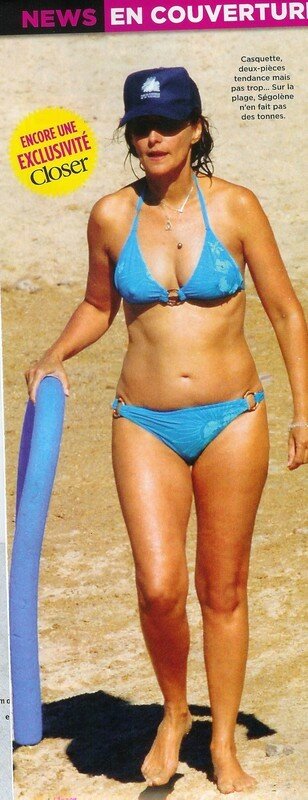
    There's a picture of her in a blue bikini circulating the internets. I'll see if I can dig it up.

  16. #16
    The Mad Scientist Gerryatrics's Avatar
    My Team
    San Antonio Spurs
    Join Date
    Oct 2004
    Post Count
    1,241


    Not bad for a 50 year old commie French chick.

  17. #17
    Veteran
    My Team
    Denver Nuggets
    Join Date
    Mar 2006
    Post Count
    12,134
    Look while you may be the most intimidating person on ST and I am pretty sure you are a 6'8 version of Billy Gibbons on a Harley in leather and carrying guns

    Must be sarcasm because I picture Elpimpo as a little .

  18. #18
    I love J.T. smeagol's Avatar
    My Team
    San Antonio Spurs
    Join Date
    Feb 2004
    Post Count
    11,756
    Who has Royal as their last name and is a socialist?

    That's ed up.

  19. #19
    Retired Ray xrayzebra's Avatar
    My Team
    San Antonio Spurs
    Join Date
    Jul 2003
    Post Count
    9,096
    Who has Royal as their last name and is a socialist?

    That's ed up.

    Hey, it is France after all.......

  20. #20
    I can live with it JoeChalupa's Avatar
    My Team
    San Antonio Spurs
    Join Date
    Nov 2001
    Post Count
    21,547
    I'd hit it.

  21. #21
    Believe. gtownspur's Avatar
    My Team
    San Antonio Spurs
    Join Date
    Aug 2005
    Post Count
    3,906
    Out of Barrack or Royal?

  22. #22
    Veteran
    My Team
    San Antonio Spurs
    Join Date
    Dec 2005
    Post Count
    15,842
    At 50+ and 4 kids, she's better than 90% of the US fatties under 40 with 2- kids.

    btw, there is no "French paradox". French women eat buttter, bread, pastries, olive oil, sauces, wine, 3- and 4-course meals, etc and don't get fat because they eat reasonable portions, and don't eat between meals. However, France's trational "raw food" culture, esp among the young and poor, has been deteriorating under US influence of fast food, junk food, useless breakfast food, convenience food, processed/industrial food, all flogged with corporate/agri-business marketing, the same well-proven, toxic formula that's sickening and killing US people.

    Another btw is that there is marked difference in cardio-vascular disease between lower rates of the south of France where the diet fat is primarily olive oil aka "the Mediterranean diet", and the higher rates of the north of France where the diet oil is butter/cream.

  23. #23
    Veteran
    My Team
    San Antonio Spurs
    Join Date
    Dec 2005
    Post Count
    15,842
    Here's couple of articles from the French press on the French elections and Franco-US relations. You can read these to get some perspective, or you can just read Whott's dumb , chauvinistic, xenophobic, simplistic, close-minded non-stop .

    ===========

    National Iden y or American Imitation?

    By Serge Halimi
    Le Monde Diplomatique

    Wednesday 18 April 2007

    Mr. Sarkozy is reproached for being very American as people mention both his foreign policy orientations - close to those of the Bush administration - and his admiration for the economic and social system of the United States (read: "Un pe conte de Noel" [ A Little Christmas Story]). But the UMP president has also taken inspiration from the American right's ideas and political recipes in other domains.

    Beginning in the 1960s, the most conservative wing of the Republican Party (Barry Goldwater, Ronald Reagan) chose to present itself as excluded from the political system (from 1955 to 1995, the Democratic Party controlled both Houses of Congress without interruption), disdained by a business world too concerned about social peace, and ostracized by the country's cultural and media ins utions. That wing asserted its determination to establish (or reestablish) its ideological hegemony, certain that such hegemony would cons ute the prerequisite to its return to power (read: "Quand la droite américaine pensait l'impensable" [When the American Right Thought the Unthinkable]).

    In the case of Mr. Sarkozy, the government's most important minister up until just a few days ago and the president of the majority party for the past two years, this posture of a dissident, of an exile, may appear incongruous. Nonetheless, just like an American Republican, the president of the Union for a Popular Movement (UMP) - no doubt aware that a candidate defending the status quo in France could only lose the election - has hammered on the idea that "too often, one-sided and politically correct thinking have dominated the debate." [1] He elaborates that the right has never really dared to be truly right, suffocated as it has been by leftist, not to say "Marxist," orthodoxy, exactly as his friend, the industrialist Bernard Arnault, CEO of LVMH and the richest man in the country, has just alleged. [2]

    In any case, the present UMP candidate in 2001 confessed himself to be "convinced that social-democratic sermonizing could only have prospered in the absence of a modern right." [3] This past April 12 in Toulouse he elaborated: "If I am elected president, I will do everything that the republican right no longer dared to do because it was ashamed of belonging to the right." Let us note in passing that it's been a long time since we've heard a socialist candidate make a symmetrical commitment to stop being "ashamed of belonging to the left."

    The second of Mr. Sarkozy's campaign themes that seems to draw inspiration from the recipes of the American right concerns his discourse intended for popular consumption. In the United States and in France, it is theoretically difficult for a candidate who has the support of management, and who simultaneously demands the suppression of inheritance taxes and the reduction of corporate taxes, to present himself as the spokesman of the people against the elite. We know that Ronald Reagan and Mr. George W. Bush have nonetheless brought off that feat (read: "Le pe peuple de George W. Bush" [George W. Bush's Lower Classes]) - a significant fraction of the categories of the least-favored voted for them with the results including a reduction of real salaries and social services, a drop in the taxation of top earners, the impugning of union rights....

    In the United States, this political prowess is largely due to the appeal to national and patriotic sentiment (anticommunism, then an errorism - read: "La droite américaine manipule le sentiment national" [The American Right Manipulates National Feeling]), to fiscal resentment (the "little taxpayer" against the "fat regulator"), to the invocation of "traditional moral values" (opposition to abortion and sexuality), and finally, to a rejection of judicial "laxity" presented as the principal purveyor of violence and crimes (read: "Sur quelques contes sécuritaires venus d'Amérique" [About Several Security Fairy Tales Imported From America]). Mr. Sarkozy's palette cannot be precisely superimposed on this register to the extent that, in France, a candidate's recourse to religious feelings and the use of religions or sects as guardians of a conservative social order still run afoul of the country's secularization as well as its republican and secular tradition. The UMP candidate has nonetheless attempted to reactivate this religious drive: "I am one of those who believes that the spiritual question has been very broadly underestimated as compared to the social question," he reiterated just recently. [4] But he quickly went on to the nitty-gritty: redefinition of "the social question." Then he strove - American style - to make his audience swallow a new line of demarcation - no longer between rich and poor, capitalists and workers, but between wage-earners and those receiving government aid, between workers and cheats.

    "There are two kinds of Americans," an ultraconservative Texas senator pronounced in 1984: "The ones who pull the wagons and the ones who ride in them without paying their way; who expect the government to take care of them." [5] To smash the solidarity born of the New Deal, the American right has, in fact, never stopped playing that chord, which seeks to line up wage-earners against slackers. "The Republican Party," proclaims neo-conservative publicist David Frum, "cannot remain faithful to its principles if it's afraid of being accused of insensitivity." On the other side of the Atlantic, questions of taxation and race contribute to feeding this reactionary resentment (under the cover, as we have seen, of breaking with the left's "political correctness") to which they seem connected. An almost exclusively white fraction of "the middle classes" (and of the blue-collar workers and salaried workers who aspire to that condition) feels abusively taxed in order to - it believes - finance social policies intended for other people, often blacks or immigrants.

    "I'm sick of poor people," one officer's wife whispered into Ronald Reagan's ear one day. The future United States president was not deaf. In consequence, he immediately evoked the (fabricated) story of a welfare cheater: a story that he thundered out for over ten years. It was the story of a "welfare queen who uses eighty names, thirty addresses and twelve social security cards, thanks to which her after-tax income comes to more than 150,000 dollars." [6] The theme had a future. It's the now well-oiled speech of the "little white man" who slaves away and "goes nuts" from "the noise and the smell" of the poor - frequently immigrants - who luxuriate, thanks to their fat bundles of social welfare aid.

    The assault on the welfare state operates obliquely. One does not frontally attack the principle itself, but those who profit unduly from it and who seize the benefits. Toughness is going to be required, but it is made more presentable by the assertion that public assistance hurts its recipients, forcing them into a "culture of dependency" that drags its litany of pathologies behind it (laziness, gaming, addictions, conjugal violence, etc.). Whoever doubts the importation of this discourse into France has only to refer to the Sarkozyist magazine, Le Point, owned by Mr. François Pinault, third wealthiest man in France. Less than a year after having headlined "Unemployment Cheaters," he has just made his cover story: "France on Social Security. The Scandals of the 'French Model.' Benefits Profiteers. How to Escape From the Trap." [7]

    As for Mr. Sarkozy, he professes to be worried about "reconciling the France that wins with the France that suffers." The first group seems to be in his pocket already; he gladly speaks to the second group, profiting from the fact that the government's left has abandoned it: "I want to speak to all these unfortunates, but I want to say that life's suffering and hardness is not limited to the French population at risk. I want to talk about another suffering, real and true, that must not be underestimated: that of the French population not at risk, that gets up early, works hard, that knocks itself out to feed its family and raise its children, and I assert that it suffers also and listens for someone to know about its suffering and finally answer its call." [8] Then, in a Puritan style more appropriate to the United States than to France (read: "Aux sources puritaines des Etats-Unis" [At the Puritan Origins of the United States]), he gets to the warning: "I don't agree that people on the dole should have as much at the end of the month as people like you [wage-earners] who get up early in the morning." He will accept it still less, in truth, because "generalized assistance is a moral capitulation. Assistance is an attack on a person's dignity. It imprisons people in a situation of dependency. It doesn't provide enough for a happy existence, but provides too much to stimulate people's own efforts."

    No doubt, a scoffer would object that there are other exploiters and other exploited in France, other rentiers, other cheats, who live in greater style than those on the dole, other privileged people who only put themselves out enough to be born into a good family (Jean-Luc Lagardère's son, Francis Bouygues's son, François Pinault's son, Vincent Bolloré's son, Bernard Arnault's daughter....); other injustices also. But those appear less worrying to Mr. Sarkozy. For, he explains, "Social welfare payments are financed by the production of the France that works and gets up early." So isn't it fair then that "these payments (be) allocated and used without fraud, lies and dishonesty?" [9]

    Moreover, the solution, recommended by the Organization for Economic Cooperation and Development (OECD) (read: "Economistes en guerre contre les chômeurs" [Economists at War on the Unemployed]), has already been discovered: "We must organize things so that the job seeker cannot reject more than three employment offers, so that everyone is forced to really look for a job, to work or to agree to training. Society cannot help those who don't want to shape up." [10] An alternative proposition is dismissed out of hand: "They say: Make capital pay! But if capital pays too much, it takes off." [11] With Mr. Sarkozy at the Elysée, it's a sure thing that capital will not pay too much.

    To really belong to the right, close to employers' milieus, and nonetheless speak to the social categories that are neoliberalism's victims often involves additional smoke screen techniques: like that which consists of exhibiting the tastes of the man in the street. Although they are millionaires and socialize principally with other rich people, Ronald Reagan and Mr. George Bush incessantly play this populist card. Since they are "men of the people," they purport to be so, if not by their fortunes, at least in their tastes (read: "Cette Amérique qui vote George W. Bush" [This America That Votes for George W. Bush]). And they intentionally broadcast their disdain for "intellectuals" and for experts - henceforth associated with the elite, the mainstream press and aristocratic superciliousness (read: "Stratagème de la droite américaine, mobiliser le peuple contre les intellectuels" [Strategy of the American Right, Mobilize the People Against Intellectuals]). Mr. Sarkozy, for his part, is the former mayor of one of the poshest communes in the country (Neuilly) as well as the intimate friend of several billionaires. Yes, but he likes Michel Drucker's programs, bicycling and Johnny Hallyday's songs. So when Mr. François Bayrou proposed to eliminate the National School of Administration [l'école nationale d'administration (ENA)], it was altogether naturally that the president of the Union for a Popular Movement retorted: "As far as I am concerned, I am neither an ENA-graduate nor a graduate degree-holder - that allows me not to be demagogic."

    But is it possible in France to be simultaneously a man of the right, legitimately adored by the CAC 40 [French "Dow Jones" companies] bosses, and the tribune of the little people and the unskilled, persecuted by the "politically correct" without demagoguery?

    --------

    [1] Nicolas Sarkozy, "Ensemble," XO, Paris, 2007, p. 7.

    [2] Interview with "Capital," Paris, April 2007.

    [3] "Nicolas Sarkozy, Libre," Robert Laffont, 2001. Cited by Eric Dupin, "A droite toute," Fayard, 2007, p. 56.

    [4] Three years ago he added: "It is much more important for young people to be able to have spiritual hope than to have violence, drugs or money as their only religion." (Nicolas Sarkozy, "La République, les religions, l'espérance," Ed. du Cerf, 2004. Cited by Eric Dupin, op. cit.)

    [5] Texas Senator Phil Gramm during the Republican Convention in Dallas, August 1984.

    [6] On this subject see: "Le Grand bond en arrière," Fayard, 2006.

    [7] "Le Point", April 12, 2007. The edition devoted to "Unemployment Cheaters" was published June 29, 2006. Also read: Renaud Lambert about this article on the Acrimed web site, "The 'Cheaters' at 'Le Point,'" July 6, 2006.

    [8] Nicolas Sarkozy, "For Working France." A speech made June 22, 2006 in Agen.

    [9] Cited par Grégory Marin, "Démagogie en terre de souffrance," "L'Humanité," December 20, 2006.

    [10] Interview published by "Les Echos," November 9, 2006.

    [11] June 22, 2006 speech, op. cit.


    ================


    The French Connection

    By Jordan Stancil
    The Nation

    Monday 30 April 2007 Issue

    "The American model" plays a big role in European domestic economic debates, with business school types convinced that the streets really are paved with gold in the land of Ronald Reagan, and the left certain that modern America is a kind of ensian inferno. The leading candidates in France's presidential election (held, in two rounds, on April 22 and May 6) have followed this pattern in their rhetoric, with conservative Nicolas Sarkozy and Socialist Ségolène Royal respectively praising and criticizing the US economy.

    At other times in history, however, these roles were reversed. During the American Civil War, French liberals supported the Union, while monarchists around Europe were drooling at the possible demise of the American experiment. Civil War historian James McPherson, in an essay on European responses to the conflict, quotes French reformer Edgar Quinet's 1862 statement that Napoleon III wanted to "destroy democracy in the United States ... because in order for Napoleonic ideas to succeed, it is absolutely indispensable that this vast republic disappear from the face of the Earth."

    Today, the transatlantic discussion is not about "Napoleonic ideas" but rather about the viability of the welfare state in an era of globalization. And just as European republicans of the nineteenth century depended on the success of the American experiment in democracy, so today, American progressives would be enormously helped if Europe can get social justice and globalization right. Thus, while the French are debating the American model, Americans should be taking a look at what's happening to the French one.

    It's all too easy to see Europe as a kind of welfare-state Alamo, desperately trying to hold on to the gains workers and the middle class made during the twentieth century. European leaders' rhetoric justifies that impression. However, the reality is much more complicated. As columnist Jean-Louis Andreani argued recently in Le Monde, EU governments, "including that of France, are supporting, or at least permitting, a policy that resists on principle anything that's public in favor of whatever is private. But this ideological shift is never admitted - or submitted to a clear decision by voters." It's like a Reagan revolution without a Reagan.

    Nicolas Sarkozy is not a European Reagan, but some of his plans seem drawn from the Republican playbook. He proposes, for instance, a cut in the estate tax and the abolition of a surcharge on large fortunes. He also proposes other tax cuts, which he promises will put more money in the average person's pocket - paid for in part by not replacing half of all retiring civil service workers. You can almost hear him saying, "It's not the government's money - it's your money!" In addition, the at-will employment system the government tried to begin installing last year (but had to retract in the face of public protest) remains a centerpiece of Sarkozy's program. This is all part of his stated goal of bringing what he describes approvingly as Anglo-Saxon flexibility to France, a project that makes him the darling of the business associations even as his law-and-order image allows him simultaneously to cull votes from the populist far right.

    And where is the fearsome French left in all this? It's not exactly AWOL, but neither is it providing a robust challenge to the current rightward drift. Ségolène Royal is running on a platform that is more Clinton than Roosevelt. She proposes some spending increases, but by far the biggest items on her wish list are for Blairite, New Economy-type programs such as more support for scientific research and improvements in training and education to help French workers compete in a globalized economy. But she says nary a word about the trade and financial flows that cause these workers to need help in the first place.

    The only parts of the Socialist program that try to address these problems are proposals to give tax credits to companies that reinvest profits in France, and to make companies reimburse the government for tax breaks if they turn around and send jobs abroad that the tax breaks were designed to subsidize. Royal's program also calls for raising the minimum wage and increasing pension benefits for the lowest-income retirees. But all these proposals are well within what most Democrats in the United States and even some Republicans could support.

    These timid suggestions come at a time when French voters are obsessed with economic insecurity and many hallmarks of the French model seem to be crumbling. For instance, even the paid vacation - the most emblematic achievement of Léon Blum's Popular Front government of the 1930s - is no longer what it once was. In 2004, one-third of French people didn't take any vacation, largely for financial or work reasons, according to a report released last summer by the nation's statistical agency.

    Sarkozy has said that he profits from this "absence of economic questions," but the Socialists have also lost voters to François Bayrou, a conservative trying to ply the middle ground who has surprisingly strong support. Bayrou has tried to distance himself from Sarkozy by warning that the United States is "not a model." But he doesn't propose any major new initiatives that might actually shore up the French model that he says he prefers.

    If none of this seems to matter to the fate of progressive politics in the United States, consider this: If a kind of Reaganomics came to dominate Europe, there would no longer be any major Western economy to demonstrate the viability of the social market. An ever-growing list of health, pension and education "reforms" - all tending in the direction of greater inequality - would eviscerate Europe's societal model. The welfare-state Alamo would fall, and American progressives would lose a powerful, living argument that - for all of its flaws - still gives the lie to the Bush/Norquist vision of the so-called "ownership society." Something to think about as French voters go to the polls.

    =============

    As Royal and Sarkozy battle in these two weeks before the run-off for the middle and independents, it seems that Sarkozy has it wrapped up.

    btw, the obituaries for Chirac's political career are mostly tending to the negative. He was obsessed his entire life with becoming President. When he finally got it, he accomplished almost nothing in 10 presidential years. At least Mitterand built a lot public buldings, aka, Mitter-Ramses.

    Last edited by boutons_; 04-24-2007 at 11:06 AM.

  24. #24
    Veteran
    My Team
    San Antonio Spurs
    Join Date
    Mar 2003
    Post Count
    29,564
    I'll be back to respond in a bit but boutons...

    The ing McDonalds thing is lame...

    We don't force the French to eat there....if they didn't it wouldn't be there.


    Should we blame them for all the winos on our streets?


    It's not like we went and conquered indigenous populations around the globe enforcing our religion, language and culture on them.


    I can't help it people like junk food.

  25. #25
    Veteran
    My Team
    San Antonio Spurs
    Join Date
    Mar 2003
    Post Count
    29,564
    Here's couple of articles from the French press on the French elections and Franco-US relations. You can read these to get some perspective, or you can just read Whott's dumb , chauvinistic, xenophohic, close-minded non-stop .

    ===========

    National Iden y or American Imitation?

    By Serge Halimi
    Le Monde Diplomatique

    Wednesday 18 April 2007

    Mr. Sarkozy is reproached for being very American as people mention both his foreign policy orientations - close to those of the Bush administration - and his admiration for the economic and social system of the United States (read: "Un pe conte de Noel" [ A Little Christmas Story]). But the UMP president has also taken inspiration from the American right's ideas and political recipes in other domains.

    Beginning in the 1960s, the most conservative wing of the Republican Party (Barry Goldwater, Ronald Reagan) chose to present itself as excluded from the political system (from 1955 to 1995, the Democratic Party controlled both Houses of Congress without interruption), disdained by a business world too concerned about social peace, and ostracized by the country's cultural and media ins utions. That wing asserted its determination to establish (or reestablish) its ideological hegemony, certain that such hegemony would cons ute the prerequisite to its return to power (read: "Quand la droite américaine pensait l'impensable" [When the American Right Thought the Unthinkable]).

    In the case of Mr. Sarkozy, the government's most important minister up until just a few days ago and the president of the majority party for the past two years, this posture of a dissident, of an exile, may appear incongruous. Nonetheless, just like an American Republican, the president of the Union for a Popular Movement (UMP) - no doubt aware that a candidate defending the status quo in France could only lose the election - has hammered on the idea that "too often, one-sided and politically correct thinking have dominated the debate." [1] He elaborates that the right has never really dared to be truly right, suffocated as it has been by leftist, not to say "Marxist," orthodoxy, exactly as his friend, the industrialist Bernard Arnault, CEO of LVMH and the richest man in the country, has just alleged. [2]

    In any case, the present UMP candidate in 2001 confessed himself to be "convinced that social-democratic sermonizing could only have prospered in the absence of a modern right." [3] This past April 12 in Toulouse he elaborated: "If I am elected president, I will do everything that the republican right no longer dared to do because it was ashamed of belonging to the right." Let us note in passing that it's been a long time since we've heard a socialist candidate make a symmetrical commitment to stop being "ashamed of belonging to the left."

    The second of Mr. Sarkozy's campaign themes that seems to draw inspiration from the recipes of the American right concerns his discourse intended for popular consumption. In the United States and in France, it is theoretically difficult for a candidate who has the support of management, and who simultaneously demands the suppression of inheritance taxes and the reduction of corporate taxes, to present himself as the spokesman of the people against the elite. We know that Ronald Reagan and Mr. George W. Bush have nonetheless brought off that feat (read: "Le pe peuple de George W. Bush" [George W. Bush's Lower Classes]) - a significant fraction of the categories of the least-favored voted for them with the results including a reduction of real salaries and social services, a drop in the taxation of top earners, the impugning of union rights....

    In the United States, this political prowess is largely due to the appeal to national and patriotic sentiment (anticommunism, then an errorism - read: "La droite américaine manipule le sentiment national" [The American Right Manipulates National Feeling]), to fiscal resentment (the "little taxpayer" against the "fat regulator"), to the invocation of "traditional moral values" (opposition to abortion and sexuality), and finally, to a rejection of judicial "laxity" presented as the principal purveyor of violence and crimes (read: "Sur quelques contes sécuritaires venus d'Amérique" [About Several Security Fairy Tales Imported From America]). Mr. Sarkozy's palette cannot be precisely superimposed on this register to the extent that, in France, a candidate's recourse to religious feelings and the use of religions or sects as guardians of a conservative social order still run afoul of the country's secularization as well as its republican and secular tradition. The UMP candidate has nonetheless attempted to reactivate this religious drive: "I am one of those who believes that the spiritual question has been very broadly underestimated as compared to the social question," he reiterated just recently. [4] But he quickly went on to the nitty-gritty: redefinition of "the social question." Then he strove - American style - to make his audience swallow a new line of demarcation - no longer between rich and poor, capitalists and workers, but between wage-earners and those receiving government aid, between workers and cheats.

    "There are two kinds of Americans," an ultraconservative Texas senator pronounced in 1984: "The ones who pull the wagons and the ones who ride in them without paying their way; who expect the government to take care of them." [5] To smash the solidarity born of the New Deal, the American right has, in fact, never stopped playing that chord, which seeks to line up wage-earners against slackers. "The Republican Party," proclaims neo-conservative publicist David Frum, "cannot remain faithful to its principles if it's afraid of being accused of insensitivity." On the other side of the Atlantic, questions of taxation and race contribute to feeding this reactionary resentment (under the cover, as we have seen, of breaking with the left's "political correctness") to which they seem connected. An almost exclusively white fraction of "the middle classes" (and of the blue-collar workers and salaried workers who aspire to that condition) feels abusively taxed in order to - it believes - finance social policies intended for other people, often blacks or immigrants.

    "I'm sick of poor people," one officer's wife whispered into Ronald Reagan's ear one day. The future United States president was not deaf. In consequence, he immediately evoked the (fabricated) story of a welfare cheater: a story that he thundered out for over ten years. It was the story of a "welfare queen who uses eighty names, thirty addresses and twelve social security cards, thanks to which her after-tax income comes to more than 150,000 dollars." [6] The theme had a future. It's the now well-oiled speech of the "little white man" who slaves away and "goes nuts" from "the noise and the smell" of the poor - frequently immigrants - who luxuriate, thanks to their fat bundles of social welfare aid.

    The assault on the welfare state operates obliquely. One does not frontally attack the principle itself, but those who profit unduly from it and who seize the benefits. Toughness is going to be required, but it is made more presentable by the assertion that public assistance hurts its recipients, forcing them into a "culture of dependency" that drags its litany of pathologies behind it (laziness, gaming, addictions, conjugal violence, etc.). Whoever doubts the importation of this discourse into France has only to refer to the Sarkozyist magazine, Le Point, owned by Mr. François Pinault, third wealthiest man in France. Less than a year after having headlined "Unemployment Cheaters," he has just made his cover story: "France on Social Security. The Scandals of the 'French Model.' Benefits Profiteers. How to Escape From the Trap." [7]

    As for Mr. Sarkozy, he professes to be worried about "reconciling the France that wins with the France that suffers." The first group seems to be in his pocket already; he gladly speaks to the second group, profiting from the fact that the government's left has abandoned it: "I want to speak to all these unfortunates, but I want to say that life's suffering and hardness is not limited to the French population at risk. I want to talk about another suffering, real and true, that must not be underestimated: that of the French population not at risk, that gets up early, works hard, that knocks itself out to feed its family and raise its children, and I assert that it suffers also and listens for someone to know about its suffering and finally answer its call." [8] Then, in a Puritan style more appropriate to the United States than to France (read: "Aux sources puritaines des Etats-Unis" [At the Puritan Origins of the United States]), he gets to the warning: "I don't agree that people on the dole should have as much at the end of the month as people like you [wage-earners] who get up early in the morning." He will accept it still less, in truth, because "generalized assistance is a moral capitulation. Assistance is an attack on a person's dignity. It imprisons people in a situation of dependency. It doesn't provide enough for a happy existence, but provides too much to stimulate people's own efforts."

    No doubt, a scoffer would object that there are other exploiters and other exploited in France, other rentiers, other cheats, who live in greater style than those on the dole, other privileged people who only put themselves out enough to be born into a good family (Jean-Luc Lagardère's son, Francis Bouygues's son, François Pinault's son, Vincent Bolloré's son, Bernard Arnault's daughter....); other injustices also. But those appear less worrying to Mr. Sarkozy. For, he explains, "Social welfare payments are financed by the production of the France that works and gets up early." So isn't it fair then that "these payments (be) allocated and used without fraud, lies and dishonesty?" [9]

    Moreover, the solution, recommended by the Organization for Economic Cooperation and Development (OECD) (read: "Economistes en guerre contre les chômeurs" [Economists at War on the Unemployed]), has already been discovered: "We must organize things so that the job seeker cannot reject more than three employment offers, so that everyone is forced to really look for a job, to work or to agree to training. Society cannot help those who don't want to shape up." [10] An alternative proposition is dismissed out of hand: "They say: Make capital pay! But if capital pays too much, it takes off." [11] With Mr. Sarkozy at the Elysée, it's a sure thing that capital will not pay too much.

    To really belong to the right, close to employers' milieus, and nonetheless speak to the social categories that are neoliberalism's victims often involves additional smoke screen techniques: like that which consists of exhibiting the tastes of the man in the street. Although they are millionaires and socialize principally with other rich people, Ronald Reagan and Mr. George Bush incessantly play this populist card. Since they are "men of the people," they purport to be so, if not by their fortunes, at least in their tastes (read: "Cette Amérique qui vote George W. Bush" [This America That Votes for George W. Bush]). And they intentionally broadcast their disdain for "intellectuals" and for experts - henceforth associated with the elite, the mainstream press and aristocratic superciliousness (read: "Stratagème de la droite américaine, mobiliser le peuple contre les intellectuels" [Strategy of the American Right, Mobilize the People Against Intellectuals]). Mr. Sarkozy, for his part, is the former mayor of one of the poshest communes in the country (Neuilly) as well as the intimate friend of several billionaires. Yes, but he likes Michel Drucker's programs, bicycling and Johnny Hallyday's songs. So when Mr. François Bayrou proposed to eliminate the National School of Administration [l'école nationale d'administration (ENA)], it was altogether naturally that the president of the Union for a Popular Movement retorted: "As far as I am concerned, I am neither an ENA-graduate nor a graduate degree-holder - that allows me not to be demagogic."

    But is it possible in France to be simultaneously a man of the right, legitimately adored by the CAC 40 [French "Dow Jones" companies] bosses, and the tribune of the little people and the unskilled, persecuted by the "politically correct" without demagoguery?

    --------

    [1] Nicolas Sarkozy, "Ensemble," XO, Paris, 2007, p. 7.

    [2] Interview with "Capital," Paris, April 2007.

    [3] "Nicolas Sarkozy, Libre," Robert Laffont, 2001. Cited by Eric Dupin, "A droite toute," Fayard, 2007, p. 56.

    [4] Three years ago he added: "It is much more important for young people to be able to have spiritual hope than to have violence, drugs or money as their only religion." (Nicolas Sarkozy, "La République, les religions, l'espérance," Ed. du Cerf, 2004. Cited by Eric Dupin, op. cit.)

    [5] Texas Senator Phil Gramm during the Republican Convention in Dallas, August 1984.

    [6] On this subject see: "Le Grand bond en arrière," Fayard, 2006.

    [7] "Le Point", April 12, 2007. The edition devoted to "Unemployment Cheaters" was published June 29, 2006. Also read: Renaud Lambert about this article on the Acrimed web site, "The 'Cheaters' at 'Le Point,'" July 6, 2006.

    [8] Nicolas Sarkozy, "For Working France." A speech made June 22, 2006 in Agen.

    [9] Cited par Grégory Marin, "Démagogie en terre de souffrance," "L'Humanité," December 20, 2006.

    [10] Interview published by "Les Echos," November 9, 2006.

    [11] June 22, 2006 speech, op. cit.


    ================


    The French Connection

    By Jordan Stancil
    The Nation

    Monday 30 April 2007 Issue

    "The American model" plays a big role in European domestic economic debates, with business school types convinced that the streets really are paved with gold in the land of Ronald Reagan, and the left certain that modern America is a kind of ensian inferno. The leading candidates in France's presidential election (held, in two rounds, on April 22 and May 6) have followed this pattern in their rhetoric, with conservative Nicolas Sarkozy and Socialist Ségolène Royal respectively praising and criticizing the US economy.

    At other times in history, however, these roles were reversed. During the American Civil War, French liberals supported the Union, while monarchists around Europe were drooling at the possible demise of the American experiment. Civil War historian James McPherson, in an essay on European responses to the conflict, quotes French reformer Edgar Quinet's 1862 statement that Napoleon III wanted to "destroy democracy in the United States ... because in order for Napoleonic ideas to succeed, it is absolutely indispensable that this vast republic disappear from the face of the Earth."

    Today, the transatlantic discussion is not about "Napoleonic ideas" but rather about the viability of the welfare state in an era of globalization. And just as European republicans of the nineteenth century depended on the success of the American experiment in democracy, so today, American progressives would be enormously helped if Europe can get social justice and globalization right. Thus, while the French are debating the American model, Americans should be taking a look at what's happening to the French one.

    It's all too easy to see Europe as a kind of welfare-state Alamo, desperately trying to hold on to the gains workers and the middle class made during the twentieth century. European leaders' rhetoric justifies that impression. However, the reality is much more complicated. As columnist Jean-Louis Andreani argued recently in Le Monde, EU governments, "including that of France, are supporting, or at least permitting, a policy that resists on principle anything that's public in favor of whatever is private. But this ideological shift is never admitted - or submitted to a clear decision by voters." It's like a Reagan revolution without a Reagan.

    Nicolas Sarkozy is not a European Reagan, but some of his plans seem drawn from the Republican playbook. He proposes, for instance, a cut in the estate tax and the abolition of a surcharge on large fortunes. He also proposes other tax cuts, which he promises will put more money in the average person's pocket - paid for in part by not replacing half of all retiring civil service workers. You can almost hear him saying, "It's not the government's money - it's your money!" In addition, the at-will employment system the government tried to begin installing last year (but had to retract in the face of public protest) remains a centerpiece of Sarkozy's program. This is all part of his stated goal of bringing what he describes approvingly as Anglo-Saxon flexibility to France, a project that makes him the darling of the business associations even as his law-and-order image allows him simultaneously to cull votes from the populist far right.

    And where is the fearsome French left in all this? It's not exactly AWOL, but neither is it providing a robust challenge to the current rightward drift. Ségolène Royal is running on a platform that is more Clinton than Roosevelt. She proposes some spending increases, but by far the biggest items on her wish list are for Blairite, New Economy-type programs such as more support for scientific research and improvements in training and education to help French workers compete in a globalized economy. But she says nary a word about the trade and financial flows that cause these workers to need help in the first place.

    The only parts of the Socialist program that try to address these problems are proposals to give tax credits to companies that reinvest profits in France, and to make companies reimburse the government for tax breaks if they turn around and send jobs abroad that the tax breaks were designed to subsidize. Royal's program also calls for raising the minimum wage and increasing pension benefits for the lowest-income retirees. But all these proposals are well within what most Democrats in the United States and even some Republicans could support.

    These timid suggestions come at a time when French voters are obsessed with economic insecurity and many hallmarks of the French model seem to be crumbling. For instance, even the paid vacation - the most emblematic achievement of Léon Blum's Popular Front government of the 1930s - is no longer what it once was. In 2004, one-third of French people didn't take any vacation, largely for financial or work reasons, according to a report released last summer by the nation's statistical agency.

    Sarkozy has said that he profits from this "absence of economic questions," but the Socialists have also lost voters to François Bayrou, a conservative trying to ply the middle ground who has surprisingly strong support. Bayrou has tried to distance himself from Sarkozy by warning that the United States is "not a model." But he doesn't propose any major new initiatives that might actually shore up the French model that he says he prefers.

    If none of this seems to matter to the fate of progressive politics in the United States, consider this: If a kind of Reaganomics came to dominate Europe, there would no longer be any major Western economy to demonstrate the viability of the social market. An ever-growing list of health, pension and education "reforms" - all tending in the direction of greater inequality - would eviscerate Europe's societal model. The welfare-state Alamo would fall, and American progressives would lose a powerful, living argument that - for all of its flaws - still gives the lie to the Bush/Norquist vision of the so-called "ownership society." Something to think about as French voters go to the polls.

    =============

    As Royal and Sarkozy battle in these two weeks before the run-off for the middle and independents, it seems that Sarkozy has it wrapped up.

    btw, the obituaries for Chirac's political career are mostly tending to the negative. He was obsessed his entire life with becoming President. When he finally got it, he accomplished almost nothing in 10 presidential years. At least Mitterand built a lot public buldings, aka, Mitter-Ramses.


    translation: boutons wants a government that will wipe his lazy ass for him.


    Moron comes on the forum and all he does is rail against the Govt...but he favors a govt that weilds almost total control.

Thread Information

Users Browsing this Thread

There are currently 1 users browsing this thread. (0 members and 1 guests)

Posting Permissions

  • You may not post new threads
  • You may not post replies
  • You may not post attachments
  • You may not edit your posts
  •