

 Reply With Quote
Remember, supply and demand, and our falling dollar. I think we will be above $100 before Christmas, and may never come below $100 again.

Up a record 75% since January alone.....now what?
World Energy to 2050.
The article at the link above includes a complete analysis of our energy future for the next 40-some years. It looks at everything we have in our arsenal today, from oil and gas to hydro, nuclear power, wind and solar, illustrated by 17 informative (and often terrifying) graphs.Introduction
Throughout history, the expansion of human civilization has been supported by a steady growth in our use of high-quality exosomatic energy. This growth has been driven by our increasing population and our increasing level of activity. As we learned to harness the energy sources around us we progressed from horse-drawn plows, hand forges and wood fires to our present level of mechanization with its wide variety of high-density energy sources. As industrialization has progressed around the world, the amount of energy each one of us uses has also increased, with the global average per capita consumption of all forms of energy rising by 50% in the last 40 years alone.
This rosy vision of continuous growth has recently been challenged by the theory of "Peak Oil", which concludes that the amount of oil and natural gas being extracted from the earth will shortly start an irreversible decline. As that decline progresses we will have to depend increasingly on other energy sources to power our civilization. In this article I will offer a glimpse into that changed energy future. I hope to be able to provide a realistic assessment of the evolution of the global energy supply picture, and to estimate how much of the various types of energy we will have available to us in the coming decades.
...
Oil and Gas Combined
Oil and natural gas are the world's primary fuel sources, used for both transportation and heat. Together they supply a full 60% of the energy currently used by humanity. According to this model, their combined energy peak will come in 2012. By 2050 their combined output will drop by 80%. To the extent that we cannot replace this shortfall through novel uses of electricity from other sources, this decline represents an enormous challenge. It is a challenge that seems destined to alter the fundamental shape of our civilization over the next three or four decades.
...
The Effect on Average Per Capita Energy
One of the interesting, though very high-level, ways to measure of global wealth is to calculate the average energy available to each person on earth. While the resulting per capita average doesn't reflect the disparity between rich and poor individuals or nations or let us know what sorts of things people might do with their energy endowments, it can give us a general feeling for how "energy-wealthy" the average global citizen is, especially compared to other times.
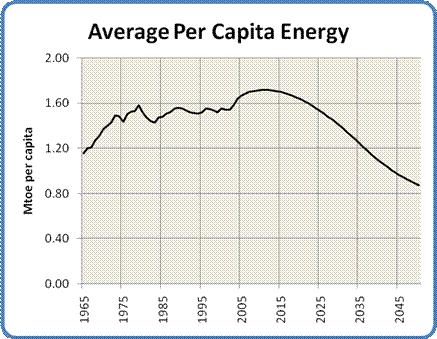
Fortunately, the energy analysis we have just completed gives us the tool we need to establish this measure. By simply dividing the total energy available in each year by that year's population we can construct the graph shown in Figure 16.
Figure 16: Global Average Per Capita Energy Consumption, 1965 to 2050
As you can see, the rising population and falling energy supply combine to produce a falling per capita energy curve. In fact, if these models of energy and population are correct, we can expect to see a drop of almost 50% in average per capita energy by 2050. Each person alive in 2050 will have available, on average, only half the energy they would have today.
It also looks at how these changes will transform the world we know into a somber place with half the number of rich and over twice the number of abject poor as there are today. On this day of record oil prices, what could make better reading?

Remember, supply and demand, and our falling dollar. I think we will be above $100 before Christmas, and may never come below $100 again.
That would be catastrophic....you know...
It's called a market correction. For years. our currency has been out of balance with the rest of the world. Finally, imports will start costing more and other countries will start buying our exports more.
It has a positive aspect too... Jobs outsources will start coming back...

The beginning of the end of dollar hegemony is upon us. Buy gold, people.
http://www.breitbart.com/article.php...show_article=1
Or Euros, at least. The Fed is going to cut again this week.
http://biz.yahoo.com/ap/071029/dollar.html?.v=3
Yeah, yipeee more cheap electronic junk...too bad the price of milk and meat will double..that's if you can find it in stores...
Yes, a very bad market correction for us. The negative impacts of the long term decline of the dollar that has just begun are going to dwarf the positive ones.
We largely export to rich countries and import from poorer ones, and we have a massive trade deficit. As long as our trade policies remain the same, it is going to take a huge decline in the dollar for the US to get anywhere near a trade balance.
Which will happen once the foreign dollar holders make their inevitable large move away from dollar based assets. We won't be able to pressure them to not do that forever. The fate of the dollar rests in the hands of foreigners, mainly the Chinese. We can thank the trade deficit and the Federal Reserve for this situation.
nice stuff BL, here's one for ya...
The mystery of the missing $2.9 trillion
Economists scour the US to find out why we're more in debt than the Department of Commerce says we are.
The US should have put a fed tax on gasoline many years ago, the tax financing oil alternative, to reduce consumption and make non-oil options more competetive. that would take courage and intelligence and leadership, something that is totally absent in Repugs and all of DC.
The US should heavily tax all dirty coal-fired electricity plants, to make retro-fitting of scrubbers and new clean plants the only options.
No, electronics from Japan, China, etc. will get more expensive is it costs more dollars to buy them...
Meat and milk? Most of that is not imported. The prices go up as feed prices increase more than anything else. Ethanol is cutting into the supply of feed!
Consider this. The cost of oil is just a fraction of the cost per gallon, I think about 25%. That makes it about 70 cents. Increasing that by... pick a number... oil goes from $70 to $105, a 50% increase. Adds about 35 more cents per gallon without increasing the profit. It doesn't increase the gas price by 50%. The 35 cents and include some profit, maybe to 45 cents, only increases the gas price by about 16% Now if transportation costs are only 5% of bringing something to market and that is increased by 16% (.05 x 1.16 = .058), then we increase the price by a whopping 1%.
Sure, arbitrary numbers, but plug in your own. It's not as disastrous as it first appears.
"our currency has been out of balance with the rest of the world"
is that your opinion? or do economists agree?
China refuses to upward value its currency. China has the US's testicles in its hands. Get ready to get squeezed.
Now we know how Clinton had a surplus! They rigged the numbers!
The price of gas does not effect the populous in equilibrium....Poor people will have to pay a higher percentage of their income for gas than the rich...so while your figures may not have a huge effect on people driving SUV's that get 10MPG. it will have a dramatic effect of the budget of the guy driving the Corolla....Consider this. The cost of oil is just a fraction of the cost per gallon, I think about 25%. That makes it about 70 cents. Increasing that by... pick a number... oil goes from $70 to $105, a 50% increase. Adds about 35 more cents per gallon without increasing the profit. It doesn't increase the gas price by 50%. The 35 cents and include some profit, maybe to 45 cents, only increases the gas price by about 16% Now if transportation costs are only 5% of bringing something to market and that is increased by 16% (.05 x 1.16 = .058), then we increase the price by a whopping 1%
So you actually want a tax that will impact poor people more than those who have extra money?
Same thing. Taxes on business and industry get passed along to the consumers. You really want to raise peoples electric bills who already have a hard time paying them?
I agree with replecing the old technology with the new. I will never argue that. You just cannot demand something without considering the impact they have.
Good read.
"So when the dollar loses value, foreign holders of dollar assets lose on their dollar investments. Almost all US foreign liabilities are in dollars and about 70 percent of US foreign assets are in foreign currencies.In what Gourinchas calls an "eye-catching, back-of-the-envelope calculation," a 10 percent depreciation of the dollar represents a transfer of 5.3 percent of US GDP from the rest of the world to the US. America's GDP is currently $13.7 trillion, and the dollar is down 20.6 percent since 2002. So foreigners have – in effect – given the US about $1.3 trillion.
It's not really that simple, emphasizes Gourinchas. Nonetheless, the US has had a free lunch."
The lunch as been free so far, but the tab is due once the foreigners decide that the situation isn't to their benefit anymore --
financing US over-consumption of their exports
while holding on to declining-vs.-other-currencies dollar assets
to keep the dollar over-valued to keep the exports flowing...and so on.
Brad, it affects out stock markets also, these unexpected drops...
Investors start pulling out of US stocks causing temporary downturns. Placing their money in foreign markets assure future growth of their money.
I think that's why we see these market hits we have had this year. After all, they were unexpected my normal indicators.
As long as the dollar is dropping, foreign stocks and metals, yes, Gold too... are the way to go.
Yes, that too. I was responding to your milk and meat price statement. Would you advocate reducing gas taxes and energy company taxes to reduce consumer prices then?
You are absolutely right. But, these foreigners that export to us, like China and Japan, aren't really able to do those things. They must hold more dollars than they would otherwise like to so they can prop up the dollar so we can keep buying tons of their exports. That means that there is a large amount of dollars that are not only held outside the US, but that are continuously being re-invested into our investment markets. These countries are intentionally going against the international currency and investment market conditions, and the dollar (and the stock market) benefits from this. But in the end, market conditions will prevail everywhere, and that is very bad for the dollar (and the stock market).
Still, conditions in this country (the Fed's stock market manipulation) are causing the dollar to lose value, even with the foreign exporters propping it up. So when you say, "as long as the dollar is dropping", I would say what is going to stop that from continuing? The short term is bad for the dollar, considering the affects that the Fed's cutting and individuals getting out of the dollar are having, but the long term is much, much worse, because that factors in a large international move away from the dollar, when we've only seen a small one so far.
Boutons is right - the Chinese have us by the balls. And they know it.
Last edited by BradLohaus; 10-29-2007 at 07:46 PM.

this is when other governments demanded debt settlements in gold. but the commodity is evaporating. times have changed forever. DC has always hard pressed the world to accept the dollar as standard currency in the oil market. house of saud agreed to keep selling oil based on the US dollar. they have the power in OPEC, for now. but the resource is vanishing. the ties between the US and Saudi's is something that needs closer scrutiny. other countries have found out that inflation has reduced their values in dollars. they will demand relief, digging us deeper. we spend all our resources pretending to hunt terror, in the wrong place. the one area of the world that we need to embrace will have the world to back them in defending against us. we are becoming our enemy.
Tax on gasoline is a consumption tax. Countries that have heavy consumption taxes give low/now income tax reductions to the low-end.
dubya gave $1T in estate tax cuts to the super-rich, gave $15B to the energyco's for "research", and gave BigPharma $300B tax break to re-patriate foreign profits as greatly reduced income tax.
We can't find a way to help the poor while making stimulating oil conservation and oil alternatives?
Consider yourself slapped, .
Oil and Trade Gains Make Major Investors Of Developing Nations
By David Cho and Thomas Heath
Washington Post Staff Writers
Tuesday, October 30, 2007; A01
The government of Libya, flush with oil, has amassed $40 billion and is ready to put it in play on Wall Street. China recently acquired a huge stake in one of the biggest names in U.S. finance. Tiny Qatar is adding $1 billion a week to its investment coffers and is trying to buy the leading grocer in Britain.
Developing nations, especially in Asia and the Middle East, are aggressively stockpiling some of the largest concentrations of investment money in history. The cash hoards, called sovereign wealth funds, are controlled not by state-run companies or private investors but by governments.
These investment pools are equal to or even bigger than the largest pension and private-equity funds in the United States, and many are highly secretive about their activities. The Abu Dhabi Investment Authority has an estimated $875 billion to invest, while China's first stab at a sovereign wealth fund, which started last month, has $200 billion. The largest private-equity firm has about $90 billion under management.
Sovereign wealth funds have been around for decades. But enriched by the surge in the price of oil, which settled at a record $93.53 yesterday, and the trade gap between the United States and Asia, these funds have grown to gigantic proportions. This has alarmed U.S. politicians and regulators, some of whom held a series of meetings on the topic here this month. Some on Wall Street say the growing prominence of these funds portends a fundamental shift in financing power away from Western nations.
"It's evidence of the emergence of the developing world as an economic superpower and . . . of a shift of economic power away from the United States," said Alex Patelis, head of international economics at Merrill Lynch.
( and dubya has done nothing in 6 years to counter it, because dubya enriches the US oilcos to the detriment of the US's interests )
In the past, these funds had largely been content to hold safe, low-yielding investments such as U.S. Treasurys. Now, with the expectation that Treasury yields could be low for years and the recent weakening in the U.S. dollar, they are seeking higher returns and taking bigger risks.
Some are buying stakes in key industries in the United States and Europe, including banks, ports, stock exchanges and energy companies. Others are looking beyond opportunities in the West, shoring up Asian banks and building Africa's infrastructure.
The new, more aggressive investing strategy is reigniting nationalistic sentiments around the world. Germany has been alarmed at Russia's move to acquire stakes in pipeline and utility companies. New Zealand opposed an effort by Dubai investors to take over a major airport.
In the United States, lawmakers reacted strongly against a state-run Chinese firm that tried to take over a U.S. oil company in 2005 and a Dubai firm that wanted to buy U.S. seaports last year. But the response to sovereign wealth funds has been more mixed.
Few eyebrows on Capitol Hill were raised when Dubai paid $825 million for U.S. clothing retailer Barneys in June and followed it with a 19.9 percent stake in the Nasdaq Stock Market last month. But some officials are concerned about what other kinds of businesses might be bought by governments that are secretive about their investment activities. It would be difficult to know whether these countries are just aiming to make money or have ulterior motives.
The emergence of sovereign funds "challenges us to ask whether these many benefits of markets and private ownership will be threatened if government ownership in the economy . . . becomes more significant," said Securities and Exchange Commission Chairman Christopher Cox at a speech at Harvard University last week. "When the regulator and the regulated are one and the same, deference to [sovereign wealth funds] can all too easily trump vigorous and neutral enforcement."
But Treasury officials are concerned that an emotional reaction to foreign investment may persuade deep-pocketed overseas financiers to spend their money outside the United States. "It's no secret that it is in the best interest of the United States to remain open to investment," said Clay Lowery, assistant secretary for international affairs.
The managers of these funds appear receptive to making the funds more transparent and following a code of best investment practices, which is being developed by the International Monetary Fund, Lowery said. The topic was a focus of a first-of-its-kind dinner at the Treasury Department this month, at which Secretary Henry M. Paulson Jr. led a wide-ranging discussion with top sovereign-wealth-fund managers from around the world.
"These funds, like many other investors, are shifting from low-risk assets to higher-risk assets to increase their expected returns," said Martin Skancke, director general of the asset management department of Norway's Finance Ministry, which runs a $350 billion fund and was represented at the dinner. The problem, he added, is that "there's a lack of transparency in many funds."
About two dozen countries have established sovereign wealth funds, including Iran, the United Arab Emirates, Singapore, Kuwait, Australia and Russia. While precise data about each of the funds can be difficult to obtain, most Wall Street analysts agree that the value of the funds has reached about $2 trillion and is likely to grow at least fivefold by 2012.
"We want to be encouraging people to invest as much of this money in the U.S. as we can," said Douglas Rediker, a former investment banker who works at the New America Foundation in the District. "We are driving our way around the country every day and sending them our U.S. dollars at $3 or $4 a gallon. . . . You really want those dollars recycled back into your economy, because if they aren't, it means they are going somewhere else and the dollar is less attractive and will continue to weaken."
Many of the oil-rich countries, including Norway, Kuwait, the United Arab Emirates and even Canada, are using sovereign funds to build up investment portfolios that will support their populations in case their output from oil pools starts to decline. The Kuwait Investment Authority, a longtime investor in Chrysler, and the Abu Dhabi Investment Authority are respected for their a en and, quite simply, for their size, according to those familiar with their activities. Norway's fund, meanwhile, is looked to as a model of transparency and governance, and its managers have been actively advising several nations, including East Timor, Bolivia, Nigeria and Russia, which are starting funds.
China's source of money is its trade surplus with the United States and other countries. In the past, China poured much of its surplus, estimated at $1.3 trillion, into U.S. Treasury issues. But now, it is seeking higher returns. On. Sept. 29, it took $200 billion from that surplus and launched a sovereign wealth fund.
Others funds are just getting off the ground and are hiring U.S. finance managers to learn how to run funds as productively as such high-return portfolios as the Yale Endowment and the $246 billion pension fund Calpers.
They are quickly becoming savvy about how to invest in the West.
"We advise them to be very careful in how they do direct investments that are politically sensitive," said Monte M. Brem, chief executive of StepStone Group, which advises sovereign-wealth-fund managers. "If you are going to do a transaction that will be in the realm of political sensitivity, make sure you do lobbying work."
With nationalistic concerns rising around the globe, many sovereign funds are giving their money to U.S. managers and letting them decide where to put it. Last month, Abu Dhabi, part of the United Arab Emirates, invested $1.35 billion in the D.C. private-equity giant Carlyle Group, a 7.5 percent ownership stake. But it agreed to forgo any management role. Likewise, China's fund bought a 9.9 percent stake in Blackstone Group but renounced any voting rights to avoid triggering a U.S. government response.
In the coming years, as these funds become more sophisticated and as the governments they represent develop more mature financial systems, they will become major compe ors to the U.S. hegemony in finance.
"You can see already in 10 to 20 years these funds are going to lead to a sophisticated asset-management system in Asia and the Middle East," said Patelis, of Merrill Lynch. "We already have huge interest among our clients to link up with these funds. Everybody wants us to introduce them."

October 31, 2007
Oil Leaders Say Prices Are Not Their Fault
By JAMES KANTER and ALISON SMALE
LONDON, Oct. 30 — Representatives from top oil-producing countries blamed a combination of financial speculation, geopolitical instability and a shortfall in refining capacity for the steady advance of oil toward $100 a barrel.
Mohammed bin Dhaen al-Hamli, the president of the Organization of the Petroleum Exporting Countries, pledged to keep markets amply supplied. But at an oil industry conference in London, he said there was only so much OPEC could do to keep a lid on prices.
“Increasingly oil markets are being driven by forces beyond OPEC’s control, such as geopolitical events and the growing influence of financial investors,” said Mr. Hamli, who is also the oil minister of the United Arab Emirates. “We are of course concerned about the high level of oil prices.”
He declined to say if, or when, the price of oil would reach $100, but he noted that OPEC members had decided last month to increase output by 500,000 barrels a day on Thursday.
Heads of state of OPEC member nations will meet next month in Riyadh, but Mr. Hamli said there were no plans to raise output at that meeting.
The price of oil has continued to surge to reach a record high of more than $93 a barrel, although it fell back by about a dollar Tuesday and more than $3 in New York.
The Qatari energy minister, Abdullah bin Hamad al-Attiyah, spoke even more bluntly about what he described as the futility of pumping more oil into the market to bring down prices.
“To increase by 500,000 or one million barrels, do you believe today it will bring back the price?” Mr. Attiyah asked. “I don’t think so,” he said, emphasizing his view that the price of oil had become almost wholly decoupled from supplies.
Financial players “lost a lot of money on real estate, shares and bonds, and then they jumped to commodities,” including oil, Mr. Attiyah said.
He also heaped responsibility for the high price on a shortage of refining capacity, which created unusually high demand for products like jet fuel and gasoline.
Other participants at the conference, whose sponsors included The International Herald Tribune, cited the need for a huge input of expertise to maintain steady oil supplies in years ahead as the search for new sources becomes more challenging.
“The easy oil is over; the difficult oil is what is left,” said Robert W. Dudley, president and chief executive of TNK-BP, the Russian joint venture with BP.
================
Same is true for North American coal. The easy coal (and West Virginia's landscape) is gone. 100s of years of dirty coal available, but much harder to extract.
http://up.nytimes.com/?d=0/4/&t=&s=2...wanted%3dprint http://wt.o.nytimes.com/dcsym57yw100...No&WT.tv=1.0.7

Top of the Drudge Report right now:
Gold hits $800...
Oil nears $95...
Fed cuts interest rate by quarter point...
Dollar hits new lows...
http://www.drudgereport.com/

You didn't mention:
More-Than-Estimated: Economy Grows at 3.9% Pace in Summer...
24th straight quarter of growth.
duh!...we're all spending more......(on gas and groceries).....
There are currently 1 users browsing this thread. (0 members and 1 guests)
 Posting Permissions


