Reply With Quote
Wow... Exxon broke 10%!

Just look at these absurd profit margins (represents profit as a % of total revenue)!!!
Data as of latest reported earnings as of 12/17/2007
Company, Ticker Symbol, Profit Margin
ExxonMobil, XOM, 11.59%
BP USA, BP, 7.25%
Chevron, CVX, 9.24%
S USA, RDS-B, 8.16%
Valero, VLO, 6.50%
Marathon Oil Corp, MRO, 7.93%
Frontier Oil Corp, FTO, 8.21%
Tesoro, TSO, 3.96%
Just look how they are raping us!!! Compare to such morally just companies, like these!
Google Inc, GOOG, 26.90%
Microsoft, MSFT, 27.51%
Apple Inc, AAPL, 12.92%
Coca-Cola, KO, 19.83%
McDonalds, MCD, 10.20%
Anheuser-Busch, BUD, 12.74%
Bank of America, BAC, 30.49%
AT&T, T, 10.29%
Citigroup, C, 21.56%
Goldman Sachs, GS, 25.84%
Its time to stop these Oil Barons from robbing us blind!!!

Wow... Exxon broke 10%!

I remember back in high school when I thought people who used google were gay.
so tell us why head is still giving the oilcos $15B annually in tax breaks and subsidies?
I was unaware that " head" wrote bills. There must have been a change in the way our government works while I was asleep.
boutons, you're a moron. I'd appreciate if you, xray, Yonivore, mookie and the countless other partisan idiots who populate this board would stay out of my threads.
Scott you bring up a good point
i mean really
why DON'T people seek out windfall profits taxes against these other companies
I can't figure it out.
It's pure politics.
Liberals make the oil companies the bad guys because the oil prices are rising, and people are having a harder time paying oil related costs.
The propaganda buys votes for liberals.
People are little affected by the profits of Google and the likes, because they are relatively low cost consumer costs anyway.
The problem with the windfall taxes on oil, increasing their taxes, or reducing their tax breaks is all the same. It would amount to more cost at the pumps.
Any cost that affects all the oil companies will have no effect on compe ion. Therefore, any increased cost of doing business is past on to us consumers in higher gas prices.
I hope those wishing for such thins realize they are asking for higher gas prices too…
People are having a hard time because oil prices are high... yet they seem to have no trouble buying iPods. If gas prices go any higher, folks may not be able to get a new plasma TV and will have to stick with their crappy old 57" widescreen REAR PROJECTION HDTV... and I think we all know how much THAT sucks.
I own no ipod, no suv, or no plasma tv.
"" head" wrote bills."
he hasn't been writing bills, but he's been dictating to the Congressional Repugs want he wants for the oil/coal industries. Do you really think he had NO hand in enriching the oilcos? That the Repugs were going against head's wishes in 2001-2006?
head's still secret 2001 National Energy Policy gave $15B to oilcos for "research". The other major element was "we invade and grab Iraq oil"
head plus his Repug enablers from 2001 to 2006 got any damn thing he wanted, and still the energy bill with Repugs in minority last week still gave $Bs to the oilcos.

This comparison, while interesting, may be a bit misleading. The nature of energy companies selling large volumes of a commodity will tend to keep this ratio down even in a high profit/high cost environment because the total revenues in the denominator get so big. It would be interesting to see the same chart using return on total assets or some similar factor if you had access to that data as well..
Put simply, Oil companies use accounting tricks to keep profit margins low, while using the bogus excuse that they are increasing production...
LinkConsider the following data, taken from the Exxon-Mobil 2004 annual report. The company earned $26.1 billion in 2004 and reported capital and exploration expenditures of $14.9 billion. Looking casually at the two numbers, this might sound exactly like what we'd expect to find, namely, a company plowing a good deal of its profits back into the investments necessary to help increase future global oil and gasoline production. But when you look at the numbers more closely, it appears to be a surprisingly low level of investment spending.
For one thing, oil companies face a significant degree of depletion of existing oil fields and depreciation on previous capital investments, meaning huge investments are required just to maintain the status quo. Standard accounting conventions recognize this by subtracting depreciation and depletion as an operating expense, with the presumption being that the investment that would be necessary in order to maintain current production would be counted as a regular business expense rather than something one needs to pay for out of profits. In addition, Exxon sold off $2.8 billion in investments in 2004, which we would need to subtract if we wanted to calculate the net productive assets that the company added during 2004. Exxon also charged off $1.1 billion in dry-hole exploration as a cost before calculating profits, meaning that these funds didn't come out of the $26.1 billion profit, either. Finally, the notes to the annual report indicate that Exxon followed the accounting convention of including in capital expenditures a proportion of capital spending by interests in which Exxon holds equity, which again require no funds directly out of profits.
One way to keep track of all this is to look at the "Summary Statement of Cash Flows" in the annual report. We can calculate the cash Exxon had available to spend by starting with the $26.1 billion net income earned in 2004 and adding the $9.8 billion that Exxon imputed to depreciation and depletion expense, plus $4.7 billion in other items such as an increase in accounts payable (which, because the funds are net yet disbursed, means such items also add to cash in hand). These three magnitudes come to $40.6 billion, Exxon's calculation of the net cash provided by operating activities.
Exxon reported its 2004 actual cash expenditures for additions to property, plant, and equipment to be $12.0 billion, which, if we subtract the $2.8 billion sales of assets, implies $9.2 billion in net capital additions. This is actually less than the $9.8 billion depreciation and depletion figure, which one might interpret as meaning that virtually none of the tremendous 2004 profits were used to acquire net new assets. So what did Exxon do with all the rest of the money? Seven billion went to dividends, $9 billion to net stock buybacks, and an incredible $12.5 billion was just hoarded as cash.
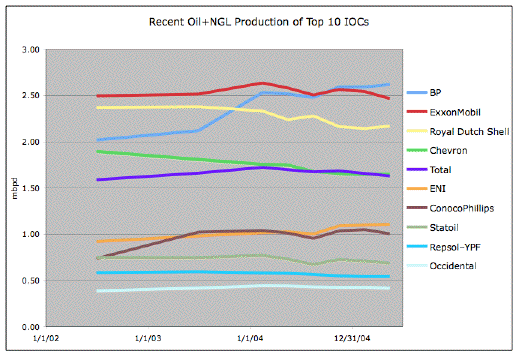
Nor was Exxon alone in this behavior. For example, ChevronTexaco had 2004 net income of $13.3 billion, which it used to ac ulate $5 billion in cash and buy back $2.1 billion of its stock.
How are companies that behave in this way going to succeed in increasing oil production? The answer is, they aren't. The graph at the top, taken from the Oil Drum, displays production over the last 3-1/2 years for the top 10 publicly traded oil companies. Half of these giants have seen their production fall over this period.
And prices and profits have continued to surge in 2005. The table below summarizes how much profits and capital spending went up in the first three quarters of this year compared to the corresponding quarters last year for three of the companies that reported big profit gains this week. Only a modest fraction of the increase in profits for these companies is showing up so far as additional investment.
Change in profits and capital expenditures between first three quarters of 2004 and first 3 quarters of 2005 Company
So what's the story? Maybe the oil companies are hoarding the cash in preparation for big investments just down the road. But we really could have used those investments several years ago, not several years from now. Or perhaps companies see enough danger of an oil price collapse that they are unwilling to make investments that would only pay if oil prices remain high. But if that's the explanation, it's unclear why they don't take the sure profit and hedge that's available from using futures prices. Alternatively, some might say that the only remaining plays at this point are in the control of governments, not oil companies, with the incipient decline in production by the international majors another milestone on the path to peak oil.
I must confess that I find it puzzling why it would make sense in the current situation to hoard cash and buy back shares. If anyone has a good explanation, I'd be very interested to hear.
That's a nice attempt to spin the reason the ratio is lower, but in the end its plain and simple because it is less profitable to sell a dollar's worth of gasoline than it is to sell a dollar's worth of consumer goods.
As for Return on Assets, I don't have time for the full rundown now, but here's a sample for you.
Company, Ticker Symbol, Return on Assets
Valero, VLO, 12.33%
ExxonMobile, XOM, 15.85%
Google, GOOG, 15.21%
Microsoft, MSFT, 18.73%
Apple, AAPL, 14.54%
All of these are available on Yahoo Finance.
I can readdress this later, but Return on Assets is a not a good comparison either. An oil companies will usually be well below other industries as well, by virtue of the fact only they need billions of dollars of asset on their balance sheet. Only banks will be worse, they can typically expect ROAs from 0.5-2.0%, but again its because of the dynamics of how the business works. You could say Return on Equity would be a good measure, but even that is funky as it is highly subject to the extent by which the company is leveraged. (A bank being the most highly levered, so the difference between their ROA and their ROE is huge - so they generate the highest profit margins by putting in the least of their own money.)
In the end, it is simply a matter of oil having the highest startup cost of any industry in the world. When people are investing billions of dollars, they are going to expect a return. For several years, refineries were operating with low and sometimes negative margins, so refineries without significant scale or the resources to spend the billions required to upgrade were forced to close. This is a cyclical boom for the industry, and it is resulting in unprecidented levels of investment in the industry. A windfall profits tax would only serve to put an end to such investment. If that is the objective, then its a fine idea. But based on the comments I've read here its only the objective when other arguments fail to hold water.
Gotta run to the office, but I can address this later too.

Without sounding like a kiss ass....Scott is by far one of the best posters, if not the best and he doesn't play the partisan card or the "dimm-o-crap", "liberal" or "conservative" card. Props.

Glad you checked in.

when do we start invading countries to steal their McDonalds?

Demos have been in control for a year now, so what's their excuse, croutons?
Oh yeah, they are taking money from the oil companies too.
Easy one, Dems' control is nowhere near the Repug control of Congress that head benefited from in the 01-06 period, when Congress was nothing but a rubber stamp for the WH. dubya vetoed not a single bill in that period, which he has done several times to the Dems in the past year.

come on boutons it's fair to compare the 1 year the dems have been in control to the rubber stamp congress of 6 yrs.. apples to apples..
Is this the part where all the fake message board civil liberatarians become socialist.

Bingo. Sadly, thats the thought process of a good chunk of this country.
I concur. People about the price of gas yet they run into starbucks and lay down the bucks for a damn cup of coffee.
People simply don't mind spending money on stuff they want. Its the stuff they actually need that they don't like paying for.
There are currently 1 users browsing this thread. (0 members and 1 guests)
 Posting Permissions