Know, O prince, that between the years when the oceans drank Atlantis and the gleaming cities, and in the years of the rise of the sons of Jordan, there was an Age undreamed of, when shining kingdoms lay spread across the land like multi-colored mantles beneath the stars -- Phoenix, Denver, Portland, Dallas, Boston with its dark-haired women and towers of spider-haunted mystery, Miami with its chivalry, Orlando that bordered on the pastoral lands of Disney, Houston with its shadow-guarded tombs, Detroit whose riders wore steel and silk. But the proudest kingdom was Los Angeles, reigning golden and supreme in the dreaming west. Hither came Duncan, the captain of the Black and Silver Horde and ruler of the lands of San Antonio, black-haired, sullen-eyed, sword in hand, a wizard, a slayer, with gigantic melancholies and gigantic mirth, to tread the jeweled thrones of the N.B.A. under his sneakered feet.



KG made it to the WCF's?!?!?!?!?!
They could put it in Almost Magazine
No, KG MIGHT have been able to do almost as much as Duncan if he had Parker Ginobili caliber player
Yeah when Duncan himself was injured
Ok the Spurs didnt pass the first round w/o Ginobili.
They wouldnt make the playoffs without TD

Who did you plagiarize this from? Be honest.

Yea that Duncan guy is so overrated.
* 2-time NBA Most Valuable Player: 2002, 2003
* 4-time NBA Champion: 1999, 2003, 2005, 2007
* 3-time NBA Finals MVP: 1999, 2003, 2005
* IBM Player Award: 2002
* The Sporting News MVP Award: 2002, 2003
* In 2003, became only the 3rd player to win NBA MVP, IBM, and TSN Awards in the same season
* 11-time NBA All-Star: 1998, 2000, 2001, 2002, 2003, 2004, 2005, 2006, 2007, 2008, 2009
* 10-time starter (2000–2009)
* NBA All-Star Game Co-MVP: 2000
* 12-time All-NBA:
* First Team: 1998, 1999, 2000, 2001, 2002, 2003, 2004, 2005, 2007
* Second Team: 2006, 2008, 2009
* 12-time All-Defensive:
* First Team: 1999, 2000, 2001, 2002, 2003, 2005, 2007, 2008
* Second Team: 1998, 2004, 2006, 2009
* NBA All-Rookie First Team: 1998
* NBA Rookie of the Year: 1998
* NBA regular-season leader, field goals made: 2002 (764)
* NBA regular-season leader, total rebounds: 2002 (1,042)
* One of only four players to receive All-NBA First Team honors in each of his first 8 seasons (1998-2005), along with Hall of Famers Bob Pet (10 seasons), Larry Bird (9 seasons), and Oscar Robertson (9 seasons).
* Only player in NBA history to receive All-NBA and All-Defensive honors in his first 12 seasons (1998-2009).
* NBA playoff records:
* Most consecutive field goals made, none missed: 12 (May 17, 2006 vs. the Dallas Mavericks; tied with Larry McNeill)
* NBA Finals records:
* Most blocks averaged per game, series: 5.3 (2003 NBA Finals)
* Most blocks, one game: 8 (decisive Game 6 of the 2003 NBA Finals; also had 21 points, 20 rebounds, and 10 assists in the same game)
* ACC Male Athlete of the Year: 1997
* John R. Wooden Award: 1997
* Naismith College Player of the Year: 1997
* USBWA College Player of the Year (1997)
* ACC Player of the Year (1996, 1997)
* Named to the ACC 50th Anniversary Men's Basketball Team: 2002
* On February 18 2006, Named one of the Next 10 Greatest Players by TNT broadcasting crew
* On August 16 2007, named starting PF on Sports Illustrated's All-Time NBA team
* On May 4 2007, named by the Association for Professional Basketball Research as one of "100 Greatest Professional Basketball Players of The 20th Century", the youngest player on that list
Hey Tacker did your parents have any children that lived?
Again it can't be proven or not (hence your use of might, I suppose), so I don't know how much of an argument can be made from that point. still...
Maybe Duncan put those players (Tony, Manu) in a position to be what they are today, where as K.G. had to have well established talent around him prior to experiencing actual (championship) play-off success.
+1 ^ truth.
This is the stupidest thread ever, Tacker is a . TD is probably underrated if anything. KG!
Really! Someone should go check Joey Whelan's blog and see if he writes anything about T.D. being overrated.

Most of these awards couldnt have happened without Parker or Ginobili
Give it up. Tim was dominating before Tony or Manu came into the league.

http://en.wikipedia.org/wiki/Marcus_Fizer
Marcus Fizer
Position Power forward
Height 6 ft 8 in (2.03 m)
Weight 265 lb (120 kg)
League Baloncesto Superior Nacional
Team Capitanes de Arecibo
Born August 10, 1978 (1978-08-10) (age 30) Inkster, Michigan
Nationality American
High school Arcadia (Louisiana)
College Iowa State
Draft 4th overall, 2000 Chicago Bulls
Pro career 2000–present
Former teams Chicago Bulls (2000–2004)
Milwaukee Bucks (2004–2005)
Austin Toros
New Orleans/Oklahoma City Hornets (2006)
Polaris World Murcia (2006–2007)
Arecibo Captains (2007)
Maccabi Tel Aviv (2007-2008)
Awards NBA All-Rookie Second Team (2001)
NBDL Most Valuable Player (2006)
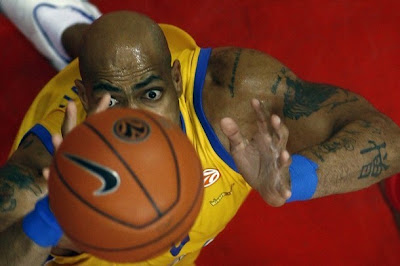
Darnell Marcus Lamar Fizer (born August 10, 1978 in Inkster, Michigan) is an American professional basketball player. Fizer was one of the most heavily tattooed players in the NBA. As of March 2006, he had 31 tattoos.[1] He signed a two-year contract ($900,000 a year) with European power house Maccabi Tel Aviv on June 20, 2007, but he did not finish his first season in the team because of an injury he suffered in February 2008, and the contract was terminated by the team on September 19, 2008. After two months Maccabi decided to sign him again, and on January 28, 2009 his second stint with the team came to an end. On February 7 he signed a contract with Capitanes de Arecibo.
Contents
[hide]
* 1 High School career
* 2 College career
* 3 Professional career
* 4 References
* 5 External links
[edit] High School career
Fizer played his high school basketball at Arcadia High School in Arcadia, Louisiana. As a senior, Fizer was selected to play in the McDonald's All-American Game.[2]
[edit] College career
Cyclone head coach Tim Floyd became aware of Fizer's potential while at a previous coaching stop in Louisiana and was able to use that connection to interest Fizer in playing his collegiate basketball at Iowa State University. In the process, Fizer became the first McDonald's All-American to wear the Cyclone uniform.[3]
Tim Floyd left Iowa State to coach the Chicago Bulls of the NBA after Fizer's freshman year and was replaced by Larry Eustachy. While playing for both Floyd and Eustachy, Fizer ac ulated many Big 12 Conference and national accolades including: All-Big 12 honorable mention (freshman), National first-team All-Freshman, first team All-Big 12 (sop re and junior), Big 12 Player of the Year (junior), Big 12 Tournament Most Outstanding Player (junior), and consensus first-team All-America (junior).[2] Additionally, he lead the Big 12 in scoring his sop re and junior seasons.[2] Following a Big 12 regular season le,[4] Big 12 tournament le,[4] and Elite Eight NCAA Tournament finish[4] his junior year, Fizer elected to declare for the NBA Draft.[2]
Fizer is ranked fifth on ISU's career scoring list with 1,830 points recorded during his three years spent at ISU.
[edit] Professional career
Fizer was selected with the fourth pick of the 2000 NBA Draft by the Chicago Bulls.[3] coached by Tim Floyd, the coach that recruited him to Iowa State. Many analysts suspected that the Bulls had drafted Fizer merely to trade him for another player, since the Bulls already had Elton Brand at the power forward position. However, no such trade ever took place, and Fizer spent the next four years struggling to find a niche with the Bulls. He never averaged more than 12.3 points per game. In 2004 he was made available to the Charlotte Bobcats in their expansion draft. Not making their final roster, he signed as a free agent with the Milwaukee Bucks. After one disappointing season in Milwaukee, he failed to sign a free agent deal with another team. In November 2005, he signed with the Austin Toros of the NBA Development League. On March 8, 2006, Fizer signed a 10-day contract with the Seattle SuperSonics, but did not play any games for them. On March 31, 2006, he was named the NBA Development League MVP for the 2005–2006 season. The same day, he was signed to a 10-day contract with the New Orleans Hornets.
He appeared in 289 career NBA games, making 35 starts and averaging 9.6 ppg, 4.6 rpg and 1.2 apg, shooting .435 from the floor and .691 from the free throw line in 20.9 mpg, and has scored 20+ points 17 times, with 10+ rebounds on 22 occasions in his four-year NBA career. He played for the gold medal-winning United States team at the 2001 Goodwill games in Brisbane, Australia while averaging 4.8 points and 3.0 rebounds, shooting .550 from the floor. In the summer of 2006 he signed a one-year contract with Polaris World Murcia of the Spanish league ACB. Then he played with Capitanes de Arecibo, in the Puerto Rico professional Basketball league (BSN).[5] In 2007 Fizer signed a two year deal with Israeli powerhouse Maccabi Tel Aviv. In the 2007–2008 season the Israeli Super League club reached the Euroleague championship game, eventually losing to CSKA Moscow. Fizer, however, was unable to play in the later stages of the Euroleague due to a knee injury that also got his contract terminated by Maccabi just before the 2008–2009 season.
[edit] References
1. ^ Allen, Percy. Tattoos tell story of former first-round pick Marcus Fizer, Seattle Times, March 10, 2006
2. ^ a b c d "Marcus Fizer". CNNSI.com. 2001. http://sportsillustrated.cnn.com/bas...layers/36.html. Retrieved on 2008-06-04.
3. ^ a b Brown, Rick (2000-10-21). "Fizer picked fourth by Bulls". DesMoinesRegister.com. http://www.usatoday.com/sports/nba/00draft/full002.htm. Retrieved on 2008-06-04.
4. ^ a b c Big 12 Men's Basketball Record Book. Big 12 Conference. pp. 8–13.
5. ^ CAPITANES DE ARECIBO roster, LatinBasket.com
[edit] External links
* Marcus Fizer NBA Profile
* Euroleague.net Profile
* Basketpedya.com Profile
* Marcus Fizer Statistics at Basketball-Reference.com
* Marcus Fizer NBADL Profile
* Marcus Fizer ACB Profile
^huh?
Marcus Fizer putting in a full summer’s work towards a healthy return
Only the Strong Survive: Part I
Marcus Fizer at the Berto Center Marcus Fizer has been logging some serious hours at the Bulls' practice facility this summer preparing for the 2003-04 season.
July 7, 2003
Just as he was emerging as a force off the Bulls’ bench in late January, it happened. Though he struggled at times during his first two seasons in the NBA—and even had his difficulties at the start of last season—Marcus Fizer was showing everyone he was really starting to get it.
He understood his role and he was starting to get a feel for how to be successful in the league. His statistics backed it up, too, as Fizer averaged 13.8 ppg and 6.4 rpg in 23.4 mpg, shooting 49.4 percent from the field over his last 29 games.
He was becoming one of the best sixth men in the NBA. Then ‘it’ happened and on January 31, 2003, Fizer suffered the dreaded injury of a torn ACL.
Surgery didn’t immediately follow. Rather, Fizer started with rehab right away to work on his knee’s range of motion and to get some of the swelling down.
“We weren’t so much concerned with strength immediately,” explained Eric Waters, the Bulls Assistant Athletic Trainer. “What we wanted to do was to get his extension back. The longer you wait to get full extension [of the leg], the more chance that there could be permanent damage—and you don’t want that. You could lose the function of your knee.”
One month after the injury, Fizer flew to Birmingham, Alabama, where famed orthopedic surgeon, Dr. James Andrews performed the operation.
“[Marcus] was a little depressed, as anyone would be if they have a serious injury like that,” Waters said of Fizer. “But to be honest, in terms of all the ACL people I’ve worked with, he was fairly upbeat. He was confident that he’d get over it, partially because he had talked to Jamal [Crawford, who suffered the exact same injury the year before] and seen first hand that he had made it all the way back.”
Despite his confidence, Fizer knew that the coming year would present enormous challenges.
Bulls.com caught up with the muscular power forward to hear how he’s handled the physical and mental challenges that the road to recovery has presented in the first half of a two-part interview (click here for the second half of the story).
Bulls.com:
It’s been almost five months since your injury. How would you summarize what you’ve been through in that time?
Marcus Fizer:
It hasn’t been as terrible as what some people might think. Your first reaction when you realize you have a torn ACL makes you cringe, but I never got that feeling. When I was told my ACL was torn, I shed tears for about thirty seconds and called my girlfriend. She and I talked, and that was it. I put the bad feeling behind me and immediately started looking forward to the rehab.
Marcus Fizer at the Berto Center "Your first reaction when you realize you have a torn ACL makes you cringe, but I never got that feeling," Fizer said. "I put the bad feeling behind me and immediately started looking forward to the rehab."
Bulls.com:
Did you know what the injury was when it happened?
Fizer:
I felt a pop, but it was more like a pop when you crack your knuckles or your wrist or your elbow. It was almost a pop that felt good and it was very deceiving because it didn’t hurt, even when I walked off the court. I remember continuing to try and lay the ball up and it was kind of tight but that was all I felt. It didn’t hurt until after the surgery.
Bulls.com:
At what level are you able to workout and/or compete right now? Are there still certain things you are limited from doing?
Fizer:
It was four months since my surgery on June 13. I’m beginning to run more but I still can’t do a lot with changes in direction. I’m running backwards and forward at about 95 percent and it’s been great to be on my feet and getting a sweat going. I personally feel [the ACL] is already a lot stronger than what the doctors think it is, but you have to go on what they say. The level that I was at before the injury was a level I had never been to before. I was extremely focused and was in the best shape I’ve been in since coming here. It was just a freak accident; now I now how it happened and I’m doing the things I can so hopefully it won’t happen again.
Bulls.com:
You were playing some of the best basketball in your pro career in those last two months.
Fizer:
I was in great shape and I had a nutritionist who got me a lot of supplements and different vitamins that help you maintain your focus and a level of energy that you need to play in this league. So I credit a lot of my success to her. She worked with me everyday and made sure I stayed on the things I needed to stay on. I was playing the best ball of my career.
Bulls.com:
What role has the Bulls’ staff played throughout this process?
Fizer:
They’ve been great and they’ve been behind me 100 percent. I was out on the court wanting to play a couple days ago because my leg was feeling so good but they pulled me off and slowed me down because they are here to look out for me. They want me to come back ready and not do anything foolish to hurt myself. They have me in here five days a week for two or three hours. I know it’s a long ordeal, but the big picture payoff in the end will be worth it.
Bulls.com:
What have you discovered about yourself as a person and as a basketball player?
Fizer:
I discovered that your season can end in just a fraction of a second. That is something that made me realize how focused I needed to be throughout this whole ordeal. Some people who’ve had this injury had it end their career. A lot of it isn’t just coming back from the injury. It’s coming back from the injury mentally. But it’s something that hasn’t burdened me at all; I put it in God’s hands and I trust Him 100 percent.
Bulls.com:
What has been the biggest challenge throughout your rehabilitation?
Fizer:
My biggest challenge has probably been not to gain too much weight and the fact that I can’t do the things I want to do on the court. You have a lot of cardiovascular work from riding a bike to Stairmaster and all that, but nothing is like being on the court. Being able to move like that and work up a sweat and get that total body workout, that’s how I tend to get in the best shape. That’s my main thing, not being able to be on the court. I lift weights everyday and I’m just as strong as I was from when I got hurt, it’s just the total cardiovascular workout I miss.
- Story and photos by Adam Fluck, Bulls.com
# Click here now for the second half of this feature story on Marcus Fizer.
Fizer says he'll be ready to go for training camp in October
Only the Strong Survive: Part II
Marcus Fizer at the Berto Center Given Fizer’s massive frame, he has had to work even harder at getting his legs back to where they were at the time of his injury.
July 8, 2003
# Only the Strong Survive: Part I
“Right after the surgery, you think you are never going to walk again,” Bulls Assistant Athletic Trainer Eric Waters described. “You wonder how you are ever going to get back from this and you feel a lot of pain. Your muscle wastes away and it looks bad. But once you get out of that stage and start to hit some milestones, you get more confident.”
Waters credits Fizer a great deal for putting in the necessary hard work, even when he wasn’t working out at the Berto Center, the team’s training facility located in suburban Deerfield, Illinois. Working on his range of motion at home and sleeping with his leg extended in a brace weren’t pleasurable experiences—but Fizer did them both and his diligence has paid off.
“Sometimes it is hard to get athletes to go outside of their comfort zone, but he did,” Waters said. “It was painful and uncomfortable, but he did it and as a result, he got his range of motion back as quick as anyone I’ve ever worked with.”
A major part of coming back from an ACL injury is strength work. Given Fizer’s massive frame, he has had to work even harder at getting his legs back to where they were at the time of his injury. Interestingly when a new ACL is put into a knee, there is an inverse relationship. At first, it is fairly strong, but over the two to three months following the surgery, it gradually gets weaker. The ACL must be protected in that time; however the player tends to get more active. As a result, in Fizer’s case specifically, there are often times where he wanted to go on the court to shoot around or play a little one-on-one but he had be held back and literally pulled off the court, just to be safe.
As Fizer continues to progress with his rehab, he has been cleared to do more and more. To date, he has received clearance to run straight ahead and slowly incorporate a few cutting exercises, while continuing to work on strength and neuromuscular stability.
Over the coming weeks, Fizer will again meet with the Bulls Team Orthopedic Surgeon, Dr. Ira Kornblatt, as well as Dr. Andrews and the Bulls Team Physician, Dr. Jeffrey Weinberg. He’ll need to get their approval after one or possibly two more check-ups for final clearance to play again. The team is hoping that Fizer will be able to play in pick-up games by the end of July.
“Barring any setbacks, I’m hopeful that he will be able to play when we start camp in early October,” Waters stated. “But he still won’t be 100 percent until he has some games under his belt. He’s got to re-gain his confidence and re-learn how to move and react and that has to happen in a game setting.”
Eric Waters and Marcus Fizer at the Berto Center “Right after the surgery, you think you are never going to walk again,” Assistant Athletic Trainer Eric Waters (above) described.
“Marcus has been stoic,” Waters acknowledged. “He hasn’t said a whole lot throughout it all, he’s put his nose to the grindstone and he’s worked very hard.”
Bulls.com caught up with the muscular power forward to hear how he’s handled the physical and mental challenges that the road to recover has presented in the second half of a two-part interview.
Bulls.com:
Do you feel that some positives could be the result of this injury? Do you expect to return as a better player?
Marcus Fizer:
No doubt positives will come from this; I’ve seen how strong Jamal has come back from his surgery. I said this before, but I had always felt like that was an injury I was going to have. I also always felt that if I did tear my ACL that it would be in my right knee because my right leg has never been nearly as strong as my left is. I can just about jump to the rim from the free throw line with my left leg but I can barely dunk close to the rim from my right. In rehab, I’ve done so much work trying to build that leg back that it is going to end up being stronger than my good leg. When they repair it, they say the ligament they put in there is ten times stronger than your other knee. As you recover from an ACL injury, at two months out of surgery the ligament is at its weakest point. Even then, at its weakest point, it is still four or five times stronger than the other one in your strong leg. So imagine how strong it will be once it is back up to 100 percent. Jamal tells me all the time, ‘That leg is going to be ten times stronger than your other one. You won’t believe it and you can’t see that happening now, but I’m telling you it will be.’
Bulls.com:
What kind of conversations have you had with Jamal Crawford, who suffered the same injury during the summer of 2001? Has he given you any advice?
Fizer:
Jamal’s been really funny. I’m a lot further along than he was at this point and he kind of laughs when I remind him of that. I remember the first time he saw me without my crutches—I was on them for a week or a week and a half—but he was on them for almost two months. He had this blank look on his face and was like, ‘Where are your crutches at?’ So I think I’m coming a long a little a quicker than Jamal did. During his rehab, [the Bulls staff] was like, Jamal might die here. [Laughing]. But my man came back. It’s just such a terrible feeling after the surgery and that was one of the toughest things I had to deal with. Even trying to sleep night after night was tough. But I got through that, I thank God for that and it’s over now and hopefully I’ll never go through it again.
Bulls.com:
Your name, along with some of your teammates, has been mentioned in various trade rumors. How do you deal with that?
Fizer:
It was something that bothered me my rookie year. But I’ve been involved in pretty much every trade rumor since I was drafted, so it’s nothing that bothers me anymore. The at ude I’ve taken towards it is that it doesn’t matter where I’m at, I just want to be a player in this league. Do I want to be in Chicago? Yes, I’ll say that each and every time I’m asked. I love it here in Chicago. I love the fans, I love the city and the rebuilding process is going great. People tell me that I should want to be on a winning team, but I’m going to know what it feels like to work and become a winner; to be that Dallas Mavericks-type team that wasn’t winning before but is a winning team now that is also a contender.
Marcus Fizer at the Berto Center "I expect to be ready to go by the start of training camp," says Fizer. "The way things are going now, the sky is the limit."
Bulls.com:
When you do return to the court, Coach Cartwright says his goal for you is to be the best sixth man in the NBA. How do you react to that statement?
Fizer:
It would be a huge success for me to do that. It’s not something I’d play for because I’ve never played for individual accolades. I’ve always felt that when a team has success, that is when the individual accolades will come about. Individual accolades come with winning and being part of a winning team. I’d rather be on a winning team than be the MVP of the league.
Bulls.com:
Are there any individual goals that you’ve set for yourself for this season and beyond?
Fizer:
I do have individual goals but they all have to do with how I can help the team do better next year and how to become a smarter player. There are all kinds of individual goals that you can set, but my main goals are team oriented. My goal for us last season was not to be the worst team in the league and we weren’t. We won 30 games and that’s not great but it was about 15 more than we won my first two years here and that says a lot.
Bulls.com:
The consensus seems to be that the team has turned the corner and that the playoffs could be in the near future. Do you think making the playoffs this season is realistic?
Fizer:
I think it’s definitely realistic. A lot of fans have come up to me and they say they feel like maybe if I hadn’t of gotten hurt, we would have been in the playoffs. But my teammates did a great job and it was fun just to sit and watch it. To see Eddy [Curry] blossom into a ing got like trick-ass Tacker and Tyson [Chandler] get it going and for Jay [Williams] to turn it around in the second half of the season. Jamal was also phenomenal. We feel like we have everything here now and hopefully we can keep this nucleus together.
Bulls.com:
Do you expect to be back at 100 percent by the start of the season?
Fizer:
There’s no question about it. I expect to be ready to go by the start of training camp. The way things are going now, the sky is the limit. I’ve just got to keep on the path that I’m on now—being ahead of schedule and trying to stay ahead of schedule—and not do anything to jeopardize that.
- Story and photos by Adam Fluck, Bulls.com
# Read the first half of this interview here.
Overall Ranking: 666
Friday, January 23, 2009
Where Are They Now?: Marcus Fizer
Where Are They Now? is a new daily blog post that will focus on a former college basketball player each day that went pro early and is now nowhere to be found. Remember to check back everyday to find out where those once can't-miss players ended up. Click here to see yesterday's player. The criteria for being included in this illustrious group of people are as follows:
1. Left college as an underclassman
2. Drafted in the 1st round of NBA draft
3. Drafted between 1990-2008
4. Not currently on an NBA roster
Today's entry into the Where Are They Now? post is former Iowa State Cyclone and Big 12 Player of the Year Marcus Fizer. Fizer played 3 years at Iowa State beforing entering the 2000 NBA Draft. He was selected 4th overall by the Chicago Bulls and was selected to the All Rookie 2nd Team. However, he was unable find a home in Chicago and even asked to be traded. However, he trade request was denied and he stayed in Chicago until 2005 when he became a free agent. He signed with the Milwaukee Bucks, but in November he was sent to the NBDL and signed with the Austin Toros. In 2006, the New Orleans/Oklahoma City Hornets signed him to a 10-day contract. This would be his last NBA team
.
In 2006 and 2007 he played in the Spanish League with Polaris World Murcia and the Puerto Rico Basketball League with Capitanes de Arecibo. In 2007 to moved up in the world and signed with Macabi Tel Aviv of the Euroleague. However, he suffered a severe knee injury and his contract was cencelled while he rehabed his injury. In January of 2009 he rejoined Maccabi Tel Aviv but has only appeared in two games and scored only 4 points. It appears as though things are not going very well for him with Maccabi Tel Aviv as he failed to participate in the teams last game against Maccabi Haifa and reports are that his rehab did not go as well as they first thought. The 2000 draft was full of disappointing players and Marcus Fizer will not be the last player from that draft class to make this list.
at 12:02 AM
Labels: 2000 NBA Draft, Chicago Bulls, Euroleague, Maccabi Tel Aviv, Marcus Fizer
Reactions:
3 comments:
Anonymous said...
Is he still launching 3 after 3?
January 23, 2009 8:08 AM
Dan Cote said...
So far he is a combined 42/134 in three-point attempts in Europe and NBDL which comes out to about 31%. In the NBA he was 21/110 for a lowly 19%, so he's improved a little but still jacking 'em up.
January 23, 2009 10:25 AM
Rob said...
Paul Shirley talks a bit about him in his book he put out a couple years ago since they were college teammates at ISU and on the Bulls. He was a monster that one year for the Cyclones. Keep these up. I love reading to start each day.
January 23, 2009 3:09 PM
Post a Comment
Fizer says he'll be ready to go for training camp in October
Only the Strong Survive: Part II
Marcus Fizer at the Berto Center Given Fizer’s massive frame, he has had to work even harder at getting his legs back to where they were at the time of his injury.
July 8, 2003
# Only the Strong Survive: Part I
“Right after the surgery, you think you are never going to walk again,” Bulls Assistant Athletic Trainer Eric Waters described. “You wonder how you are ever going to get back from this and you feel a lot of pain. Your muscle wastes away and it looks bad. But once you get out of that stage and start to hit some milestones, you get more confident.”
Waters credits Fizer a great deal for putting in the necessary hard work, even when he wasn’t working out at the Berto Center, the team’s training facility located in suburban Deerfield, Illinois. Working on his range of motion at home and sleeping with his leg extended in a brace weren’t pleasurable experiences—but Fizer did them both and his diligence has paid off.
“Sometimes it is hard to get athletes to go outside of their comfort zone, but he did,” Waters said. “It was painful and uncomfortable, but he did it and as a result, he got his range of motion back as quick as anyone I’ve ever worked with.”
A major part of coming back from an ACL injury is strength work. Given Fizer’s massive frame, he has had to work even harder at getting his legs back to where they were at the time of his injury. Interestingly when a new ACL is put into a knee, there is an inverse relationship. At first, it is fairly strong, but over the two to three months following the surgery, it gradually gets weaker. The ACL must be protected in that time; however the player tends to get more active. As a result, in Fizer’s case specifically, there are often times where he wanted to go on the court to shoot around or play a little one-on-one but he had be held back and literally pulled off the court, just to be safe.
As Fizer continues to progress with his rehab, he has been cleared to do more and more. To date, he has received clearance to run straight ahead and slowly incorporate a few cutting exercises, while continuing to work on strength and neuromuscular stability.
Over the coming weeks, Fizer will again meet with the Bulls Team Orthopedic Surgeon, Dr. Ira Kornblatt, as well as Dr. Andrews and the Bulls Team Physician, Dr. Jeffrey Weinberg. He’ll need to get their approval after one or possibly two more check-ups for final clearance to play again. The team is hoping that Fizer will be able to play in pick-up games by the end of July.
“Barring any setbacks, I’m hopeful that he will be able to play when we start camp in early October,” Waters stated. “But he still won’t be 100 percent until he has some games under his belt. He’s got to re-gain his confidence and re-learn how to move and react and that has to happen in a game setting.”
Eric Waters and Marcus Fizer at the Berto Center “Right after the surgery, you think you are never going to walk again,” Assistant Athletic Trainer Eric Waters (above) described.
“Marcus has been stoic,” Waters acknowledged. “He hasn’t said a whole lot throughout it all, he’s put his nose to the grindstone and he’s worked very hard.”
Bulls.com caught up with the muscular power forward to hear how he’s handled the physical and mental challenges that the road to recover has presented in the second half of a two-part interview.
Bulls.com:
Do you feel that some positives could be the result of this injury? Do you expect to return as a better player?
Marcus Fizer:
No doubt positives will come from this; I’ve seen how strong Jamal has come back from his surgery. I said this before, but I had always felt like that was an injury I was going to have. I also always felt that if I did tear my ACL that it would be in my right knee because my right leg has never been nearly as strong as my left is. I can just about jump to the rim from the free throw line with my left leg but I can barely dunk close to the rim from my right. In rehab, I’ve done so much work trying to build that leg back that it is going to end up being stronger than my good leg. When they repair it, they say the ligament they put in there is ten times stronger than your other knee. As you recover from an ACL injury, at two months out of surgery the ligament is at its weakest point. Even then, at its weakest point, it is still four or five times stronger than the other one in your strong leg. So imagine how strong it will be once it is back up to 100 percent. Jamal tells me all the time, ‘That leg is going to be ten times stronger than your other one. You won’t believe it and you can’t see that happening now, but I’m telling you it will be.’
Bulls.com:
What kind of conversations have you had with Jamal Crawford, who suffered the same injury during the summer of 2001? Has he given you any advice?
Fizer:
Jamal’s been really funny. I’m a lot further along than he was at this point and he kind of laughs when I remind him of that. I remember the first time he saw me without my crutches—I was on them for a week or a week and a half—but he was on them for almost two months. He had this blank look on his face and was like, ‘Where are your crutches at?’ So I think I’m coming a long a little a quicker than Jamal did. During his rehab, [the Bulls staff] was like, Jamal might die here. [Laughing]. But my man came back. It’s just such a terrible feeling after the surgery and that was one of the toughest things I had to deal with. Even trying to sleep night after night was tough. But I got through that, I thank God for that and it’s over now and hopefully I’ll never go through it again.
Bulls.com:
Your name, along with some of your teammates, has been mentioned in various trade rumors. How do you deal with that?
Fizer:
It was something that bothered me my rookie year. But I’ve been involved in pretty much every trade rumor since I was drafted, so it’s nothing that bothers me anymore. The at ude I’ve taken towards it is that it doesn’t matter where I’m at, I just want to be a player in this league. Do I want to be in Chicago? Yes, I’ll say that each and every time I’m asked. I love it here in Chicago. I love the fans, I love the city and the rebuilding process is going great. People tell me that I should want to be on a winning team, but I’m going to know what it feels like to work and become a winner; to be that Dallas Mavericks-type team that wasn’t winning before but is a winning team now that is also a contender.
Marcus Fizer at the Berto Center "I expect to be ready to go by the start of training camp," says Fizer. "The way things are going now, the sky is the limit."
Bulls.com:
When you do return to the court, Coach Cartwright says his goal for you is to be the best sixth man in the NBA. How do you react to that statement?
Fizer:
It would be a huge success for me to do that. It’s not something I’d play for because I’ve never played for individual accolades. I’ve always felt that when a team has success, that is when the individual accolades will come about. Individual accolades come with winning and being part of a winning team. I’d rather be on a winning team than be the MVP of the league.
Bulls.com:
Are there any individual goals that you’ve set for yourself for this season and beyond?
Fizer:
I do have individual goals but they all have to do with how I can help the team do better next year and how to become a smarter player. There are all kinds of individual goals that you can set, but my main goals are team oriented. My goal for us last season was not to be the worst team in the league and we weren’t. We won 30 games and that’s not great but it was about 15 more than we won my first two years here and that says a lot.
Bulls.com:
The consensus seems to be that the team has turned the corner and that the playoffs could be in the near future. Do you think making the playoffs this season is realistic?
Fizer:
I think it’s definitely realistic. A lot of fans have come up to me and they say they feel like maybe if I hadn’t of gotten hurt, we would have been in the playoffs. But my teammates did a great job and it was fun just to sit and watch it. To see Eddy [Curry] blossom into a ing got like trick-ass Tacker and Tyson [Chandler] get it going and for Jay [Williams] to turn it around in the second half of the season. Jamal was also phenomenal. We feel like we have everything here now and hopefully we can keep this nucleus together.
Bulls.com:
Do you expect to be back at 100 percent by the start of the season?
Fizer:
There’s no question about it. I expect to be ready to go by the start of training camp. The way things are going now, the sky is the limit. I’ve just got to keep on the path that I’m on now—being ahead of schedule and trying to stay ahead of schedule—and not do anything to jeopardize that.
- Story and photos by Adam Fluck, Bulls.com
# Read the first half of this interview here.

@ Tacker
i was basically saying Duncan is better...
There are currently 1 users browsing this thread. (0 members and 1 guests)
 Posting Permissions


 Reply With Quote