Reply With Quote
My feeling with talking to people, especially Canadians, is they love it for the young ones.

But do you ask them why they all hate their universal healthcare? Because I've been told it's disastrous and they all hate it.

My feeling with talking to people, especially Canadians, is they love it for the young ones.

She was too busy playing into his game.

How would a king operate?
You get power (ergo king)
You don't look for ways to defeat your opponents, you get them close to you, to commit. Then you have them arrested or indicted for crimes. You can fire them and shame them. Maybe Trump will bring in the biggest GOP assholes and take them down one by one.
Yeah that

She was too busy popping champagne to see the Trump Train coming.

This. I want to hear about all the Canadians who had to wait 20 months for doctors to operate on their life threatening condition!

that should be a slogan, tbh... "Social Security, extending life expectancy since 1940"...
Republicans Who Think Nobody Would Miss Obamacare Should Ask People Who Depend On It
Millions value their coverage — and worry what the GOP would do instead.
Some of the Republicans agitating to repeal Obamacare say they aren’t worried about taking health insurance away from more than 20 million people. Their theory: The program is wildly unpopular and even the people with coverage wouldn’t miss it, no matter what takes it place.
“People have crappy insurance,” Rep. John Shimkus (R-Ill.) told Politico last week. “This fear that they’re going to lose something that they don’t think they have anyway is crazy.”
Many people are unhappy with Obamacare, yes. But many others value the coverage. On the whole, these people are not likely to get as much assistance or protection from a Republican replacement plan, and that’s assuming Congress can even pass one at all.
The Majority Of People With Obamacare Seem To Value It
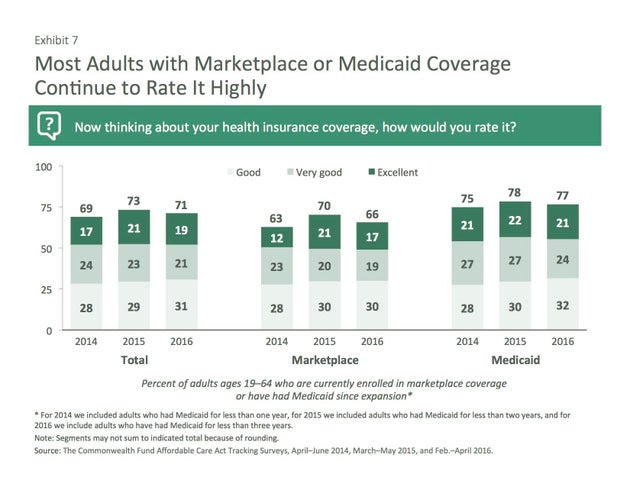
The popularity of Obamacare with its users may surprise not only Republicans, but also people who know about the law primarily through press coverage. One of the biggest myths about the law is that most people who have the coverage think it’s lousy.
Kaiser looked at people buying coverage on their own, breaking out those who got coverage through one of the law’s exchanges and those buying directly from insurers. Commonwealth looked specifically at people who got insurance through the exchanges, as well as people who had enrolled in Medicaid.
The questions covered all the important issues, from premiums and deductibles to doctor choice. The results were remarkably consistent across the board. When asked to judge the plans overall, majorities rated their insurance as good, very good or excellent.
http://www.huffingtonpost.com/entry/...er%20Obamacare

lol.
Tried talking to a right wing guy in my family about it and first thing he said was something like "dont care on what they do over in commie europe. this is AMerica". tried reasoning with him and saying that you know he has a European ancestry and these people are basically biologically identical to him and its the same planet at the same time so would be a good test case or example for how some fellow people have responded to it but he didn't care. I mean its not like its some other planet with a different species that I'm using as an example but what the do I know
hallmark of rightwingnutjobs is self-screwing stupidity, ignorance.
Trumpcare Is Likely to Be Costlier, Less Efficient, and More Annoying Than Obamacare
Donald Trump has provided few details of his health plan, but experiments in Republican-run states offer a good preview
states under Republican control have already provided a good preview of what a GOP replacement of Obamacare might look like. And if they're any indication, Trumpcare is likely to be more expensive and more complicated than the current system, while covering fewer people and micromanaging them more.
Trump's website offers vague notions about creating a more "patient-centered healthcare system" and giving the states more control over its regulation. The latter promise echoes a trend over the past couple of years in Republican-controlled states, which have agreed to expand Medicaid coverage under the Affordable Care Act only if they gained leeway to implement it in accordance with their conservative principles. The Obama administration agreed to many of these changes to give more people access to health care. Those state expansion plans now offer one of the best looks at what Trump and a Republican Congress might have in store for Obamacare.
The party of smaller government has made an art of designing expensive, complicated, and intrusively bureaucratic health care programs under the guise of promoting personal responsibility.
Perhaps the best example comes from Indiana, under the leadership of Gov. Mike Pence, now the vice president-elect. Healthy Indiana Plan 2.0 (HIP 2.0) was designed to force low-income people to put some "skin in the game," by requiring them to contribute their own money to the plan as a way of deterring them from using too many unnecessary health care services. To that end, the program has a bewildering array of at least six different benefit levels and cost-sharing requirements. It's so complicated Pence himself had trouble explaining it
It provides recipients with a $2,500 health care account, paid for by the state and Medicaid enrollees' premiums. When the money runs out, a high-deductible insurance plan kicks in. If recipients engage in preventive care, the amount of money they can roll over from one year to the next goes up. The setup is supposed to encourage beneficiaries to limit their health care usage while taking personal responsibility for their health.
the incentive program doesn't seem to be working especially well, mainly because most people in the plan have no idea what it is. A recent evaluation of the program found that at least 60 percent of the people surveyed who had a POWER account had never heard of it, and of those who had, many didn't understand how it worked.
The survey mirrored similar research in Iowa and Michigan, where Republicans had tried to force behavioral changes on Medicaid recipients through complex incentive plans. Research shows that simply giving people insurance in traditional Medicaid will increase the number of people who use preventive care, without the need for incentives.
"Premiums are not generating revenue for states,"
Arkansas would spend more than $15 for every dollar it collected in contributions to Medicaid health savings accounts. The Michigan Medicaid expansion, with features similar to Indiana's, cost $20 million a year to administer.
The premiums do serve another function: They depress enrollment in Medicaid. That phenomenon has been well do ented in other states and now also in Indiana. About a third of people in Indiana who apply for HIP 2.0 and are found eligible ultimately don't get insured because they fail to pay the first premiums. People who don't pay premiums while in the program can be dropped and then blocked from reenrolling for six months.
"There's this assumption that these people are not worthy and therefore we're going to make arbitrary hoops for them to jump through so we can punish them when they fail to jump through them,"
"We're lawyers and analysts and we can't figure [these programs] out."
(Indiana's uninsured rate is more than 9 percent, compared with 6 percent in Kentucky, which expanded Medicaid under a Democratic governor without any restrictions.)
Other states, including Arizona, Ohio, and Pennsylvania, have asked the Obama administration for a laundry list of conservative changes
requests include the types of provisions that were incorporated into the welfare reform law in the 1990s, such as work requirements and lifetime limits on benefits.
It's the health care version of self-deportation: Create enough hurdles to enrollment, and most people will drop out of the insurance program all on their own.
http://www.motherjones.com/politics/2016/11/trumpcare-likely-be-more-costly-less-efficient-and-more-annoying-obamacare
Repugs ALWAYS the poor, even white poor who vote Repug, because they are sub-human Rick Santelli "losers". If God loved the poor, He would have made them rich.
Trump promised to repeal Obamacare, but it turns out Americans like most of it, a poll finds
Despite sharp partisan differences over the Affordable Care Act, Democrats and Republicans,
including voters who backed President-elect Donald Trump,
strongly support most of the law’s key provisions, a new national poll indicates.
most Trump voters still favor repealing the law, often called Obamacare, an increasing share of Americans overall oppose that approach,
Just a quarter of Americans say they wanted to scrap the law, down from nearly a third in October.
By contrast, nearly half say they want the law expanded or implemented as it is. Another 17% say they want the law scaled back.
http://www.latimes.com/nation/la-na-...201-story.html
Just like doing nothing about immigration used only as Repug campaign issue, I bet the Repugs won't (be able to) do anything about ACA, and will campaign on repealing ACA again in the 2108 mid-terms.

The best parts of medicare is already privatized through advantage plans.
Translation - Everybody wants everything free. Reality - Health insurance that no one can afford to use is no insurance at all, whether it is part of Obamacare or Trumpcare.
Medicare Advantage is nothing but a Repug gift to BigInsurance, shifting taxpayer $Bs to BigInsurance.
Medicare Advantage costs taxpayers 10%+ more than standard Medicare.
You Lie.
People know they can't have free health care and don't mind paying for health care, but they do mind OVER-paying $1T+ per year, which never stops increasing, than they would pay compared to other industrial countries.
Health insurance under TrashCare/RyanCare (if they ever figure out what it will be. They haven't done so for 6+ years) will cost more and cover less, based on what analysts know so far.
TrashCare/RyanCare will force Ms to suffer and/or die for want of health care.
Last edited by boutons_deux; 12-01-2016 at 06:01 PM.
boutons, traditional Medicare only pays for 80% of Part B (medical insurance). There are no limits to the Part B 20% co-pays so some seniors buy MediGap to cover. Medicare Advantage is just another way to cover - gives you more choices - either way (MediGap or Medicare Advantage) you pay to cover that 20%.
Medicare Advantage costs taxpayers 10% or more than standard Medicare. the 10%? it goes to BigInsurance investors.

Gutting medicare didn't go through in 05 but looks like a lock this time. Weird because all the rural whites who are struggling financially would be devastated by it when they get older but they live in an alternate trump/ fox news reality to where they'll think this is a good thing or find a way to blame the Democrats somehow

They'll probably accomplish it the same way Ryan wanted to in 2012: by preserving it in full for baby boomers (who are their base) and then ripping it from every younger generation.
8 Big Changes Under Tom Price’s Obamacare Replacement Plan
Here are eight big changes in U.S. health care that may be coming if Price’s legislationEmpower Patients First Act prevails:
-- Obamacare would be scrapped, including the government-run insurance markets in every state, the mandates on individuals and businesses and federal tax credits to subsidize the insurance of lower income Americans. Price’s plan instead would offer fixed tax credits – pegged to a person’s age rather than their income -- so that they can buy their insurance policies in the private market.
-- Those tax credits would be fairly modest, ranging from $1,200 a year for people 18 to 35 years of age to $3,000 for those 51 and older. In many regions of the country, that would hardly begin to cover the premiums and out-of-pocket costs for a relatively comprehensive health insurance plan.
-- Just as is the case under Obamacare, people with pre-existing medical conditions or chronic illnesses couldn’t be denied coverage under Price’s approach -- provided they had continuous insurance for 18 months before choosing a new policy. That’s a big caveat designed to discourage people from obtaining coverage during an illness and then dropping the policy after recovering. If someone allows their policy to lapse, the next time they return to the market they could be charged up to 150 percent of the standard premiums for the next two years.
-- This concept of requiring people to maintain “continuous coverage,” is a popular one among Republican policymakers, and is also included in House Speaker Paul Ryan’s “Better Way” approach.
-- Price would seek expanded use of health savings accounts to allow people to save income before taxes to pay for future health care needs. Health savings accounts already are a common feature in many workplaces. One twist under Price’s approach is that people who are currently covered by Medicare, the Veterans Affairs Department or some other government health program could contribute to health savings accounts to help cover their premiums and copayments.
-- As a way of addressing the insurance industry’s challenge in covering older and sicker Americans, Price would provide grants to states to insure the “high risk” population. The risk pools would be the equivalent of a safety net for insurers, to offset part of their costs when hit with enrollees’ catastrophic health care costs. But Price appears to be seriously low-balling the scope of the problem by proposing to invest a mere $3 billion into state risk pools over a three-year period. Ryan’s “Better Way” plan, for instance, would provide $25 billion over the coming decade, and even that might prove to be woefully inadequate.
-- Price would likely roil businesses by imposing a cap on the amount of money that companies could deduct from their taxes to defray the cost of providing health insurance to their workers. This exclusion is one of the largest in the federal tax code and costs the government an estimated $260 billion a year in foregone revenue. Price’s approach would limit the employer tax exclusion for providing health insurance to $8,000 a year for individual policies and $20,000 for families.
-- In one of the biggest blows to poor and low-income Americans, Price would repeal the expanded Medicaid coverage in 32 states and the District of Columbia for able-bodied single people and leave those current beneficiaries to fend for themselves on the open market, using other tax credits and benefits.
-- Price’s approach matches that of GOP President-elect Donald Trump in one notable way – by allowing health insurers licensed to sell policies in one state to offer them to residents of other states. This approach would allow consumers to shop around for health insurance across state lines just as they might for any other insurance product.
-- Finally, the Price proposals would foster an insurance market very welcoming to young, healthy and financially self-sufficient people but hostile to sicker and older people. For one thing, it would eliminate Obamacare-style mandates for insurers to include a standard package of benefits such as maternity services and pediatric care and allow them to offer cheaper, less comprehensive policies to younger people who are looking for a bargain.
http://www.msn.com/en-us/money/healt...lan/ar-AAkXhse
Repugs, Trash gonna up America even worse than it already is, and above all Trash/Repug voters.
And BigInsurance, BigHealthCare, BigPharma won't lose a penny.
What a piece of plan.
The Repugs won't apply their Medicare/ACA only to the under-50s. Current Medicare people will see much higher premiums and copays, get less coverage, and get totally insufficient vouchers to go buy for-profit insurance rather than no-profit govt insurance.
I don't know, in 2012 Ryan was talking about how we made promises to the baby boomers already and have to honor those, so no vouchers for them. Only vouchers for everyone else.
There are currently 1 users browsing this thread. (0 members and 1 guests)
 Posting Permissions